Green Card vs Visa: Status, Entry and Immigrant Intent
How a green card differs from a visa, why intent matters for visa applicants, which visas allow dual intent and how to change plans safely after entering.
 Tradiciones del Mundo
The green card turns a temporary stay into a life in America. Here is how people actually get one, how long it takes, and what changes once the card is in your hand.
Key points
Millions of people have built their lives in the United States through permanent residence, and the legal framework behind it has barely changed since 1990. What has changed, especially in 2025 and 2026, are fees, processing times, security vetting and some programs. This guide gives you the big picture first; every section links to a detailed article.
Give me your tired, your poor, / Your huddled masses yearning to breathe free
A Permanent Resident Card, universally known as the green card, is the document that proves you are a lawful permanent resident (LPR) of the United States. It lets you live and work anywhere in the country indefinitely, without being tied to a specific employer or visa expiry date.
It is not citizenship. A permanent resident keeps their original nationality, cannot vote in federal elections and can, in serious cases, lose their status. But for most practical purposes, it is the foundation of a stable life in the US and the usual stepping stone to naturalization.
Good to know: the card itself is valid for 10 years and must be renewed, but the status does not expire. A conditional card, issued in some marriage and investor cases, lasts only 2 years and requires a separate petition to remove the conditions.
US immigration law offers a limited number of routes. Almost every applicant fits into one of these five.
Spouses, unmarried children under 21 and parents of US citizens are immediate relatives with no annual cap. Other relatives (adult children, siblings, spouses of permanent residents) fall into preference categories with yearly limits and waiting lines.
Key form: I-130
Five categories, EB-1 to EB-5. They range from people with extraordinary ability and multinational managers to professionals with advanced degrees, skilled workers and investors. Most require an employer sponsor and a labor certification (PERM).
Key form: I-140
The EB-5 program grants residence to those who invest in a US business that creates at least 10 full-time jobs. The minimum is currently $1,050,000, or $800,000 in targeted employment areas and certain infrastructure projects.
Key form: I-526E
Each year up to 55,000 visas are offered by random draw to nationals of countries with low immigration rates to the US. Entry is online only, with a $1 registration fee introduced in 2025, and selection is only the start: winners must still qualify and complete the process within the fiscal year.
Registration: dvprogram.state.gov
Refugees and people granted asylum can apply for permanent residence after one year in that status. Other protected routes exist for victims of abuse (VAWA), of trafficking (T visa) and of certain crimes (U visa).
Key form: I-485
Details vary by category, but the overall shape is the same for nearly everyone.
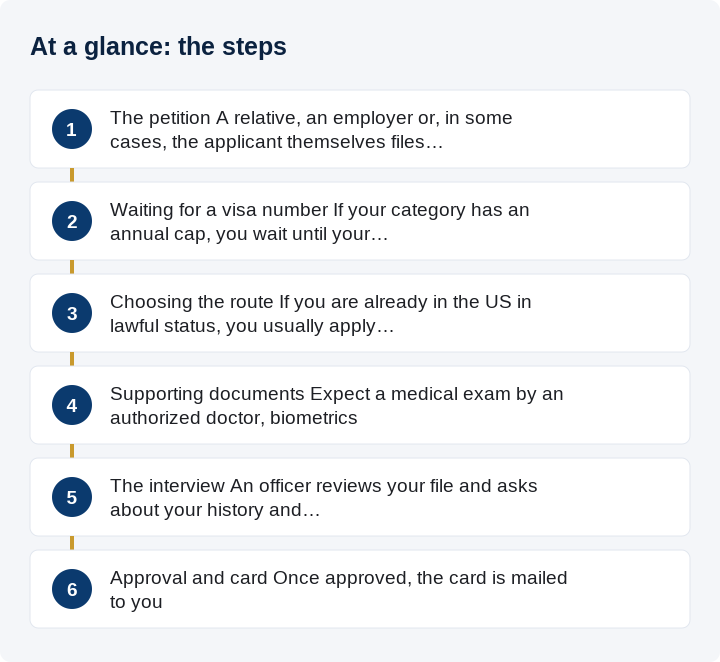
A relative, an employer or, in some cases, the applicant themselves files a petition with US Citizenship and Immigration Services (USCIS) to establish eligibility.
If your category has an annual cap, you wait until your priority date (the date your petition was filed) becomes current in the monthly Visa Bulletin published by the State Department.
If you are already in the US in lawful status, you usually apply for adjustment of status (form I-485) without leaving the country. If you are abroad, you go through consular processing at a US embassy or consulate.
Expect a medical exam by an authorized doctor, biometrics (fingerprints and photo), civil documents with certified translations and, in family cases, an Affidavit of Support (I-864) showing the sponsor can support you financially.
An officer reviews your file and asks about your history and eligibility. Marriage cases often include questions about the relationship. Bring originals of everything you submitted.
Once approved, the card is mailed to you. If you came through consular processing, you enter the US with an immigrant visa and the card arrives after you pay the USCIS immigrant fee.
Timing is the part of the process that surprises people most. It depends on the category, your country of birth and the workload of each office.
| Route | Typical timeframe | Main bottleneck |
|---|---|---|
| Spouse of a US citizen | About 1 to 2 years | Processing times |
| Family preference categories | Several years, sometimes over 20 | Annual caps and per-country limits |
| Employment (EB-2, EB-3) | From 2 years to over a decade | Labor certification and country backlogs |
| Extraordinary ability (EB-1) | Often under 2 years | Evidence of acclaim |
| Diversity Visa winner | Within the fiscal year, or never | Hard deadline of 30 September |
Applicants born in countries with very high demand, such as India, China, Mexico and the Philippines, often face much longer waits in capped categories.
Permanent residence can be abandoned. Trips abroad of more than six months may prompt questions at the border, and an absence of one year or more generally means losing the card unless you obtained a re-entry permit (form I-131) before leaving, which covers up to two years.
Status can also be lost through certain criminal convictions, immigration fraud or failing to remove conditions on a 2-year card in time. Renewing an expiring 10-year card is done with form I-90.
After five years as a permanent resident, or three years if you have been married to and living with a US citizen, you can apply to naturalize with form N-400. You will need continuous residence, physical presence in the US for at least half of that period, good moral character and a passing grade on the English and civics tests.
Citizenship brings the right to vote, a US passport and protection from deportation. Whether you can keep your original nationality depends on the law of your home country, so check before you apply.
Entering as a tourist with the hidden intention of staying can be treated as misrepresentation. Immediate relatives of US citizens can sometimes adjust status after a lawful entry, but this is an area where professional advice is strongly recommended.
If you file for adjustment of status, you can request a work permit (Employment Authorization Document, form I-765) and a travel permit (Advance Parole) at the same time.
Government fees depend on the forms involved and change periodically. Add the medical exam, translations and, if you hire one, an attorney. Always check the current USCIS fee schedule before filing.
Not legally. Many straightforward family cases are filed without one. For employment, investment, asylum or any case involving past immigration problems or a criminal record, a licensed immigration attorney is a sensible investment.
This guide is the overview. Each step has its own detailed article:
Disclaimer. This article is general information, not legal advice, and it is not affiliated with any government agency. US immigration rules, fees and processing times change often, and they changed repeatedly in 2025 and 2026. Confirm current requirements on uscis.gov and travel.state.gov, or speak with a licensed immigration attorney or a DOJ-accredited representative.
How a green card differs from a visa, why intent matters for visa applicants, which visas allow dual intent and how to change plans safely after entering.

Every field on the Permanent Resident Card explained, from the A-number to the resident since date, plus what IR1, CR1, F2A, E21 and other category codes mean.

How priority dates work, where to find yours, and how to read the monthly Visa Bulletin: final action vs filing dates, symbols, retrogression and examples.