The I-485 Package, Biometrics and the Green Card Interview
What to file with Form I-485, what happens at the biometrics appointment and how to prepare for the green card interview, with checklists and common questions.
 Tradiciones del Mundo
Most immigrants receive their green card through a US embassy or consulate. The process is managed by the State Department, and most delays are within your control.
Key points
Consular processing has three phases: the National Visa Center, the medical exam and the embassy interview. This guide explains each in turn, including the medical requirements that also apply to applicants adjusting inside the US.
Since 2025, immigrant visa applicants are generally interviewed in their country of nationality or residence.
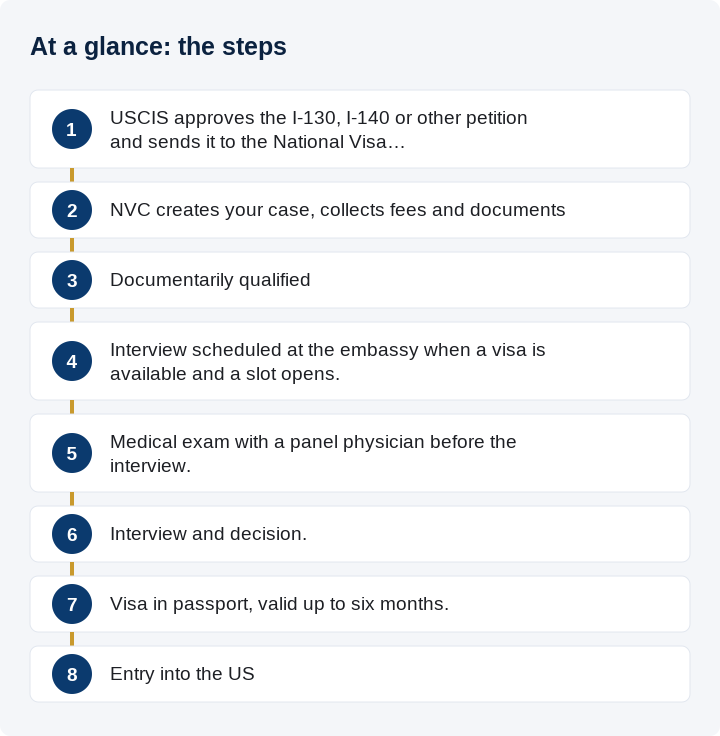
Most immigrants receive their green card through an embassy or consulate abroad. The process is managed by the State Department, not USCIS.
If you live outside the US, or are in the US but not eligible to adjust status, your case goes through consular processing after USCIS approves the petition.
| Fee | Amount |
|---|---|
| Immigrant visa application (family, employment) | $325 |
| Affidavit of Support review (family) | $120 |
| USCIS immigrant fee | $235 |
| Medical exam | Set by the physician, varies by country |
A refusal under section 221(g) means the officer needs more information or more checks. It can last weeks or many months. Respond to requests quickly and follow the embassy's instructions.
Since 2025, immigrant visa applicants are generally interviewed in their country of nationality or residence, some embassies paused interviews for certain nationalities, and the travel restrictions suspended immigrant visas for nationals of 39 countries. Check the embassy's website before booking anything.
Applicants 16 and older generally need police certificates from their country of nationality, their country of current residence if they have lived there more than six months, and any country where they lived 12 months or more. The State Department's reciprocity tables explain how to obtain certificates in each country and which ones are unavailable.
Between USCIS approval and the embassy interview, your case lives at the National Visa Center. Most delays here are within your control.
After receiving the approved petition, the NVC sends a welcome letter or email with your case number and invoice ID. If you have not heard anything weeks after approval, use the NVC Public Inquiry Form.
In the Consular Electronic Application Center (CEAC), you can choose an agent (yourself, the petitioner or an attorney) to receive communications.
Pay the Affidavit of Support fee ($120) and the immigrant visa application fee ($325 for most cases) online. In preference categories, the NVC may wait until your priority date is close to current.
Complete the online immigrant visa application for each applicant. Be consistent with earlier forms: addresses, employment and travel history.
When everything is accepted, your case is "documentarily qualified" and waits for an interview slot at the embassy, scheduled according to visa availability and the embassy's capacity.
A hypothetical spouse case is approved by USCIS in January. The NVC sends the welcome email in February. The couple pays fees and uploads documents in March. NVC review takes several weeks and the case is documentarily qualified in April. The embassy schedules an interview in June or later, depending on its capacity.
Every green card applicant needs a medical exam by a doctor approved by the US government. It is a screening, not a full check-up.
Applicants must show vaccinations recommended by the CDC for their age, such as MMR, polio, tetanus and diphtheria, hepatitis B, varicella, influenza (in season) and others. The COVID-19 vaccine requirement ended in January 2025. Bring your vaccination records to avoid paying for unnecessary shots.
Doctors set their own prices; in the US, expect a few hundred dollars plus vaccines and lab work. Ask what is included.
The I-693 must be filed with the I-485, and the civil surgeon's signature must be dated no more than 60 days before filing. It then remains valid for as long as that I-485 is pending.
Active tuberculosis must be treated before the exam is completed. Other conditions usually do not affect the case, unless they are communicable diseases of public health significance or a mental disorder associated with harmful behavior. Drug abuse findings can make the applicant inadmissible.
Generally you interview in your country of nationality or residence. Since 2025 the State Department has limited interviews elsewhere.
Usually up to six months, or until the medical exam expires if sooner. You must enter before it expires.
Derivatives must enter at the same time as or after the principal applicant.
After you pay the immigrant fee and enter, USCIS mails the card, usually within weeks to a few months. Your passport's immigrant visa stamp serves as temporary proof for one year.
The NVC publishes current timeframes on its website, usually in weeks.
Yes, through the Public Inquiry Form or by phone.
You can still submit documents if invited, but the interview waits for a current date.
You can request a transfer to another embassy, which must agree to accept the case.
Only if they are a designated civil surgeon.
You can request a waiver for religious or moral objections to all vaccinations, though it requires a separate filing.
It must be submitted with the I-485 within 60 days of the civil surgeon's signature.
Disclaimer. This article is general information, not legal advice, and it is not affiliated with any government agency. US immigration rules, fees and processing times change often, and they changed repeatedly in 2025 and 2026. Confirm current requirements on uscis.gov and travel.state.gov, or speak with a licensed immigration attorney or a DOJ-accredited representative.
What to file with Form I-485, what happens at the biometrics appointment and how to prepare for the green card interview, with checklists and common questions.
How to respond to a Request for Evidence, track a delayed case, request an expedite, handle inadmissibility with waivers and what to do after a denial.
Every main green card fee in 2026, the I-864 Affidavit of Support income rules and joint sponsors, and how the public charge test works.