Renew or Replace a Green Card and Report Address Changes
How to renew a 10-year card with Form I-90, replace a lost or stolen card in the US or abroad, and report a change of address within 10 days.
 Tradiciones del Mundo
There is no single maximum number of days abroad. There are thresholds that change what officers presume, and tools to protect your card before a long trip.
Key points
Permanent residents can travel freely, but the green card assumes the US is your home. This guide explains the thresholds, the planning tools for long absences and what to do if a trip runs longer than planned.
Even short trips can raise problems if your life is really abroad. Officers look at where you live, work and pay taxes.
There is no single "maximum" number of days. There are thresholds that change what officers presume, and a test of where your life really is.
| Time abroad | Effect on your green card | Effect on citizenship timeline |
|---|---|---|
| Under 6 months | Generally no problem | No break in continuous residence |
| 6 months to 1 year | CBP may ask questions; you may be treated as seeking admission | Presumed break in continuous residence, which you can rebut |
| 1 year or more | Green card no longer valid for re-entry; presumed abandonment unless you have a re-entry permit | Break in continuous residence (with limited exceptions) |
Even short trips can raise problems if your life is really abroad. Officers look at:
If a CBP officer suggests you have abandoned your residence and asks you to sign Form I-407, you are not required to sign. You have the right to have an immigration judge decide. See Form I-407.
A hypothetical permanent resident spends eight months in Italy caring for her ill father. She keeps her US apartment, her job grants unpaid leave, and she files US taxes as a resident. On return, CBP asks about the trip; she shows the leave letter and lease, and is admitted. For citizenship, the eight-month trip creates a presumed break in continuous residence, which she can rebut with the same evidence.
If you need to spend a year or more abroad, a re-entry permit is the main tool to keep your green card. It must be requested before you leave.
A re-entry permit is a travel document valid for up to two years. It allows you to return after an absence of more than a year without the green card being considered invalid for entry, and it is evidence that you did not intend to abandon your residence.
Usually two years. If you spent more than four of the last five years outside the US since becoming a resident, USCIS generally limits it to one year. It cannot be extended; you must return and apply again.
A hypothetical resident accepts an 18-month research position in Japan. Before leaving, he files an I-131 for a re-entry permit, attends biometrics, and asks for delivery to the US embassy in Tokyo. He keeps his US bank account, files US taxes as a resident and returns within the permit's validity. His green card remains valid, although the long absence breaks his continuous residence for citizenship purposes.
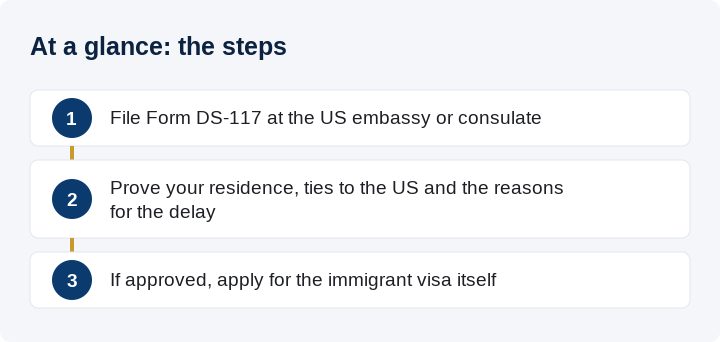
If you stayed abroad longer than planned for reasons outside your control, the SB-1 is the narrow path back to your green card.
SB-1 visas are refused often. Long absences by choice, such as staying to work or care for property, do not qualify.
If refused, a new petition (for example by a US citizen spouse) may be needed, or a tourist visa to return temporarily. Some people attempt to present the green card at the border and argue their case before an immigration judge; that carries risk and needs legal advice.
A hypothetical resident traveled to India in 2025 for a planned three-month visit and suffered a serious illness requiring long hospitalization. Fourteen months later she is fit to travel. She applies for an SB-1, showing her medical records, her US job leave, her US home and her return ticket. The consulate approves the SB-1, and she completes the immigrant visa process to return.
Each trip is assessed on its own for abandonment, but a pattern of living mostly abroad can show your residence is elsewhere.
Possibly, with a re-entry permit and strong ties, but long assignments carry risk.
Document the reasons. An SB-1 returning resident visa may be needed if you were away more than a year.
No. You must be in the US when you file and for biometrics.
Yes, after biometrics, but you must have the permit delivered abroad or return to collect it.
Some countries accept it as a travel document, especially for people who cannot obtain a passport, but check entry requirements.
No. Advance parole is for applicants with pending cases; the re-entry permit is for permanent residents.
Weeks to months, as the consulate reviews the DS-117 and then processes the immigrant visa.
Yes, each resident abroad files their own.
An absence of more than a year breaks continuous residence, even if the SB-1 is approved.
Disclaimer. This article is general information, not legal advice, and it is not affiliated with any government agency. US immigration rules, fees and processing times change often, and they changed repeatedly in 2025 and 2026. Confirm current requirements on uscis.gov and travel.state.gov, or speak with a licensed immigration attorney or a DOJ-accredited representative.
How to renew a 10-year card with Form I-90, replace a lost or stolen card in the US or abroad, and report a change of address within 10 days.

What to do after getting a green card: Social Security, ID, taxes on worldwide income, Medicare and benefits, and college aid and in-state tuition.
The main risks to a green card: deportable crimes, abandonment and Form I-407, illegal voting and false citizenship claims, and Selective Service duties.