Sponsoring Children and Spouses: Categories, F2A and the CSPA
How citizens and permanent residents sponsor children and spouses: immediate relative, F1, F2A, F2B and F3, aging out at 21 and how the CSPA protects children.
 Tradiciones del Mundo
Parents of adult citizens move fast; siblings wait in one of the longest lines in the system. And surviving spouses have their own path when a citizen spouse dies.
Key points
Only US citizens can sponsor parents and siblings, and only once they turn 21. The rules about who counts as a "parent" or "sibling" are stricter than everyday language, especially for fathers, step-relatives and adoptive families. This guide covers both cases and then explains the protection the law gives to spouses whose citizen partner died.
The death of a US citizen spouse does not have to end the immigration case. The law gives surviving spouses their own path, with a firm deadline.
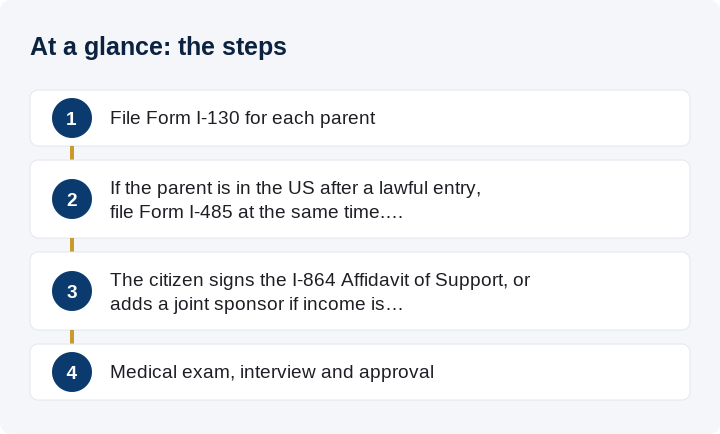
Parents of adult US citizens are immediate relatives, so there is no waiting line. The rules on who counts as a parent are stricter than most people expect.
The petitioner must be a US citizen aged 21 or older. Permanent residents cannot petition for parents. Each parent needs a separate I-130 petition.
Older parents often worry about health care. New permanent residents may buy coverage on the Health Insurance Marketplace, but most are not eligible for Medicare until they have five years of residence and meet other conditions, and many means-tested benefits have a five-year bar. Plan for private insurance. See Social Security and Medicare for residents.
Many parents want to split time between countries. A green card requires the US to be your permanent home; long absences can lead to a finding of abandonment. If your parents plan to stay abroad more than six months a year, discuss a re-entry permit or whether a visitor visa suits them better.
The F4 category is open to any adult US citizen with a brother or sister abroad, but it carries the longest wait in the family system.
Only a US citizen aged 21 or older can file for a brother or sister. Permanent residents cannot. The sibling relationship must be shown through birth certificates naming at least one common parent. Half-siblings qualify; step-siblings qualify only if the step-relationship was created before both turned 18.
The sibling's spouse and unmarried children under 21 can immigrate as derivatives on the same petition. Children who turn 21 before a visa is available may be protected by the CSPA.
F4 receives 65,000 visas a year worldwide, far fewer than the demand. In recent Visa Bulletins, the cutoff for most countries has been well over a decade in the past, and over twenty years for the Philippines and Mexico. Check the Visa Bulletin for current dates. While waiting, the sibling usually cannot hold a US visitor visa easily, because the petition shows immigrant intent.
Normally the petition is automatically revoked. But under section 204(l) of the INA, a beneficiary who was living in the US when the petitioner died may still proceed, and USCIS can also reinstate the petition on humanitarian grounds. A substitute sponsor must sign the Affidavit of Support.
Many F4 beneficiaries will see their children turn 21 before a visa is available. Some will see the petitioner die or naturalize their own families in the meantime. Keep contact details updated with USCIS and the NVC, keep civil documents current, and watch the Visa Bulletin each year. When the date approaches, the NVC will contact the beneficiary.
The death of a US citizen spouse does not have to end the immigration case. The law gives surviving spouses their own path, with a firm deadline.
If your spouse filed an I-130 before dying, it automatically converts into a widow(er) petition. You do not need to file a new one, though you should notify USCIS and provide the death certificate.
You must file Form I-360 yourself within two years of your spouse's death. There is no filing fee for widow(er)s. If you are in the US, you can file the I-485 at the same time.
Your unmarried children under 21 can be included as derivatives on your petition.
Widow(er) self-petitioners do not need an I-864 Affidavit of Support. If the case continues under section 204(l) for other relationships, a substitute sponsor is needed instead.
Remarrying before you receive the green card ends eligibility through this route. Wait until the case is approved, or seek advice.
After the I-360 is approved, the case is sent to the National Visa Center and then to a consulate for an immigrant visa interview, like other family cases.
No. Immediate relative cases have no derivatives. Siblings under 21 could be sponsored later by your parents as F2A once they are residents, or by you as F4 siblings.
Parents of adult citizens are immediate relatives, so an overstay after a lawful entry generally does not prevent adjustment. Entry without inspection is different.
They can apply for a visitor visa, but the pending petition makes it harder to prove they will return home. Refusals under 214(b) are common.
For many families yes, because the priority date protects their place in line and the sibling's children may still benefit. The fee is the main cost.
If you have a pending I-485 that converted to a widow(er) case, your work permit and advance parole remain valid while the case continues.
The widow(er) category is only for spouses of citizens. Spouses of deceased permanent residents may continue under section 204(l) if they lived in the US when the petitioner died.
Disclaimer. This article is general information, not legal advice, and it is not affiliated with any government agency. US immigration rules, fees and processing times change often, and they changed repeatedly in 2025 and 2026. Confirm current requirements on uscis.gov and travel.state.gov, or speak with a licensed immigration attorney or a DOJ-accredited representative.
How citizens and permanent residents sponsor children and spouses: immediate relative, F1, F2A, F2B and F3, aging out at 21 and how the CSPA protects children.
How adopted children immigrate to the US: Hague Convention vs orphan processes, Forms I-800A and I-600A, home studies, IR3 and IR4 visas and automatic citizenship.
When children born outside the US to American parents are citizens at birth, the physical presence rules for transmitting citizenship, and how to apply for a CRBA and passport.