EB-5 Due Diligence: Source of Funds, Risks and Reserved Visas
How to document a lawful source of EB-5 funds, the financial and fraud risks of EB-5 projects, and how the rural and high-unemployment reserved visas work.
 Tradiciones del Mundo
EB-5 grants permanent residence in exchange for an at-risk investment that creates US jobs. It is a legal and financial project as much as an immigration filing.
Key points
The EB-5 program was reformed in 2022, and the rules in this guide reflect that reform. Read it in order: the core requirements, the choice between a regional center and a direct investment, how targeted employment areas reduce the investment amount, and what happens two years after the green card when the investor must prove the project delivered.
EB-5 combines two risks: losing the money and not getting the green card. Good due diligence reduces both.
EB-5 offers permanent residence in exchange for an at-risk investment that creates jobs. It is a legal and financial project, not just an immigration filing.
A direct investment in a business you help run, where only direct jobs count, or an investment through a regional center, a USCIS-designated entity that sponsors projects and can count indirect jobs. Most EB-5 investors use regional centers. See regional center vs direct investment.
The RIA reserved 32% of EB-5 visas: 20% for rural projects, 10% for high-unemployment areas and 2% for infrastructure. These "set-aside" categories have generally been current even for Chinese and Indian investors, which made them very popular. See reserved visas and rural projects.
Beyond the investment, expect regional center administrative fees (often $50,000 to $80,000), legal fees, source-of-funds documentation costs and government fees. Remember that the investment itself may not be returned for five years or more, and could be lost.
The regional center program is authorized through 30 September 2027. Petitions filed on or before 30 September 2026 are protected by grandfathering if the program later lapses; later filings do not have that protection. Check the current status before investing.
An EB-5 investor's spouse and unmarried children under 21 obtain green cards as derivatives. Only one investment is required for the whole family. The same is true in the I-829 phase: the family's conditions are removed together.
The choice between a regional center and a direct investment shapes your risk, your role and how jobs are counted.
| Regional center | Direct | |
|---|---|---|
| Jobs counted | Direct, indirect and induced, using economic models | Direct W-2 employees only |
| Your role | Passive limited partner | Active management or policy role |
| Typical project | Real estate, hotels, infrastructure | Your own business or a franchise |
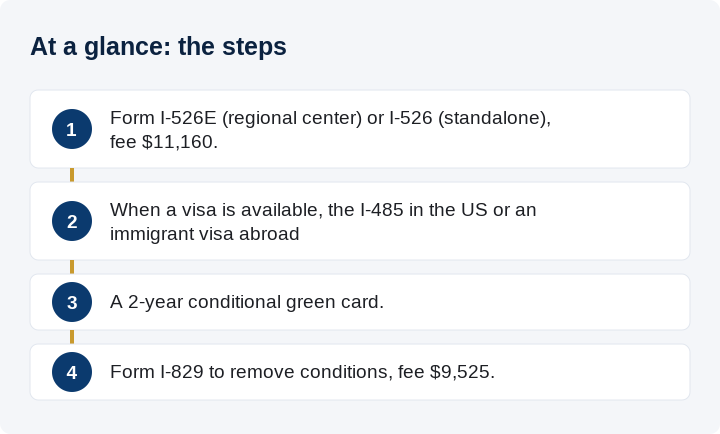
| Petition | I-526E | I-526 |
| Extra costs | Administrative fee; annual Integrity Fund fee paid by the center | Business operating risk |
| Live where? | Anywhere in the US | Usually near your business |
If you want to run your own business and can realistically hire ten full-time employees within the required period, a direct investment gives you control. But ten W-2 jobs is a high bar for a small business, and if the business does not grow, the I-829 can be denied.
Most investors are passive and want to live anywhere in the US. Indirect job counting makes it easier to meet the 10-job requirement, especially on large construction projects. The trade-off is less control and reliance on the developer's competence and honesty. See risks and due diligence.
If a project finishes before investors' conditions are removed, the capital can be redeployed into another qualifying investment to stay "at risk". The RIA set clearer rules for this. Ask the regional center how and where redeployment would happen.
A hypothetical investor wants to open a restaurant group. With a direct investment of $1,050,000 she must create ten full-time W-2 jobs for US workers directly employed by her company and must be actively involved. If she invests $800,000 in a rural regional center project financing a manufacturing plant, she can live anywhere and the jobs can be counted through an economic model, but she has no control over the project and depends on the developer.
A TEA designation cuts the EB-5 investment by $250,000. Since 2022 USCIS decides it directly, using federal data.
Before 2022, state agencies issued TEA letters. Under the EB-5 Reform and Integrity Act, DHS designates TEAs, and USCIS reviews the designation as part of the I-526E or I-526 petition. Designations are valid for two years, and the RIA restricts how many tracts can be combined, closing the "gerrymandering" practice of linking a downtown project to distant poor neighborhoods.
USCIS looks at whether the area qualified when the investment was made or the petition was filed. A later change in local unemployment does not take the TEA status away from investors already in the project.
A hotel project sits in a census tract with 4% unemployment while the national rate is 4%. On its own it would not qualify. Under the old practice, developers combined distant high-unemployment tracts. Under the RIA, the project can combine only its own tract and directly adjacent tracts, and the weighted average must be at least 150% of the national rate, 6% in this example.
EB-5 investors receive a 2-year conditional card. Turning it into a 10-year card depends on what the project actually achieved.
File Form I-829 in the 90 days before the second anniversary of becoming a conditional resident. The fee is $9,525 under the April 2024 schedule. Family members included in the original case are usually included in the investor's I-829.
The I-829 receipt extends conditional status, currently for 48 months. I-829 cases have historically taken years, so expect to rely on the extended receipt notice for travel and work.
If the project created fewer jobs than needed, USCIS can deny the petition and terminate status. Investors can then contest the termination in immigration court. The RIA added some protections for investors whose regional center was terminated or whose project was affected by fraud by others.
Repayment of the investment depends on the project's terms and success, not on the I-829. Many projects repay only after all investors' I-829 petitions are approved.
Keep project updates and job creation reports organized from the beginning, so the I-829 can be prepared quickly.
Yes, if the loan is secured by your own assets and you are personally liable. Loans secured by the project's assets do not qualify.
Yes. EB-5 investors who use regional centers can live and work anywhere in the US.
Not guaranteed. Repayment depends on the project's success and terms.
An investment must be in a single new commercial enterprise; you cannot split it between models.
Generally a business created after 29 November 1990, or an existing business restructured or expanded in qualifying ways.
No. It is about where the job-creating project is located.
For high unemployment, the American Community Survey estimates and other reliable federal data. For rural areas, Office of Management and Budget metropolitan area definitions and decennial census populations.
An investor who invested only $800,000 would not meet the higher threshold, and the petition would be denied unless additional capital qualifies.
You can count the conditional period toward the five years, but conditions must be removed before naturalization.
Yes, with your expired card and the I-829 receipt.
USCIS may interview investors, but many cases are decided on paper.
Disclaimer. This article is general information, not legal advice, and it is not affiliated with any government agency. US immigration rules, fees and processing times change often, and they changed repeatedly in 2025 and 2026. Confirm current requirements on uscis.gov and travel.state.gov, or speak with a licensed immigration attorney or a DOJ-accredited representative.
How to document a lawful source of EB-5 funds, the financial and fraud risks of EB-5 projects, and how the rural and high-unemployment reserved visas work.
Alternatives to EB-5 for investors and entrepreneurs: the E-2 treaty investor visa, the 2025 Gold Card program, and green card routes for startup founders.