Consular Processing, the NVC and the Immigration Medical Exam
How immigrant visas are processed abroad: the National Visa Center, fees, civil documents, the medical exam, the embassy interview and entering the US.
 Tradiciones del Mundo
Adjustment of status lets people already in the US become permanent residents without an embassy interview abroad. How you entered, and what you did since, decide whether you can.
Key points
For people already in the United States, adjustment is usually the preferred route to a green card. But it is not available to everyone, and the choice between adjusting and processing abroad can decide whether an unlawful presence bar applies. This guide covers eligibility, the choice of route and how to live, work and travel while the case is pending.
may be adjusted by the Attorney General, in his discretion and under such regulations as he may prescribe, to that of an alien lawfully admitted for permanent residence
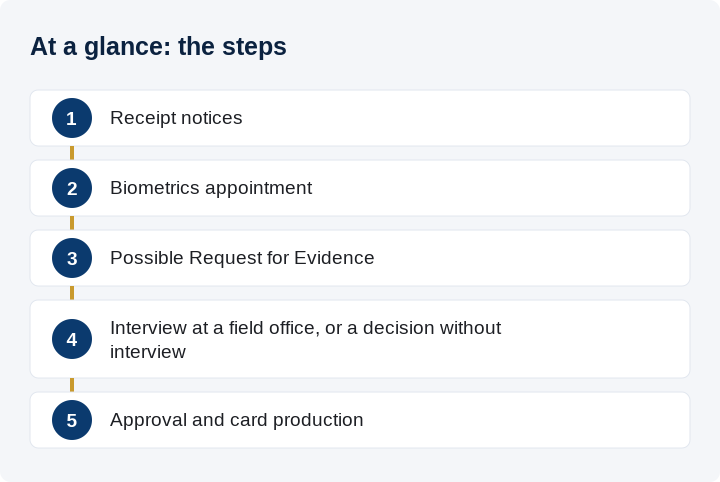
Adjustment of status lets people already in the US become permanent residents without returning home for an embassy interview. Eligibility depends on how you entered and what you did since.
Most applicants are barred if they worked without authorization, failed to maintain status or overstayed. Immediate relatives of US citizens are exempt from these bars, which is why a spouse of a citizen can usually adjust after overstaying. Employment applicants may be forgiven up to 180 days of status violations under section 245(k). People who entered without inspection generally cannot adjust unless they are covered by section 245(i), which requires a petition filed by 30 April 2001.
The I-485 package typically includes the form, the fee, the I-693 medical exam, photos, birth certificate, passport and I-94, the underlying petition or its approval, the Affidavit of Support for family cases, and evidence of any arrests. See the I-485 checklist.
You can request a work permit (I-765) and advance parole (I-131). Do not travel abroad without advance parole, or your I-485 will be treated as abandoned (H-1B and L-1 holders are an exception). See work and travel permits while pending.
Adjustment is a discretionary benefit: even an eligible applicant can be denied if negative factors outweigh positive ones. USCIS emphasized this in 2026 policy guidance. Be truthful about every past arrest, entry and status problem.
When the underlying petition and the I-485 can be filed together, it is called concurrent filing. It is available for immediate relatives, for employment cases when the priority date is current, and in some other categories. Concurrent filing starts the work permit and travel permit clock sooner, and it lets USCIS review everything in one package.
If you are in the US and eligible to adjust, you often have a real choice. Each route has advantages that depend on your situation.
| Adjustment (USCIS) | Consular (State Department) | |
|---|---|---|
| Where you wait | In the US | Usually abroad |
| Government fees (main applicant) | $1,440 I-485 (plus optional EAD/AP) | About $680 ($325 + $120 + $235) |
| Work while waiting | Yes, with an EAD | Only if you hold other status |
| Travel while waiting | Only with advance parole | Free, you are abroad |
| If refused | Motions, and renewal before an immigration judge | Very limited review of consular decisions |
| Risk from past overstay | Usually not triggered for immediate relatives | Leaving the US can trigger the 3- or 10-year bar |
A hypothetical spouse of a US citizen is in the US on an expired student visa. Leaving the US would trigger the 10-year bar for over a year of unlawful presence. Adjustment avoids that because overstays are forgiven for immediate relatives who entered lawfully. A different hypothetical spouse living in Peru with no US history has no practical choice: consular processing in Lima.
Anyone with past unlawful presence, a prior removal, a criminal record or a previous visa refusal should get advice before choosing a route. The choice can determine whether a bar applies.
Adjustment can take a year or more. A work permit and a travel document make that wait livable, if you use them correctly.
Applicants with a pending I-485 can request an Employment Authorization Document with Form I-765, category (c)(9). Since April 2024 there is a fee ($260 when filed with or after the I-485). In late 2025 USCIS shortened the maximum validity of these work permits from five years to 18 months, so plan to renew while the case is pending.
Form I-131 requests permission to travel abroad and return without abandoning the I-485. Leaving the US without it usually ends the adjustment application, except for people maintaining valid H-1B, H-4, L-1 or L-2 status who return in that status.
When both are approved together, USCIS issues a single card that says "Serves as I-512 Advance Parole".
File a renewal up to 180 days before the EAD expires. Since 2025, automatic extensions of expiring work permits during renewal have been narrowed for many categories, so file early to avoid gaps in work authorization.
Only immediate relatives of US citizens, and only if they otherwise qualify. Other ESTA entrants cannot adjust.
Yes, and you must report it within 10 days online so notices reach you.
Yes. Many applicants keep their nonimmigrant status as a backup while the I-485 is pending.
Your I-485 remains pending, and you keep your work and travel permits until a number is available again.
Yes, if you are in the US and eligible to adjust, by filing an I-485. You should inform the NVC.
The legal standards are the same, but consular officers have less formal review and more discretion in practice.
It depends entirely on the specific USCIS field office and consulate. Compare current processing times before deciding.
Only with advance parole, unless you maintain H or L status.
No. You need the approved card (or a valid status).
Yes, with an emergency advance parole request at a field office in urgent cases.
No, it only authorizes employment.
Only if you plan to work or travel. Many applicants request both to be safe.
Disclaimer. This article is general information, not legal advice, and it is not affiliated with any government agency. US immigration rules, fees and processing times change often, and they changed repeatedly in 2025 and 2026. Confirm current requirements on uscis.gov and travel.state.gov, or speak with a licensed immigration attorney or a DOJ-accredited representative.
How immigrant visas are processed abroad: the National Visa Center, fees, civil documents, the medical exam, the embassy interview and entering the US.
What to file with Form I-485, what happens at the biometrics appointment and how to prepare for the green card interview, with checklists and common questions.
How to respond to a Request for Evidence, track a delayed case, request an expedite, handle inadmissibility with waivers and what to do after a denial.