Green Cards for Foreign Nurses: Schedule A, NCLEX and VisaScreen
How internationally educated nurses immigrate to the US: Schedule A (no PERM recruitment), the NCLEX, VisaScreen certificates, state licensing, EB-3 backlogs and recruiter contracts.
 Tradiciones del Mundo
Most employment green cards go to people already working in the US. The path is well trodden, but each step has a timing rule that can make or break the case.

Key points
This guide follows the typical journey of an H-1B worker in order: the overall path, the labor certification that starts it, the I-140 petition that classifies the worker, and the portability rules that let careers continue while the green card is pending.
Changing jobs before the I-140 is approved usually means starting over. After approval, you keep your place in line.
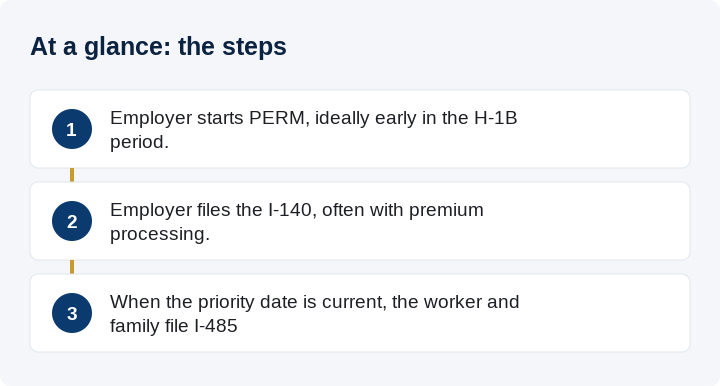
Most employment green cards go to people already working in the US on an H-1B. The path is well trodden, but its timing has to be managed carefully.
The H-1B allows dual intent, so starting a green card case does not threaten your status or your visa renewals. See immigrant and nonimmigrant intent.
H-1B status is normally limited to six years. The American Competitiveness in the 21st Century Act (AC21) allows extensions beyond that:
That is why starting PERM by the end of the fourth year matters.
H-4 spouses can request work authorization once the H-1B worker has an approved I-140 (or extended status under AC21). Children must keep H-4 status until the green card, and may need CSPA protection if they approach 21.
A September 2025 proclamation imposed a $100,000 payment on certain new H-1B petitions for workers outside the US, and the H-1B lottery moved toward wage-weighted selection. These changes affect new H-1B workers more than people already in H-1B status, and some are being litigated. Check the current rules before planning.
Changing jobs before the I-140 is approved usually means starting again. After approval, you keep the priority date. After the I-485 has been pending 180 days, you can often port the case to a new employer. See changing jobs during the green card process.
Before most employers can sponsor a green card, they must prove to the Department of Labor that no qualified US worker wants the job. That is PERM.
The labor certification protects US workers' jobs and wages. The employer tests the labor market and certifies that hiring a foreign worker will not adversely affect similarly employed US workers.
The filing date becomes your priority date, and an approved PERM is valid for 180 days to file the I-140.
Between the wage determination, recruitment and DOL's processing queue, PERM has commonly taken well over a year from start to approval in recent years. Check DOL's processing times page for current figures.
The employer must pay all costs related to the labor certification, including attorney fees and advertising. Workers cannot reimburse these costs. The I-140 and I-485 fees can be paid by either party.
For professional occupations, the employer must run a 30-day job order with the state workforce agency, place two Sunday print ads in a newspaper of general circulation, and choose three additional steps such as job fairs, the employer's website, job search websites, on-campus recruiting, trade organizations, private recruitment firms, employee referral programs, campus placement offices, local newspapers or radio ads. All recruitment must describe the job accurately and cannot list requirements beyond what is normal for the occupation unless justified by business necessity.
Employers must keep a recruitment file for five years: copies of ads, resumes received and the lawful, job-related reasons each US applicant was not hired. DOL may audit any case, and an unanswered audit leads to denial.
The I-140 is where USCIS decides whether you fit your employment category. Its approval is a milestone even if you still face a long wait.
Form I-140, Immigrant Petition for Alien Workers, asks USCIS to classify a worker in EB-1, EB-2 or EB-3. Employers file it for their workers; EB-1A and National Interest Waiver applicants can file it themselves.
| Item | Amount (April 2024 schedule) |
|---|---|
| I-140 filing fee | $715 |
| Asylum Program Fee | $600 ($300 for employers with 25 or fewer employees, $0 for nonprofits) |
| Premium processing (optional) | Several thousand dollars; check Form I-907 for the current amount |
For an additional fee, USCIS decides the case (approval, denial or RFE) within 15 business days for most categories, or 45 business days for EB-1C and NIW. It does not speed up the green card itself if the priority date is not current.
If your priority date is already current, you can file the I-140 and I-485 together, which gets work and travel permits moving sooner.
Careers do not freeze for green card backlogs. The law lets workers move, but only at the right moment and to the right kind of job.
A labor certification and I-140 belong to a specific employer and job. If you leave before the I-140 is approved, the new employer generally has to start PERM again. You lose the time invested, and you may not keep the priority date.
Once the I-140 is approved, you keep its priority date for any later I-140, unless the approval is revoked for fraud, misrepresentation or a material error. The new employer still needs PERM and a new I-140, but you do not lose your place in line. An approved I-140 that has been in place 180 days is not automatically revoked if the employer withdraws it.
Section 204(j) of the INA, added by AC21, allows you to "port" your pending green card case to a new job if:
The new employer completes Supplement J to Form I-485, confirming the job offer. No new PERM is needed.
USCIS compares duties, skills, education and wages, often using occupational classification codes. A promotion from engineer to engineering manager usually qualifies; a move from software engineer to sales manager usually does not.
Porting to self-employment is possible in principle, but you must show a real, bona fide job offer from your own company, which USCIS reviews closely.
A hypothetical accountant has an I-485 pending for eight months, based on an approved EB-3 I-140. She receives an offer for a senior accountant position at another company with a higher salary. Because her I-485 has been pending more than 180 days and the job is in the same occupation, she can accept. Her new employer signs Supplement J, which she submits to USCIS when requested or proactively. Her case continues without a new PERM.
Yes, through EB-1A or the National Interest Waiver, alongside any employer-sponsored case.
Many keep H-1B status as a backup. Working on the EAD ends H-1B status if you stop working for the H-1B employer, which matters if the green card is later denied.
No. The foreign worker should not be involved in reviewing applicants.
The employer cannot certify that no qualified US workers are available, and the PERM cannot be filed for that recruitment.
No. It is a classification, not a status. You need separate status (such as H-1B) to stay in the US until the I-485.
Yes, but if the I-140 was approved 180 days or more before withdrawal, it is not automatically revoked and you keep the priority date.
It is best practice to file Supplement J with the new job offer, and USCIS will require it before approval.
Yes. Salary differences are one factor, but the main test is whether the duties are same or similar.
Changing jobs on H-1B requires a new H-1B petition from the new employer, unless you are working on your EAD.
Disclaimer. This article is general information, not legal advice, and it is not affiliated with any government agency. US immigration rules, fees and processing times change often, and they changed repeatedly in 2025 and 2026. Confirm current requirements on uscis.gov and travel.state.gov, or speak with a licensed immigration attorney or a DOJ-accredited representative.
How internationally educated nurses immigrate to the US: Schedule A (no PERM recruitment), the NCLEX, VisaScreen certificates, state licensing, EB-3 backlogs and recruiter contracts.
How international medical graduates train and work in the US: ECFMG certification, J-1 and H-1B for residency, the Conrad 30 waiver, physician National Interest Waivers and green cards.

How immigrants get foreign degrees evaluated and professional licenses recognized: credential evaluation services, state licensing boards, regulated professions and bridging programs.