SIJ Status, Afghan and Iraqi SIVs and the Cuban Adjustment Act
Three special humanitarian paths to a green card: Special Immigrant Juvenile status, Afghan and Iraqi special immigrant visas and the Cuban Adjustment Act.
 Tradiciones del Mundo
US law protects immigrants who survive abuse, crime or trafficking, and lets them build a future without depending on the person who harmed them.
Key points
These three protections share a principle: immigration status should never be a tool for abusers or traffickers to control someone. Each has its own requirements and evidence, and each is confidential. If you are in danger, the hotlines listed in the sections below can help regardless of immigration status.
Federal law prohibits USCIS from contacting the abuser or using information from the abuser against you.
The Violence Against Women Act lets victims of abuse petition for themselves, without the abuser's knowledge or help. It applies to men and women alike.
Any credible evidence is accepted: your own detailed declaration, police reports, protective orders, medical records, shelter records, and statements from counselors, clergy, friends or family.
Federal law prohibits USCIS from contacting the abuser or using information from the abuser against you. Mail can be sent to a safe address.
File Form I-360 (no fee). If you are in the US and the abuser is a citizen, you can file the I-485 at the same time. Approved self-petitioners can request work authorization even before the green card.
A hypothetical woman married a US citizen who never filed for her green card and used that as a threat. He controlled her money, isolated her from friends and threatened to report her to immigration. She can self-petition under VAWA with her own declaration, messages showing the threats, statements from a counselor and a friend, and evidence of the marriage. She does not need a police report or the husband's cooperation.
Despite its name, VAWA protects people of any gender and same-sex spouses equally.
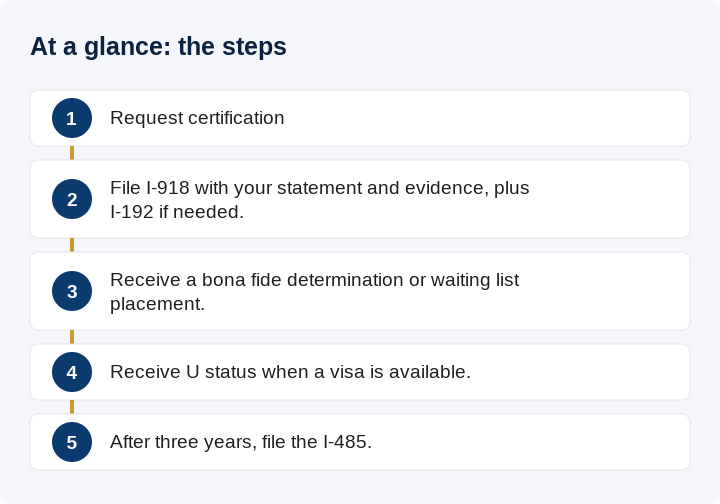
The U visa protects victims of serious crimes who cooperate with police or prosecutors. After three years, it can lead to permanent residence.
A certifying agency (police, prosecutor, judge, or agencies such as the EEOC) must sign Form I-918 Supplement B. Agencies are not required to sign, and policies vary widely.
Only 10,000 U visas can be issued to principal victims each year, and demand far exceeds that. Since 2021 USCIS has issued bona fide determinations that give work permits and deferred action to many applicants while they wait, which can take many years.
After three years of continuous physical presence in U status, you can apply for a green card with Form I-485 if you have not unreasonably refused to help law enforcement and your presence is justified on humanitarian grounds, for family unity or in the public interest.
Contact the agency that investigated or prosecuted the crime (the police department, district attorney, or a judge). Many have designated certifying officials and written procedures. Provide the case number, your statement and your contact information. Certification can be requested even years after the crime, as long as you helped or are willing to help.
U visa applicants can request a broad waiver of inadmissibility with Form I-192, which covers most grounds, including unlawful entry and many prior immigration violations.
The T visa protects people brought or kept in the US through force, fraud or coercion for labor or sex. It can lead to a green card.
File Form I-914 (no fee). A law enforcement declaration (Supplement B) helps but is not required. Family members can be included with Supplement A. Up to 5,000 T visas are available each year to principals, a limit not reached in practice.
After three years in T status, or earlier if the investigation or prosecution is complete, you can file Form I-485 for a green card. You must show good moral character and continued compliance with reasonable requests for assistance.
The National Human Trafficking Hotline (1-888-373-7888) connects survivors with services and legal help.
Trafficking can happen in any industry, including agriculture, construction, domestic work, restaurants and beauty salons, and the victim may have entered the US legally.
T visa holders can work, and many qualify for federal and state benefits on the same basis as refugees. Family members can receive derivative T visas.
No. Any credible evidence is accepted, and your own detailed declaration is central.
Yes, within two years of the divorce, if the divorce was connected to the abuse.
USCIS cannot notify or seek information from the abuser and must keep your case confidential.
Yes, unmarried children under 21 can be included as derivatives.
No. Helpfulness to an investigation is enough, even if no one is charged.
Yes. Spouses, children and, for victims under 21, parents and unmarried siblings under 18 can be derivatives.
A bona fide determination or placement on the waiting list gives deferred action and work authorization.
You must comply with reasonable requests for assistance, but exceptions exist for trauma and for minors.
No. You must be physically present in the US because of the trafficking.
Yes. Services through the National Human Trafficking Hotline do not require status.
Disclaimer. This article is general information, not legal advice, and it is not affiliated with any government agency. US immigration rules, fees and processing times change often, and they changed repeatedly in 2025 and 2026. Confirm current requirements on uscis.gov and travel.state.gov, or speak with a licensed immigration attorney or a DOJ-accredited representative.
Three special humanitarian paths to a green card: Special Immigrant Juvenile status, Afghan and Iraqi special immigrant visas and the Cuban Adjustment Act.
Whether Temporary Protected Status, humanitarian parole or long residence can lead to a green card, the 2025 changes, and the registry provision for pre-1972 residents.
How refugees and asylees become permanent residents after one year, the asylum one-year filing deadline and its exceptions, fees and family members.