From H-1B to Green Card: PERM, I-140 and Changing Jobs
The path from H-1B to permanent residence: PERM labor certification, Form I-140, extending H-1B past six years, and changing employers under AC21 portability.
 Tradiciones del Mundo
EB-2 is the workhorse category for professionals. Most cases need an employer and PERM; the National Interest Waiver lets qualified people skip both and file for themselves.
Key points
EB-2 sits between the elite EB-1 categories and the broad EB-3. For many professionals, the real question is whether to go through an employer's labor certification or to argue a National Interest Waiver. This guide explains the EB-2 requirements first, then the NIW test and how to build a petition that meets it.
Two practical notes before you start. First, the job's minimum requirements, not your personal qualifications, decide whether an employer-sponsored case is EB-2 or EB-3. Second, EB-2 has had a cutoff date for most countries since 2023, so approval of the petition is often followed by a wait for the Visa Bulletin. Filing an NIW in parallel with an employer case is common and legitimate, and whichever is approved first can be used.
"Working as a data scientist" is a job. A specific plan with expected outcomes and national implications is an endeavor.
EB-2 is the workhorse category for professionals. Most cases need an employer and labor certification; the National Interest Waiver is the exception.
The job must require, and you must hold, a US master's degree or higher, or a foreign equivalent. A bachelor's degree plus five years of progressive experience in the field counts as equivalent to a master's.
Ability significantly above that ordinarily encountered in the sciences, arts or business, shown by at least three of six criteria: an academic record, ten years of full-time experience, a professional license, a high salary, membership in professional associations, or recognition for achievements.
A credential evaluation is usually needed to show that a foreign degree is equivalent to a US one. Three-year bachelor's degrees, common in India and Europe, can be a problem: USCIS often treats them as not equivalent to a US bachelor's, and they generally cannot be combined with other degrees to reach equivalency.
Standard EB-2 cases need a full-time permanent job offer and an approved PERM labor certification. The job's minimum requirements, not the worker's qualifications, decide whether it is EB-2 or EB-3.
If your work benefits the US significantly, you can request a waiver of both the job offer and PERM and file for yourself. See National Interest Waiver.
EB-2 has had a cutoff date for most countries since 2023, and much longer waits for India and China. Some applicants "downgrade" to EB-3 when it moves faster; this requires a new I-140 but keeps the priority date.
A hypothetical engineer has a four-year bachelor's degree from Mexico and six years of increasingly senior experience. The job her employer sponsors requires a master's degree or a bachelor's plus five years of progressive experience. Her five years must be after the bachelor's degree, and she must have gained them before the priority date. The employer can count experience with the same employer only in limited circumstances, so experience letters from prior employers matter.
Each letter should be on company letterhead, signed by a supervisor or HR, and include dates of employment, job titles, hours per week and a description of the duties. Letters missing any of these details often trigger RFEs.
The NIW lets qualified professionals skip the job offer and labor certification entirely. It became one of the most popular routes of the past decade.
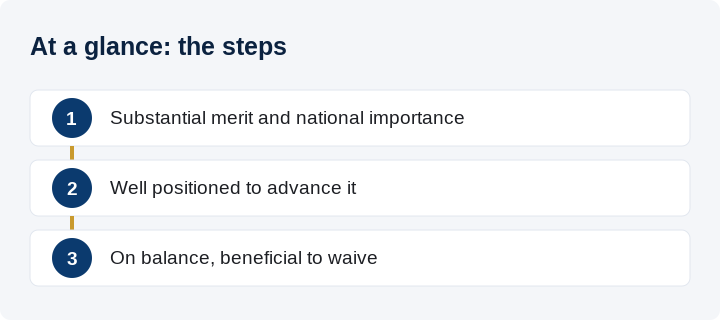
An NIW is an EB-2 petition in which the applicant asks USCIS to waive the job offer and labor certification because doing so is in the national interest. You must first qualify for EB-2 (advanced degree or exceptional ability), and then meet the three-part test from Matter of Dhanasar (2016).
File Form I-140 with fees of $715 plus the $600 Asylum Program Fee. Premium processing has been available for NIW cases since 2023. Approval rates have fallen in recent years, so preparation quality matters more than ever. After approval you still wait for your EB-2 priority date.
The proposed endeavor should be specific: what you will do, where, for whom and with what expected outcomes. "Working as a data scientist" is a job; "developing machine-learning tools to detect early sepsis in rural hospitals, building on my published models and pilot deployments" is an endeavor. National importance comes from the endeavor's broader effect, not from the field being important in general.
For foreign degrees, yes in practice. Use an evaluation service that explains the basis for equivalency.
No. The category follows the job's minimum requirements, which must reflect the employer's real needs.
No. A master's degree, or a bachelor's plus five years of progressive experience, is enough to qualify for EB-2; exceptional ability also works.
Yes, as long as you continue working in the proposed endeavor.
Disclaimer. This article is general information, not legal advice, and it is not affiliated with any government agency. US immigration rules, fees and processing times change often, and they changed repeatedly in 2025 and 2026. Confirm current requirements on uscis.gov and travel.state.gov, or speak with a licensed immigration attorney or a DOJ-accredited representative.
The path from H-1B to permanent residence: PERM labor certification, Form I-140, extending H-1B past six years, and changing employers under AC21 portability.
How internationally educated nurses immigrate to the US: Schedule A (no PERM recruitment), the NCLEX, VisaScreen certificates, state licensing, EB-3 backlogs and recruiter contracts.
How international medical graduates train and work in the US: ECFMG certification, J-1 and H-1B for residency, the Conrad 30 waiver, physician National Interest Waivers and green cards.