Citizenship Residence Rules: Continuous Residence and Physical Presence
The residence tests for naturalization: continuous residence and long trips, counting physical presence days, and the three-year rule for spouses.
 Tradiciones del Mundo
For most permanent residents, naturalization is the final step of the immigration journey. The process is predictable if you check eligibility and timing carefully first.

Key points
Citizenship brings the right to vote, a US passport and protection from deportation. This guide covers eligibility and the process, then the two practical questions applicants ask most: when exactly they can file and how much it will cost.
All persons born or naturalized in the United States, and subject to the jurisdiction thereof, are citizens of the United States and of the State wherein they reside.
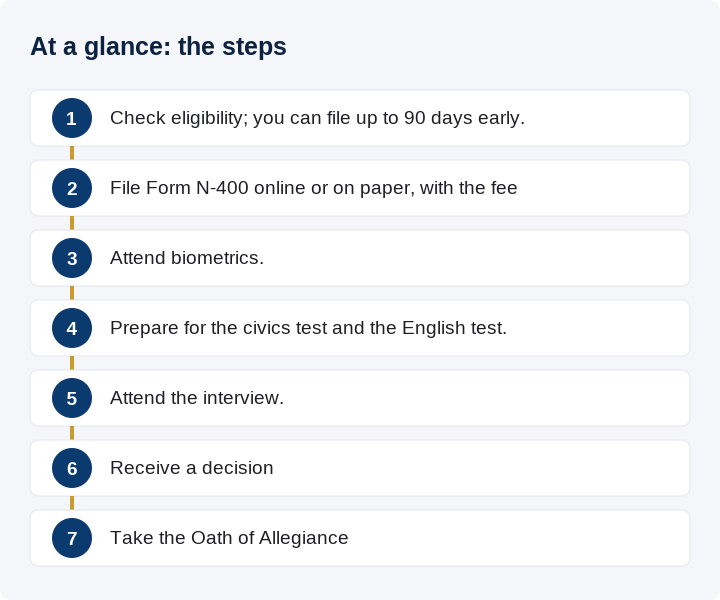
For most permanent residents, naturalization is the last step of the immigration journey. The process is predictable if you check eligibility carefully first.
National median processing times for the N-400 were roughly six months to a year in 2025 and 2026, varying widely by field office. USCIS also reintroduced neighborhood investigations and stricter good moral character reviews in 2025, which can lengthen some cases.
Review your history with a lawyer if you have any arrests, long trips abroad, tax debts, a past immigration problem or child support arrears. Applying exposes your whole record, and in serious cases can lead to removal proceedings instead of citizenship.
Calculate your dates: our citizenship eligibility date calculator estimates when you become eligible, the earliest filing day and whether you meet physical presence.
You do not have to wait for the exact anniversary. The law lets you file up to 90 days before you complete the residence period.
You can file Form N-400 up to 90 days before you complete the 5-year (or 3-year) continuous residence period. USCIS provides an early filing calculator online.
Take the "Resident Since" date on your green card, add 5 years (or 3), and subtract 90 days. Example: resident since 15 March 2021 → eligible 15 March 2026 → earliest filing 15 December 2025.
Filing early gets your case into the queue sooner, which can mean the interview and oath happen near your actual anniversary. If you plan international travel, schedule it so you are available for biometrics and the interview, which are not easy to reschedule.
The N-400 fee is one of the largest costs on the way to citizenship, but lower-income applicants can pay less.
| Option | Fee |
|---|---|
| Online filing | $710 |
| Paper filing | $760 |
| Reduced fee (household income at or below 400% of the federal poverty guidelines), paper only | $380 |
| Fee waiver (Form I-912) | $0 |
| Military applicants under INA 328 and 329 | $0 |
The biometrics fee is included since April 2024.
Form I-912 can be granted if you receive a means-tested benefit, your household income is at or below 150% of the poverty guidelines, or you face financial hardship.
In 2026 DHS proposed raising the N-400 fee substantially and eliminating fee waivers and the reduced fee for naturalization. Until a final rule takes effect, the fees above apply. If you are eligible now and cost matters, consider filing before any change.
A hypothetical household of three earns $90,000 a year, which is below 400% of the poverty guidelines for that size. The applicant files on paper with the reduced fee of $380, including evidence of household income. If income had been below 150% of the guidelines, a fee waiver might apply.
Generally you, your spouse living with you, your unmarried children under 21 living with you, and other dependents you claim on your tax return. Documentation must match what you list.
Beyond the USCIS fee, applicants may spend on certified court records, translations, passport photos, study materials and travel to the interview. Attorney fees, if used, vary widely. Planning these costs in advance avoids delays in filing.
Yes, most applicants can file the N-400 online, which is cheaper and lets you track the case.
Yes, but avoid long trips that could break continuous residence and make sure you are back for biometrics and interviews.
Not for a straightforward case. Use one if you have any arrests, long absences, tax problems or prior immigration issues.
Yes, you can request a legal name change as part of naturalization in many places.
Yes.
Military applicants have different requirements and often no residence period.
USCIS denies early-filed applications and the fee is lost. Use the official calculator.
It starts processing up to three months earlier.
Yes, at the time of filing.
Yes, with Form G-1450 or online.
No.
No.
The reduced fee is filed on paper only.
Disclaimer. This article is general information, not legal advice, and it is not affiliated with any government agency. US immigration rules, fees and processing times change often, and they changed repeatedly in 2025 and 2026. Confirm current requirements on uscis.gov and travel.state.gov, or speak with a licensed immigration attorney or a DOJ-accredited representative.

The residence tests for naturalization: continuous residence and long trips, counting physical presence days, and the three-year rule for spouses.

How the naturalization interview works, the 2025 civics test (128 questions, 12 correct of up to 20), the English test and the age-based exemptions.

The final citizenship hurdles: good moral character bars and the 2025 policy, faster naturalization through military service, and the oath ceremony.