Green Card Limits and Backlogs: Annual Caps and Country Limits
How many green cards are issued each year, how the 226,000 family and 140,000 employment caps work, and why the 7% per-country limit creates decade-long waits.
 Tradiciones del Mundo
In every capped green card category, two things decide when you move: your priority date and the monthly Visa Bulletin. Here is how both work, with worked examples.

Key points
Applicants in family preference, employment and diversity categories spend most of their wait not on paperwork but on visa availability. That is why the Visa Bulletin is the most-watched government document in immigration. Read the two sections below in order: first how your date is set, then how to compare it with each month's cutoffs.
Your priority date never changes. What moves, forward and sometimes backward, is the cutoff it is compared with.
In capped green card categories you wait in a line. The priority date is your ticket number, and understanding it explains most green card timelines.
Your priority date marks your place in line for an immigrant visa number in categories that have annual limits. Only when that date is "current" in the Department of State's monthly Visa Bulletin can you take the final step toward a green card.
The priority date is printed on the I-130 or I-140 receipt and approval notices (Form I-797).
Spouses, unmarried children under 21 and parents of US citizens are not subject to annual limits, so their priority date does not matter in practice. They can move to the final stage as soon as the petition is approved, or file everything together if they are in the US. See green card through marriage.
In employment cases, once an I-140 is approved you can generally keep its priority date for a later I-140, even with a different employer, unless the approval was revoked for fraud or error. This lets workers change jobs without losing years in line. In family cases, the date carries over when a beneficiary moves between categories, for example from F2B to F1 when the petitioner naturalizes.
No single country can receive more than 7% of the total family and employment visas in a year. Applicants born in countries with very high demand, such as India, China, Mexico and the Philippines, can face much later cutoff dates than everyone else. See per-country limits explained.
Consider a hypothetical engineer born in Brazil. Her employer filed a PERM labor certification on 10 March 2024, so her priority date is 10 March 2024. The PERM was approved in 2025, followed by an EB-2 I-140. In the months after approval, the EB-2 Final Action Date for "All Chargeability" sat in 2023 and then advanced. Only when the bulletin's EB-2 date moved past 10 March 2024 could her I-485 be approved. If the bulletin for that month showed "01APR24", she would be current; if it showed "01JAN24", she would still be waiting.
The State Department publishes each bulletin on travel.state.gov, and USCIS publishes the chart it will use. Many applicants keep a simple spreadsheet with their priority date and each month's cutoff to see the trend. Remember that past movement does not guarantee future movement.
Once a month, the Department of State publishes a table that tells millions of people whether they can move forward. Here is how to read it in five minutes.
The Visa Bulletin is a monthly publication from the Department of State that shows which priority dates can receive an immigrant visa number in each capped category. It is usually released around the middle of the month for the following month.
USCIS announces each month on its "Adjustment of Status Filing Charts" page which chart applicants inside the US must use. Do not assume it will be the Dates for Filing chart.
| Symbol | Meaning |
|---|---|
| C | Current: every priority date qualifies |
| U | Unauthorized: no visas available this month, whatever your date |
| A date (for example 01JAN19) | Only priority dates earlier than this date qualify |
Dates usually advance, but they can move backward when demand is higher than expected, often near the end of the fiscal year (September). If your category retrogresses while your I-485 is pending, the application stays pending until the date becomes current again; it is not denied.
The bulletin also lists the rank number cutoffs for Diversity Visa selectees by region. See DV rank numbers and the Visa Bulletin.
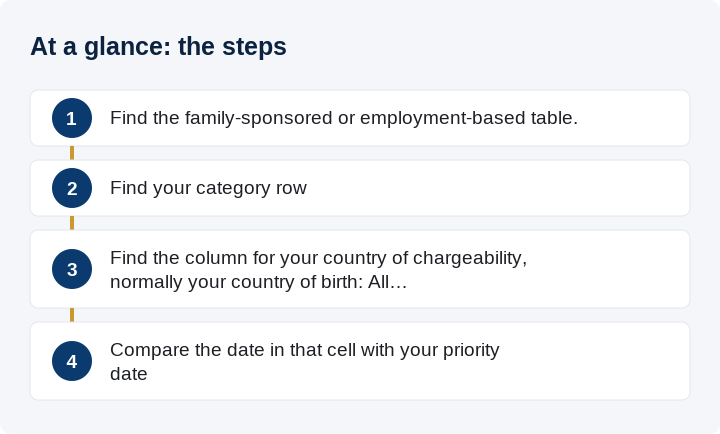
Suppose you are the brother of a US citizen, born in Mexico, and your I-130 was filed on 5 May 2002. Your category is F4, your chargeability is Mexico. You open the bulletin, find the F4 row in the family table, and read the Mexico column. If that cell shows "08JAN01", you are not current, because your date (05MAY02) is later. If a later bulletin shows "15JUN02", you are current and can move to the final stage.
The bulletin often contains notes in its later sections: warnings that a category may retrogress, explanations of unusual movement, and the Diversity Visa rank numbers. Read them. The State Department occasionally publishes projections, but they are not commitments.
Each fiscal year runs from 1 October to 30 September. Annual limits reset on 1 October, which is why dates sometimes jump forward in the October bulletin after retrogressing in the summer.
Check your date: enter your priority date and this month's cutoff in our Visa Bulletin checker.
Your date never changes, but the cutoff in the Visa Bulletin can retrogress (move backward) when demand exceeds supply. You then wait until it moves forward again.
Yes. Derivative beneficiaries (spouse and unmarried children under 21) share the principal's priority date.
Because of the 7% per-country limit. Countries whose demand is higher than their share get separate, usually later, dates. See per-country limits.
Yes, in some cases. Cross-chargeability lets you be charged to your spouse's country of birth if it has a better date and you immigrate together.
Disclaimer. This article is general information, not legal advice, and it is not affiliated with any government agency. US immigration rules, fees and processing times change often, and they changed repeatedly in 2025 and 2026. Confirm current requirements on uscis.gov and travel.state.gov, or speak with a licensed immigration attorney or a DOJ-accredited representative.
How many green cards are issued each year, how the 226,000 family and 140,000 employment caps work, and why the 7% per-country limit creates decade-long waits.
Realistic green card timelines by category, what slows cases down, how to check processing times, plus the most common myths that cost applicants time and money.

A clear guide to permanent residence in the United States: who qualifies for a green card, how the process works, how long it takes and what it changes.