New Green Card Holders: First Steps, Taxes and Benefits
What to do after getting a green card: Social Security, ID, taxes on worldwide income, Medicare and benefits, and college aid and in-state tuition.
 Tradiciones del Mundo
Three routine tasks keep your status paperwork in order: renewing the card, replacing it if lost, and telling USCIS when you move.

Key points
None of these tasks is complicated, but each one can create serious problems if ignored: missed interview notices, denied boarding, or employers refusing an expired card. This guide covers all three.
An expired 10-year card does not end your status, but employers, airlines and the DMV may refuse it.
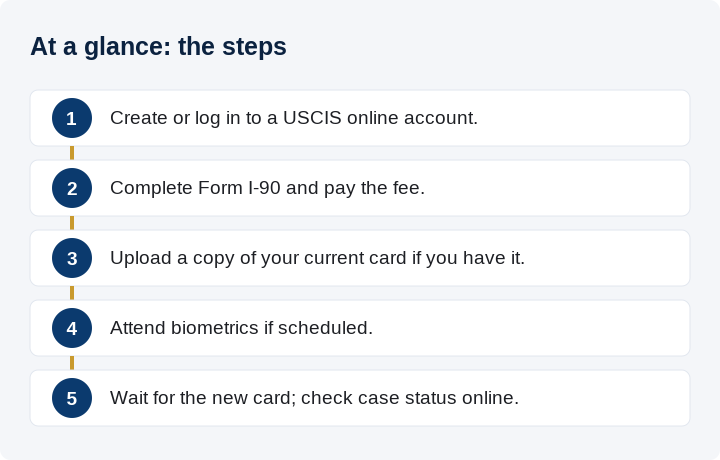
Renewing a 10-year card is usually simple, and it can be done online. The receipt notice keeps you covered while you wait.
Within six months before your 10-year card expires, or after it has expired. Also file to replace a card that was lost, stolen, damaged, or contains errors, or after a legal name change.
$465 on paper or $415 online under the April 2024 schedule. No fee if the card has an error caused by USCIS.
Since September 2024, the I-90 receipt notice extends the validity of your expired or expiring card for 36 months. Carry it with your card for work, travel and ID. You can also request an ADIT stamp at a field office in urgent cases.
You will usually be asked to attend biometrics, though USCIS sometimes reuses previous ones.
Losing your card is stressful but fixable. What you do depends on whether you are in the US or abroad.
File Form I-131A at the US embassy or consulate (or online, depending on the location) to request a boarding foil, a travel document that lets you board a flight back. The fee is $575. Bring proof of your residence status, a passport, a police report and evidence of the loss. After returning, file the I-90.
Your A-number and personal details can be misused. Monitor your credit and consider reporting the loss to the Federal Trade Commission.
A photo of both sides of the card, stored securely, speeds up replacement.
For a new job, the I-90 receipt notice for a lost or stolen card is an acceptable "receipt" under Form I-9 rules for 90 days; you must show the new card when it arrives. An ADIT stamp can also serve as temporary proof.
It takes five minutes and it is the law. Failing to report a move can also cost you notices you cannot afford to miss.
Non-citizens in the US, including permanent residents, must report a change of address to USCIS within 10 days of moving. Willful failure is a misdemeanor and can be a ground of removal, though enforcement for innocent mistakes is rare.
If you have a pending application, update the address online so notices and cards go to the new address. The postal service does not reliably forward USCIS mail, and green cards are not forwarded.
Save the confirmation page. When applying for citizenship, you will list your address history for five years.
USCIS sends interview notices, biometrics appointments, requests for evidence and cards by mail to the address on file. Missing a notice because it went to an old address can lead to denial for abandonment, which is far harder to fix than a five-minute online update. Cards sent to an old address are returned to USCIS and can take months to reissue.
A hypothetical applicant with a pending I-485 moves from Houston to Austin. She updates her address online the next day, adding her receipt number. Her case is transferred to the field office serving Austin and her interview notice arrives at her new apartment. Had she not updated, the notice would have gone to Houston and she might have missed the interview.
Carry both your expired card and the I-90 receipt notice that extends it.
If eligible, naturalizing replaces the need to renew, but the N-400 does not extend your card. Many people do both if travel or work requires a valid card.
Your status is unaffected; file the I-90 as soon as possible.
No. Use Form I-751 or I-829.
Usually several months. Check current processing times.
No. Abroad, you need the boarding foil from the consulate.
No. Your status is unaffected.
Do not use it; return it to USCIS once your new card arrives, as it may have been reported lost.
Yes, each non-citizen family member should report their own change.
The AR-11 applies to addresses in the US. If you move abroad permanently, consider whether you are abandoning residence.
Report as soon as possible. Late reporting is rarely punished when it was not willful.
Disclaimer. This article is general information, not legal advice, and it is not affiliated with any government agency. US immigration rules, fees and processing times change often, and they changed repeatedly in 2025 and 2026. Confirm current requirements on uscis.gov and travel.state.gov, or speak with a licensed immigration attorney or a DOJ-accredited representative.

What to do after getting a green card: Social Security, ID, taxes on worldwide income, Medicare and benefits, and college aid and in-state tuition.

The main risks to a green card: deportable crimes, abandonment and Form I-407, illegal voting and false citizenship claims, and Selective Service duties.

A step-by-step relocation checklist for immigrants moving to the US: documents, money, housing, health insurance, phone, banking, schools, driving and the first 90 days.