Moving to the US: A Complete Relocation Checklist for Immigrants
An immigrant visa or job offer is only the beginning. The move itself has dozens of steps, and doing them in the right order makes the first months much easier.
Start 3–6 months before the move with documents, records and money planning.
Carry original documents in your hand luggage: passports, visas, civil records, diplomas.
The first 30 days are for an address, a phone, a bank account, a Social Security number and health coverage.
The first 90 days are for a driver's license, credit building, schools and settling taxes.
Moving to another country is one of the most demanding projects a family can take on. Moving to the United States adds specific challenges: a credit system that ignores your past, health care tied to insurance, a car-dependent geography in much of the country, and immigration rules that keep applying after you arrive. This checklist is organized by time, from months before departure to the end of your first three months.
Adapt it to your situation: a single professional on an H-1B, a family arriving with green cards and a student on an F-1 have different priorities, but most of the steps are shared.
Do the paperwork while you still have access to your home country's offices. Many documents are much harder to obtain from abroad.
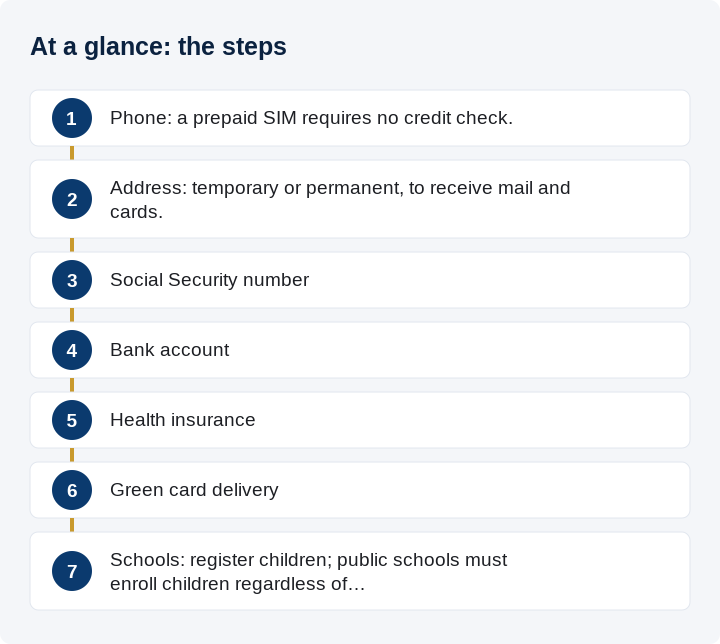
The main steps at a glance. Details in the sections below.
3 to 6 months before
Documents
Check passports for everyone are valid for the length of your visa or at least well beyond your arrival.
Obtain multiple certified copies of birth, marriage and divorce certificates.
Get school records and vaccination records for children, translated into English.
Health insurance: enroll in employer coverage within 30 days, or use the Marketplace special enrollment period.
Green card delivery: track it; report your address with USCIS if you move.
Schools: register children; public schools must enroll children regardless of immigration status.
Days 30 to 90
Long-term housing: leases often require credit checks; see renting an apartment.
Driver's license: the period you can drive on a foreign license is limited. See driver's licenses.
Credit: open a secured card and start building history.
Car insurance and renters insurance.
Doctors: choose a primary care physician in your insurance network.
Taxes: check your W-4 withholding and learn your state's tax rules.
Community: libraries, community centers and immigrant organizations offer free orientation, English classes and advice.
A worked example
A hypothetical family of four from Brazil arrives in Atlanta with green cards based on the father's EB-2 case. Before leaving, they obtained translated school and vaccination records, credential evaluations and a letter from their Brazilian car insurer. In the first week they buy prepaid phones, open a checking account with passports and green cards, and enroll the children in the local public school. Within a month their health insurance through the father's employer starts and their Social Security cards arrive. In the second month they sign a lease, using a larger deposit and the employer's letter because they have no US credit, and the parents pass their Georgia driving tests.
Common mistakes
Leaving original documents in shipped boxes
Signing a long lease before knowing the area
Assuming health insurance starts on the first day of work
Driving on a foreign license beyond the allowed period
Forgetting to report address changes to USCIS within 10 days
Keep this list with your documents folder and tick items off as you go; most families finish it within their first three months.
If you are on a temporary visa, add one more item: note the expiry dates of your visa, I-94 and passport in a calendar with reminders months in advance.
Frequently asked questions
Can I bring my pet?
Yes, subject to CDC rules for dogs, which were tightened in 2024, and USDA rules for other animals.
Can I bring medicines?
Personal quantities of prescription drugs in original packaging with a prescription are generally allowed; some substances are prohibited.
Do I pay customs duty on my belongings?
Household goods used abroad for a year or more are generally duty-free for returning residents and new immigrants, with conditions.
Disclaimer. This article is general information, not legal advice, and it is not affiliated with any government agency. US immigration rules, fees and processing times change often, and they changed repeatedly in 2025 and 2026. Confirm current requirements on uscis.gov and travel.state.gov, or speak with a licensed immigration attorney or a DOJ-accredited representative.
How immigrants find jobs in the US: proving work authorization with Form I-9, writing a US-style resume, networking, interviews, salary negotiation and avoiding employment scams.
How newcomers rent an apartment in the US: what landlords check, options without credit, leases, deposits and fees, tenant rights, fair housing and rental scams.
How immigrants get a US driver's license: driving on a foreign license, tests, documents by status, REAL ID rules since May 2025, licenses in states that accept any status and insurance.
 Tradiciones