Life and Disability Insurance for Immigrants: How to Protect Your Family
How life and disability insurance work for immigrants: term vs permanent policies, how much coverage, visa and residency underwriting rules and beneficiaries abroad.
 Tradiciones del Mundo
Car insurance is mandatory almost everywhere in the US, and newcomers often get quoted shocking prices. Renters insurance is optional, cheap and widely ignored. Here is how both work.

Key points
In much of the United States a car is not a luxury but the only practical way to reach work. That makes car insurance one of the first financial products many immigrants buy, and one of the most expensive. Renters insurance protects what you own in your apartment and is sometimes required by landlords. This guide explains both and how to keep costs reasonable.
The minimum coverage your state requires is a legal floor, not a recommendation. A serious accident can exceed it many times over.
| Coverage | What it pays for | Required? |
|---|---|---|
| Bodily injury liability | Injuries you cause to others | Required in almost all states |
| Property damage liability | Damage you cause to others' property | Required in almost all states |
| Uninsured/underinsured motorist | Your injuries when the other driver lacks enough insurance | Required in some states |
| Personal injury protection | Your medical costs regardless of fault | Required in "no-fault" states |
| Collision | Damage to your car in a crash | Optional, but lenders require it |
| Comprehensive | Theft, weather, fire, animals | Optional, but lenders require it |
Liability limits are often written as three numbers, such as 25/50/25: $25,000 per injured person, $50,000 per accident for injuries and $25,000 for property damage. Many advisers suggest far higher limits than state minimums if you have savings to protect.
Each state sets its own rules on how long you can drive with a foreign license after becoming a resident, often a short period such as 30 to 90 days. An International Driving Permit is a translation, not a license on its own. Some states have reciprocity agreements that let you exchange certain foreign licenses without a road test. Getting a US license early also helps your insurance rates.
Your landlord's insurance covers the building, not your belongings or your liability. A renters policy typically covers:
Floods and earthquakes are usually excluded and need separate policies. Choose replacement cost coverage rather than "actual cash value" if possible, so you can buy new items rather than receive their depreciated value. Make a video inventory of your belongings and keep receipts for valuable items.
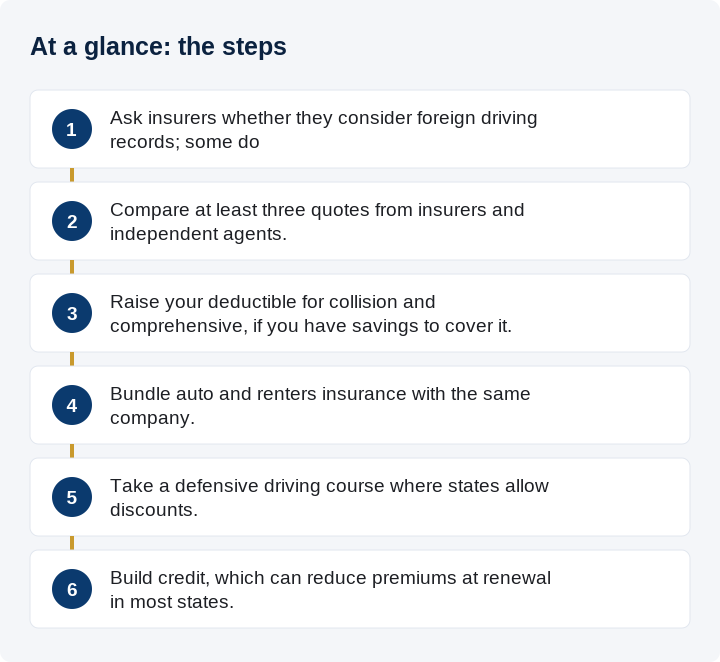
A hypothetical newcomer moves to Texas with fifteen years of accident-free driving in Mexico and buys a used sedan. Her first quotes are high because she has no US record. She gets a Texas license as soon as allowed, asks two insurers to consider an official driving record from her home country, raises her collision deductible to $1,000 and bundles renters insurance. Six months later, with a clean US record and a growing credit history, her renewal quote drops. Shopping again at each renewal keeps pressure on prices.
Do not admit fault at the scene or sign statements you do not understand. Request an interpreter from your insurer if needed.
Driving uninsured can lead to fines, license suspension, vehicle impoundment and personal liability for every dollar of damage you cause. For non-citizens, traffic offenses can also create records that appear in later immigration applications, and some offenses, such as driving under the influence, can have immigration consequences.
Once you have savings or a home to protect, consider an umbrella policy. It adds extra liability coverage, often starting at $1 million, on top of your auto and home or renters policies. Insurers usually require minimum underlying limits on those policies before selling an umbrella.
Many insurers accept an ITIN or a passport, though options may be fewer and prices higher.
No, but a letter from your previous insurer showing claim-free years can help with some companies.
Not by law, but many leases require it.
Disclaimer. This article is general education, not financial, investment, tax or insurance advice, and it does not recommend any specific product or provider. Prices, rates, limits and rules change; check official sources such as irs.gov, consumerfinance.gov and investor.gov, and consider a licensed professional for decisions about your own money.

How life and disability insurance work for immigrants: term vs permanent policies, how much coverage, visa and residency underwriting rules and beneficiaries abroad.

How to insure parents visiting the US on B-2 visas or ESTA: why Medicare and ACA plans do not cover them, visitor plan types, pre-existing conditions, costs and claims.

How US medical billing works, the No Surprises Act, good faith estimates for the uninsured, hospital financial assistance, negotiating bills and medical debt.