Getting a Driver's License and REAL ID as an Immigrant
In most of the US, a driver's license is both your car key and your main ID. Each state sets its own rules, and immigration status shapes what you can get.
Licenses are issued by states, each with its own tests, documents and rules for foreign licenses.
REAL ID-compliant cards have been required for domestic flights and federal buildings since 7 May 2025.
REAL ID requires lawful status; for temporary visa holders the card usually expires with the authorized stay.
Some states issue standard licenses regardless of immigration status; they are not valid for federal purposes.
For new arrivals, the driver's license solves two problems at once: legal driving and a widely accepted photo ID. But there is no national license. The process, the tests and the treatment of foreign licenses depend on the state where you live, and your immigration status determines which kind of card you can receive and how long it lasts. This guide explains the general rules and how to prepare.
Check your state's Department of Motor Vehicles (DMV), sometimes called the Department of Public Safety or Secretary of State, for the exact requirements.
A REAL ID star on your license is a federal security standard. It is not proof of citizenship and never means you can vote.
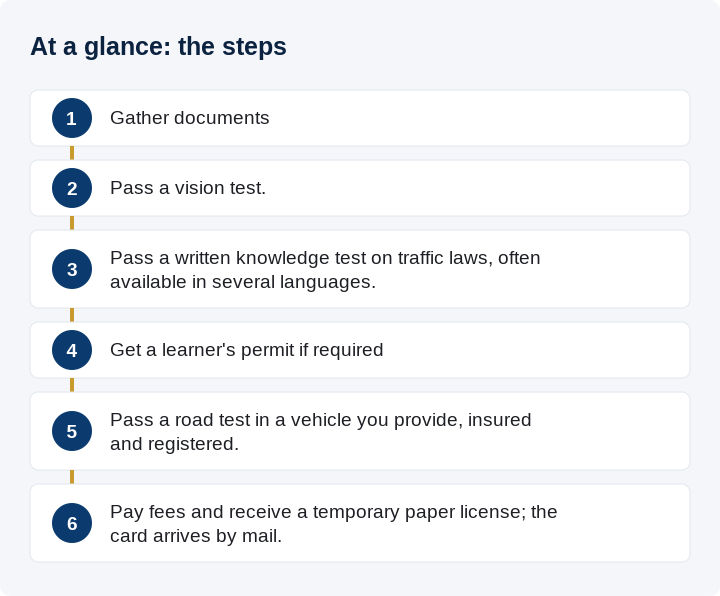
The main steps at a glance. Details in the sections below.
Driving with a foreign license
Visitors can usually drive on a valid foreign license, sometimes with an International Driving Permit as a translation. Once you become a resident of a state, most states require a local license within a limited period, often between 10 and 90 days. Each state defines residency differently: getting a job, signing a lease or enrolling children in school can trigger it.
Reciprocity and exchanges
Some states have agreements with specific countries (or Canadian provinces) that let holders exchange their license without road or written tests. Examples have included agreements with Germany, France, South Korea, Taiwan and others in certain states. Without an agreement, you take the full tests.
The usual steps
Gather documents: identity, legal presence, Social Security number (or proof of ineligibility), and two proofs of state residence.
Pass a vision test.
Pass a written knowledge test on traffic laws, often available in several languages.
Get a learner's permit if required, with supervised driving periods for young or new drivers.
Pass a road test in a vehicle you provide, insured and registered.
Pay fees and receive a temporary paper license; the card arrives by mail.
Documents by status
Status
Common legal presence documents
Typical license validity
Permanent resident
Green card
Standard validity, like citizens
Temporary visa holder
Passport, visa, I-94, and status documents (I-797, I-20, DS-2019)
Limited to the authorized stay
Asylum applicant or EAD holder
EAD card and related documents
Limited to the EAD validity
No lawful status
Varies; only in states issuing licenses regardless of status
Standard license, not REAL ID
DMVs verify status through the federal SAVE system, which can take extra days. Bring originals, not copies.
REAL ID
Since 7 May 2025, federal agencies, including the TSA at airports, require a REAL ID-compliant license, a passport or another accepted document. To get REAL ID you show identity, SSN, two proofs of address and lawful status. Permanent residents receive REAL IDs normally. Temporary visa holders receive REAL IDs limited to their authorized stay. People without lawful status cannot receive a REAL ID.
Licenses regardless of status
About a third of states and the District of Columbia issue driver's licenses to residents regardless of immigration status. These cards are marked as not valid for federal purposes. Rules and documents vary; some accept foreign passports and consular IDs. The goal of these laws is road safety and insurance coverage.
Insurance and registration
You must insure and register any car you own. Newcomers often pay high premiums at first; see car insurance for newcomers.
A worked example
A hypothetical H-1B worker moves from India to Illinois. She drives on her Indian license with an International Driving Permit for the first weeks. She brings her passport, visa, I-94, I-797 approval, Social Security card and two utility bills to the DMV, passes the vision and written tests, then the road test in a rented car. She receives a REAL ID valid until her I-94 expiry. When her H-1B is extended, she renews the license with the new approval notice.
Common mistakes
Driving on a foreign license long after becoming a resident
Bringing photocopies instead of original documents
Assuming a license from one state works after moving to another; you must switch
Letting the license expire with your I-94 and continuing to drive
Preparing for the tests
Download your state's driver handbook, often available in several languages, and take practice tests online.
Practice driving on local roads with a licensed driver, focusing on rules that differ from your country: right turns on red, four-way stops, school buses.
Bring a vehicle that is insured, registered and in good condition for the road test.
Glossary
DMV: the state agency that issues licenses.
SAVE: the federal system DMVs use to verify immigration status.
REAL ID: the federal standard for licenses used for federal purposes.
Finally, keep your license address current: most states require an update within a few weeks of moving, and the address on the license is often used as proof of residence elsewhere.
If you lose your license, request a replacement from the DMV quickly, and report a theft to the police in case of identity misuse.
Frequently asked questions
Does a driver's license prove I can work?
No. It proves identity, and for Form I-9 it must be combined with a document such as an unrestricted Social Security card.
Can a DMV share my information with immigration authorities?
Policies vary by state and have been the subject of debate and changes. Ask a local legal service if you are concerned.
Can I use my license to fly?
Only if it is REAL ID-compliant; otherwise use a passport or another accepted ID.
Do I need a license to buy a car?
Not always, but you need one to drive it legally and usually to insure and register it.
Disclaimer. This article is general information, not legal advice, and it is not affiliated with any government agency. US immigration rules, fees and processing times change often, and they changed repeatedly in 2025 and 2026. Confirm current requirements on uscis.gov and travel.state.gov, or speak with a licensed immigration attorney or a DOJ-accredited representative.
The labor rights immigrant workers have in the US regardless of status: minimum wage and overtime, safe workplaces, protection from discrimination and retaliation, and where to complain.
The most common scams aimed at immigrants: fake USCIS calls, notario fraud, visa lottery and job scams, investment and romance fraud, and how to report them safely.
Where immigrants can learn English in the US for free or at low cost: adult education ESL classes, libraries, community colleges, online tools and preparing for the citizenship test.
 Tradiciones