Employment-Based Green Cards: EB-1 to EB-5, EB-3 and EB-4
The employment green card system explained: the five EB categories, who needs a job offer and PERM, EB-3 for skilled workers and EB-4 special immigrants.
 Tradiciones del Mundo
Many immigrants arrive with degrees and years of experience but end up in jobs far below their skills. Understanding how US recognition works is the first step out of that trap.

Key points
In many countries a ministry formally recognizes foreign degrees. The US works differently: unregulated jobs depend on what employers accept, while regulated professions depend on state licensing boards. For immigrants, this means two separate tasks: proving what your education is worth, and meeting licensing rules where you want to work.
A degree evaluation tells employers what your education equals. A license tells the state you may practice. You often need both.
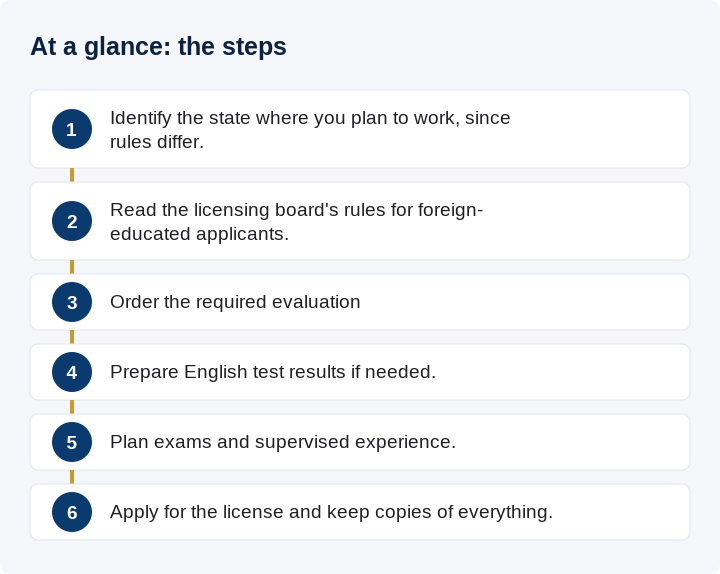
Private evaluation services compare your foreign education with US degrees. Two main types:
Members of the National Association of Credential Evaluation Services (NACES) and the Association of International Credential Evaluators (AICE) are widely accepted, but some boards require a specific evaluator. Check before paying.
| Profession | Typical path for foreign-trained professionals |
|---|---|
| Physicians | USMLE, ECFMG certification, US residency (some state alternatives exist); see physicians |
| Nurses | Credential review, NCLEX, state license; see nurses |
| Engineers | Degree evaluation, FE and PE exams, supervised experience |
| Lawyers | Some states allow foreign lawyers to sit the bar after an LLM; others require a US law degree |
| Teachers | State teaching certificate, sometimes with additional coursework and exams |
| Accountants | Education evaluation and the CPA exam; mutual recognition for some countries |
| Pharmacists | FPGEC certification, exams and internship hours |
Boards and evaluators often require transcripts sent directly by the issuing institution in a sealed envelope or electronically. Start early; some universities take months, and some countries require official apostilles or translations. Refugees who cannot obtain documents should ask about alternative evaluations, which some services offer.
Many professionals work in related roles while completing requirements: foreign doctors as research assistants or medical scribes, lawyers as paralegals or compliance analysts, engineers as technicians or drafters. These roles build US experience and references.
A hypothetical civil engineer from Colombia with ten years of experience moves to Florida with a green card. She orders a course-by-course evaluation from a NACES member, which finds her degree equivalent to a US bachelor's in civil engineering. She passes the Fundamentals of Engineering exam, works as an engineer under a licensed PE, and after documenting qualifying experience, sits the Principles and Practice of Engineering exam to become licensed in Florida.
Employers often do not know foreign universities or companies. Help them understand your background:
For some professions, relicensing takes years and significant cost. Compare the earnings and satisfaction of returning to your profession with related careers that do not require a license. Many internationally trained professionals do both: work in a related field first, then complete licensing step by step.
American Job Centers, funded by the Department of Labor, offer free career counseling and sometimes training funds. Some states have offices for new Americans that publish licensing guides for immigrants.
Keep a portfolio of your evaluations, licenses, certificates and reference letters, in English, ready to share with employers and boards. It saves weeks each time a new application asks for the same documents.
USCIS considers evaluations as advisory evidence and can disagree, especially for three-year degrees.
Generally not directly, but some states recognize parts of foreign training, and a few professions have international agreements.
Typically from about a hundred to a few hundred dollars depending on the type.
Disclaimer. This article is general information, not legal advice, and it is not affiliated with any government agency. US immigration rules, fees and processing times change often, and they changed repeatedly in 2025 and 2026. Confirm current requirements on uscis.gov and travel.state.gov, or speak with a licensed immigration attorney or a DOJ-accredited representative.

The employment green card system explained: the five EB categories, who needs a job offer and PERM, EB-3 for skilled workers and EB-4 special immigrants.

The three EB-1 categories explained: EB-1A extraordinary ability, EB-1B outstanding professors and researchers, and EB-1C multinational managers and executives.
Who qualifies for EB-2 with an advanced degree or exceptional ability, how foreign degrees are evaluated, and how the National Interest Waiver works under Dhanasar.