The US Economy Explained for Newcomers: Inflation, Rates and Jobs
How inflation, Federal Reserve interest rates and the job market work in the US, and how they affect immigrants' wages, rent, loans and plans.
 Tradiciones del Mundo
Your bank account and credit score are the foundations of financial life in the US. Neither transfers from your home country, so here is how to build both from zero.
Key points
In much of the world, a bank account is enough to rent a flat, sign a phone contract or buy a car on installments. In the United States, landlords, insurers, phone companies and lenders also check your credit report, a record of how you have borrowed and repaid. New arrivals usually have no report at all, which makes them "credit invisible". The good news: with the right steps, a usable score can appear within about six months.
The fastest way to a good credit score is boring: a small credit line, used lightly and paid in full every month.
You will meet three types of institutions:
A checking account is for daily spending: debit card, direct deposit of your salary, bill payments and transfers. A savings account pays interest and is where your emergency fund should live. Many people open both at the same institution to move money instantly.
| Document | Usually accepted |
|---|---|
| Primary ID | Passport, green card, US driver's license or state ID |
| Secondary ID | Another government ID, a foreign driver's license, a consular ID at some banks |
| Taxpayer number | Social Security number, or an ITIN for people not eligible for an SSN; some banks open accounts without one and collect it later |
| US address | Lease, utility bill, employer letter |
| Opening deposit | Often $25 to $100, sometimes nothing |
Requirements vary by institution because each bank sets its own "know your customer" rules under federal anti-money-laundering law. If one bank says no, another may say yes.
The Federal Deposit Insurance Corporation (FDIC) insures deposits at member banks, and the National Credit Union Administration (NCUA) does the same for federal credit unions. Coverage is $250,000 per depositor, per institution, per ownership category. A joint account with a spouse is a separate category from individual accounts, so couples can be insured for more. Investments such as stocks or mutual funds bought through a bank are not covered by deposit insurance.
Three private credit bureaus (Equifax, Experian and TransUnion) collect data about your borrowing. Scoring models such as FICO and VantageScore turn that data into a number, typically between 300 and 850. FICO publishes the general weight of each factor:
| Factor | Approximate weight (FICO) | What it means for you |
|---|---|---|
| Payment history | 35% | One payment 30 days late can hurt for years |
| Amounts owed | 30% | Keep card balances low relative to limits |
| Length of history | 15% | Keep your first account open |
| New credit | 10% | Avoid many applications at once |
| Credit mix | 10% | Cards plus an installment loan help, eventually |
Other options: being added as an authorized user on a trusted family member's card, and asking some lenders whether they accept foreign credit reports through specialized services that translate them.
Avoid "credit repair" offers that promise to erase accurate negative information or to create a new credit identity with an EIN. Using a number other than your SSN or ITIN to hide your history is illegal. Dispute real errors yourself, free, directly with the bureaus.
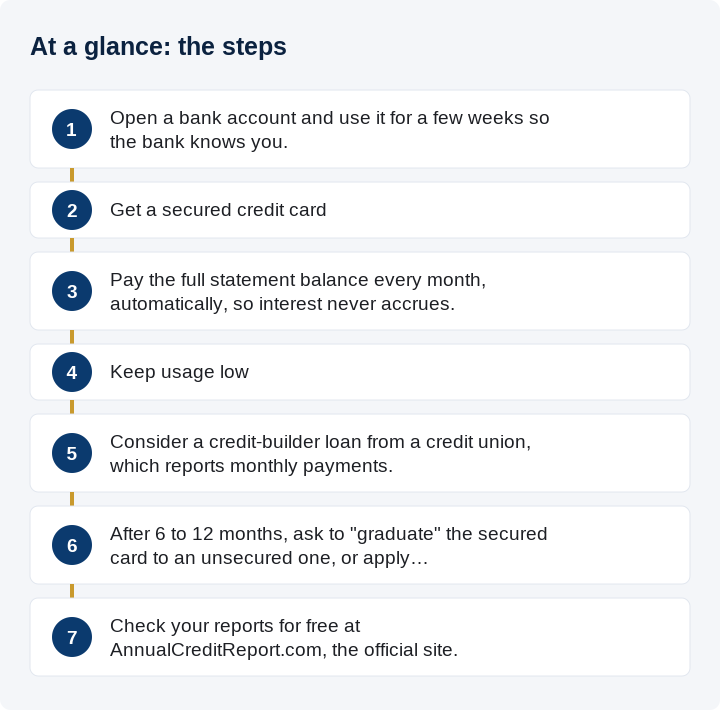
A hypothetical newcomer opens a checking account in his first week and a $500 secured card in his second month. He puts only his phone bill on the card and sets up autopay for the full balance. After six months he has a FICO score; after a year, his bank converts the card to an unsecured one with a higher limit and returns his deposit. When he applies for an apartment lease, he now has a credit history to show.
Often yes. Many banks accept a passport and proof of address and let you add the SSN later. Some require an ITIN or SSN for interest-bearing accounts because interest is reported to the IRS.
Generally not in the US credit bureaus. A few card issuers and lenders accept foreign credit data through translation services for certain countries.
A FICO score generally needs at least one account open for six months with activity reported in the last six months.
No. Debit cards draw on your own money and are not reported to credit bureaus.
Disclaimer. This article is general education, not financial, investment, tax or insurance advice, and it does not recommend any specific product or provider. Prices, rates, limits and rules change; check official sources such as irs.gov, consumerfinance.gov and investor.gov, and consider a licensed professional for decisions about your own money.
How inflation, Federal Reserve interest rates and the job market work in the US, and how they affect immigrants' wages, rent, loans and plans.
A practical first-year budget for immigrants: rent and deposits, utilities, transport, health care, taxes on your paycheck, emergency funds and a sample plan.
How US credit cards work for newcomers: APR, grace periods, fees, secured and starter cards, rewards, the CARD Act protections and habits that build a strong credit score.