Car and Renters Insurance for Newcomers Without US History
How immigrants buy auto and renters insurance with no US driving or credit history: state minimums, foreign licenses, what drives premiums and how to lower them.
 Tradiciones del Mundo
US health care is expensive and insurance is how most people pay for it. Which options you have depends on your job, your income and your immigration status.
Key points
A single emergency hospital stay in the United States can cost tens of thousands of dollars. Health insurance turns that open-ended risk into a predictable monthly premium plus limited out-of-pocket costs. For immigrants, the right option depends on three things: whether you have a job with benefits, your household income, and your immigration status. This guide explains each route and how to compare plans.
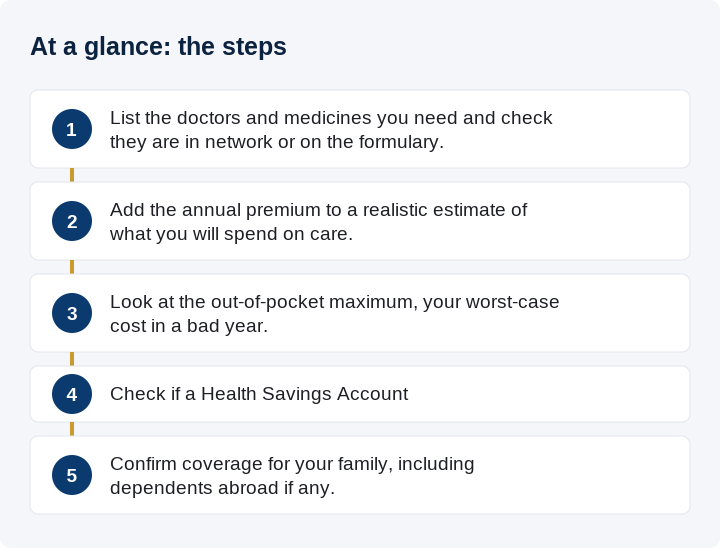
In the US, the cheapest plan is rarely the cheapest year. Compare the premium plus what you would pay if you actually get sick.
| Term | Meaning |
|---|---|
| Premium | What you pay every month to have the insurance |
| Deductible | What you pay each year before the insurer starts sharing costs (for many services) |
| Copay | A fixed amount per visit or prescription |
| Coinsurance | Your percentage of costs after the deductible, such as 20% |
| Out-of-pocket maximum | The most you pay in a year for covered in-network care |
| Network | Doctors and hospitals with contracts with the insurer; HMOs require you to stay in network, PPOs pay something outside it |
Large employers generally offer group health insurance and pay a large share of the premium. You usually have 30 days from your start date to enroll yourself, your spouse and children. Miss it and you may have to wait for the annual open enrollment, unless a "qualifying life event" such as marriage, a birth or loss of other coverage gives you a special enrollment period. Premiums are deducted from your pay, often before tax.
Visa holders such as H-1B, L-1 and O-1 workers enroll in employer plans exactly like citizens. J-1 exchange visitors must hold insurance meeting minimum standards set by the State Department for the whole program.
The Health Insurance Marketplace (HealthCare.gov or a state exchange) sells individual plans that must cover essential health benefits and cannot exclude pre-existing conditions. Plans are grouped as Bronze, Silver, Gold and Platinum according to how costs are split.
Citizens and lawfully present immigrants, a category that has included green card holders, many visa holders and other groups. Income-based premium tax credits lower the monthly cost for many households. The 2025 budget law narrowed which lawfully present immigrants qualify for those credits, with changes phasing in from 2026 and 2027; green card holders remain eligible. The enhanced subsidies in place from 2021 through 2025 were scheduled to end with 2025, so check current subsidy levels when you enroll.
Medicaid covers people with low incomes and is run by each state. Many permanent residents must wait five years after obtaining "qualified" status before enrolling, but refugees, asylees and some other groups are exempt, and many states cover lawfully residing children and pregnant women without the wait. Emergency Medicaid can pay for emergency treatment regardless of status. Medicaid use by family members does not count against an applicant under the current public charge rule; see public charge.
Parents visiting on tourist visas, and some new arrivals waiting for coverage to start, buy visitor or short-term travel medical insurance. These policies are useful for emergencies, but they usually exclude pre-existing conditions, have benefit caps and are not ACA plans. Read exclusions carefully, especially for older parents.
Under the federal EMTALA law, hospitals with emergency departments that take Medicare must screen and stabilize anyone with an emergency medical condition, regardless of insurance or immigration status. That does not make the care free; the bill follows.
A hypothetical family of three arrives with green cards in March. The parents' new employer offers coverage starting on the first of the following month. They enroll within 30 days, choosing a PPO because their child needs a specialist outside the HMO network. Until coverage starts, they buy a short-term travel medical policy for emergencies. Because gaining lawful presence in the US is a qualifying event, they could instead have used the Marketplace special enrollment period if the employer had not offered insurance.
Under the public charge rule in force since 2022, private insurance, Marketplace plans and most Medicaid do not count against you. A new rule proposed in 2025 could change this; check before applying.
International plans exist, but most do not meet ACA standards, and many US providers will not bill them directly.
Community health centers charge on a sliding scale based on income, regardless of insurance or immigration status.
Disclaimer. This article is general education, not financial, investment, tax or insurance advice, and it does not recommend any specific product or provider. Prices, rates, limits and rules change; check official sources such as irs.gov, consumerfinance.gov and investor.gov, and consider a licensed professional for decisions about your own money.

How immigrants buy auto and renters insurance with no US driving or credit history: state minimums, foreign licenses, what drives premiums and how to lower them.

How life and disability insurance work for immigrants: term vs permanent policies, how much coverage, visa and residency underwriting rules and beneficiaries abroad.
How to insure parents visiting the US on B-2 visas or ESTA: why Medicare and ACA plans do not cover them, visitor plan types, pre-existing conditions, costs and claims.