Moving to the US: A Complete Relocation Checklist for Immigrants
A step-by-step relocation checklist for immigrants moving to the US: documents, money, housing, health insurance, phone, banking, schools, driving and the first 90 days.
 Tradiciones del Mundo
A green card is permanent but not unconditional. Most people who lose it do so through a few predictable mistakes.

Key points
This guide brings together the four situations that most often put permanent residence at risk. Understanding them is also the best preparation for citizenship, which removes most of these risks for good.
Voting illegally is one of the fastest ways to lose a green card permanently. Many cases start with an innocent mistake at the DMV.
Yes. A green card is permanent but not unconditional. Knowing the main risks helps you avoid them, especially in the criminal justice system.
Before pleading guilty to any offense, including a misdemeanor, ask your criminal defense lawyer about the immigration consequences. The Supreme Court held in Padilla v. Kentucky (2010) that defense lawyers must advise non-citizen clients about deportation risks. Becoming a citizen removes the risk.
A permanent resident usually enters removal proceedings after a criminal conviction comes to the attention of immigration authorities, after a long trip abroad, or after applying for naturalization or another benefit. ICE or USCIS issues a Notice to Appear, and the case is heard by an immigration judge. Residents have the right to a lawyer at their own expense and to present defenses.
Some residents move abroad for good and want to close their status cleanly. Others are pressured to sign at the airport. The form is the same; the situations are not.
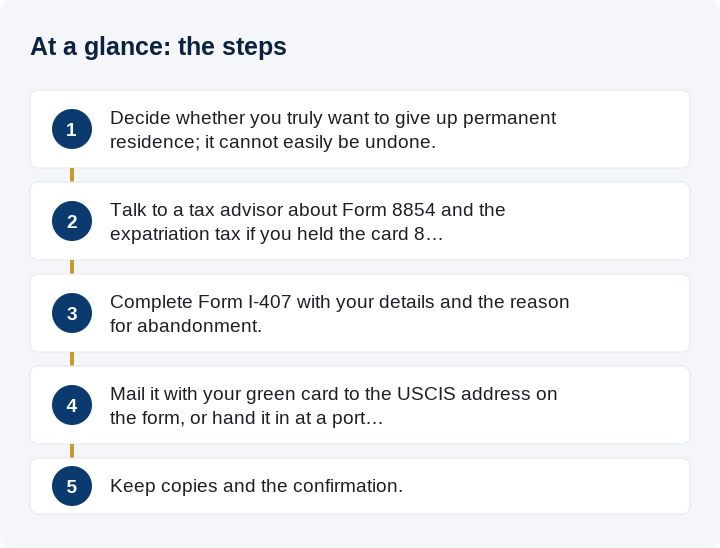
If you have moved abroad permanently, filing Form I-407 formally records that you gave up your status. It can make future visitor visas easier, because it shows you are no longer trying to keep US residence.
Mail Form I-407 to USCIS with your green card, or give it to a CBP officer at a port of entry. There is no fee. Keep a copy of the form and the confirmation.
Abandoning residence does not end your tax obligations automatically. Long-term residents (green card in 8 of the last 15 years) must file Form 8854 and may face the expatriation tax. See taxes for green card holders.
CBP officers sometimes ask returning residents to sign an I-407 after long absences. You do not have to sign. If you believe you have not abandoned your residence, you can ask to have an immigration judge decide. Only a judge can take away permanent residence involuntarily, unless you sign.
A hypothetical retiree returns permanently to Portugal after 12 years in the US. She files an I-407 by mail with her green card, files a final US tax return and Form 8854 as a long-term resident, and checks whether the expatriation tax applies to her assets. Years later, she applies for a tourist visa to visit her grandchildren; the I-407 confirmation helps show she has no intention of immigrating.
Voting illegally is one of the fastest ways to lose a green card permanently. Many cases start with an innocent mistake.
Non-citizens, including permanent residents, cannot vote in federal elections. Doing so is a federal crime and a ground of deportation and inadmissibility. Falsely claiming to be a citizen to register is a separate, permanent bar with almost no waiver.
A few municipalities, for example some towns in Maryland and Vermont, allow non-citizens to vote in local elections. Even there, residents must register only for those local elections, separately from state and federal rolls. Several states have amended their constitutions to forbid non-citizen voting entirely.
Do not vote. Cancel the registration in writing with your county election office and keep copies. Speak with an immigration lawyer before applying for citizenship, because the N-400 asks whether you ever registered or voted.
Be careful with any form that has a citizenship checkbox: voter registration, jury questionnaires, some job applications and loan forms. Checking "US citizen" when you are not can be treated as a false claim to citizenship, which has severe and often permanent immigration consequences. If unsure, write "permanent resident" or ask before signing.
Permanent residents may receive jury summonses because jury lists are drawn from DMV and voter records. You must respond, but you should state that you are not a citizen and therefore not eligible. Do not serve on a jury.
Registration is a legal duty for young men who are permanent residents, and missing it can delay citizenship years later.
Almost all men living in the US aged 18 through 25 must register, including permanent residents, refugees, asylees and undocumented immigrants. Men on valid nonimmigrant visas (students, H-1B) do not. Registration does not mean you will be drafted; there has been no draft since 1973.
Online at sss.gov, at a post office, or automatically through some driver's license applications. Many green card holders between 18 and 25 are registered automatically when they immigrate, but check rather than assume.
Knowingly and willfully failing to register can show a lack of good moral character. For naturalization:
A hypothetical man became a permanent resident at 20 and was unaware of the registration requirement. At 27 he applies for citizenship. Because he is within the five-year statutory period (from 26 to 31), USCIS asks why he did not register. He provides a sworn statement and a Status Information Letter showing he was not required to register before immigrating and did not know of the requirement. USCIS evaluates whether the failure was knowing and willful.
A simple DUI usually is not a deportable offense, but DUI with aggravating factors or multiple DUIs can create problems.
Often yes. Immigration law generally does not recognize state expungements.
Travel can expose you to inspection as an applicant for admission. Talk to a lawyer first.
Yes, citizenship eliminates deportation risk, but applying with a criminal record can trigger proceedings.
Yes, through a new petition, if eligible.
Benefits earned may still be payable abroad, depending on your country.
No. You can file whenever you decide.
Generally no, once it is processed.
Permanent residents can make contributions to US campaigns under federal law; foreign nationals without residence cannot.
Yes.
Yes, peacefully. Be careful about any arrest, which may have immigration consequences.
Do not apply for citizenship or travel before consulting an immigration lawyer.
No, under current law.
No. Nonimmigrants in valid status are exempt during that time.
No. Registration is only possible until the 26th birthday.
No. It only fulfills a legal duty.
Disclaimer. This article is general information, not legal advice, and it is not affiliated with any government agency. US immigration rules, fees and processing times change often, and they changed repeatedly in 2025 and 2026. Confirm current requirements on uscis.gov and travel.state.gov, or speak with a licensed immigration attorney or a DOJ-accredited representative.

A step-by-step relocation checklist for immigrants moving to the US: documents, money, housing, health insurance, phone, banking, schools, driving and the first 90 days.

How immigrants find jobs in the US: proving work authorization with Form I-9, writing a US-style resume, networking, interviews, salary negotiation and avoiding employment scams.

How newcomers rent an apartment in the US: what landlords check, options without credit, leases, deposits and fees, tenant rights, fair housing and rental scams.