Forex Trading in the US: How It Works, Rules and Real Risks
An honest guide to retail forex trading in the US: how currency pairs and leverage work, CFTC and NFA rules, taxes, visa considerations and how to spot forex scams.
 Tradiciones del Mundo
Bringing savings from your home country is a one-time decision with lasting consequences. The rate you get, the timing and the paperwork all matter.
Key points
Immigrants often hold savings, property or pensions in another currency. Moving that money to the United States, or deciding not to, exposes you to currency risk and to US reporting rules that are easy to miss. This guide explains how exchange rates are set, practical ways to transfer larger sums and the reports US law requires.
Moving your own savings into the US is not income. But not reporting accounts you are required to report can cost far more than any exchange rate.
Most major currencies, including the US dollar, euro, pound, yen and peso, float: their prices are set by supply and demand in the global foreign exchange market, the largest financial market in the world. Interest rate differences, inflation, trade and investor sentiment all move rates. Some countries peg or manage their currencies, or restrict how much money can leave.
A quote such as EUR/USD 1.10 means one euro costs 1.10 dollars. Providers quote a bid (what they pay you) and an ask (what they charge you); the gap is the spread. Retail customers rarely get the mid-market rate, but the narrower the gap, the better.
Expect your US bank to ask about the source of funds for large incoming transfers. Keep sale contracts, bank statements and tax documents ready, the same kind of evidence used in EB-5 source-of-funds cases.
| Situation | Report | Threshold |
|---|---|---|
| Carrying cash or bearer instruments in or out of the US | FinCEN Form 105 (filed with CBP) | More than $10,000 |
| Foreign bank and financial accounts (US persons) | FBAR, FinCEN Form 114 | Combined value over $10,000 at any time in the year |
| Specified foreign financial assets | Form 8938 with your tax return | Higher thresholds that vary with filing status and residence |
| Gifts or inheritances from foreign individuals | Form 3520 | More than $100,000 in a year |
Declaring cash is not a tax; the problem is failing to declare, which can lead to seizure. "Structuring" amounts to stay below thresholds is itself illegal.
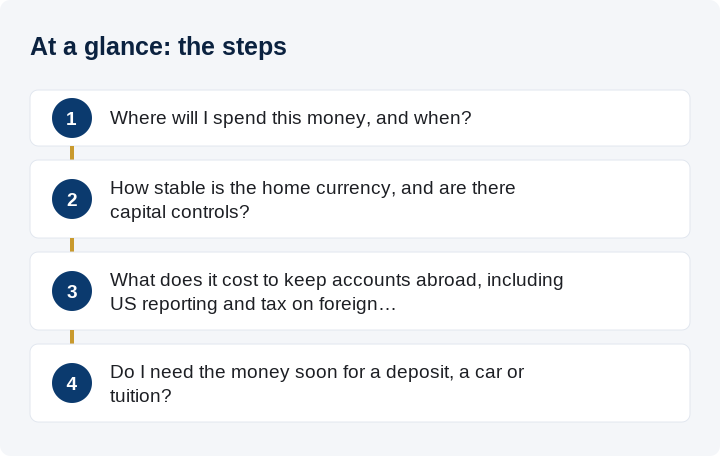
If you will spend your future in dollars but keep savings in another currency, a fall in that currency reduces your wealth in dollar terms. Conversely, keeping some savings at home may make sense if you plan to retire there. Questions to ask:
A hypothetical family sells an apartment in their home country for the equivalent of $300,000 and wants to move the money to the US to buy a house. Their home bank offers a rate 2% worse than mid-market: $6,000 in hidden cost. A specialist provider offers 0.5%: $1,500. They also split the transfer into three tranches over two months to reduce timing risk, and keep the sale contract, tax receipts and bank statements because their US bank asks for source-of-funds documentation. Since they are now US tax residents, they report the foreign account that held the proceeds on their FBAR for that year.
Each of these can be avoided with an hour of preparation before the transfer.
Some countries limit how much currency residents can buy or send abroad each year. Follow those rules: informal exchange channels may be illegal at home, can expose you to fraud, and make it harder to document the lawful source of funds in the US.
It depends on your plans and your home country's stability. Many people move what they need in the US and keep the rest, while reporting it correctly.
FBAR applies to US persons, which includes green card holders and others who meet the tax residence tests, for the years they are US persons.
Banks can delay or decline transfers they cannot verify under anti-money-laundering rules.
Disclaimer. This article is general education, not financial, investment, tax or insurance advice, and it does not recommend any specific product or provider. Prices, rates, limits and rules change; check official sources such as irs.gov, consumerfinance.gov and investor.gov, and consider a licensed professional for decisions about your own money.
An honest guide to retail forex trading in the US: how currency pairs and leverage work, CFTC and NFA rules, taxes, visa considerations and how to spot forex scams.
How multi-currency accounts and cards work, when they save money for immigrants with income or family abroad, deposit protection, fees, and dynamic currency conversion traps.
Why the US dollar rises and falls, how it is measured, and what a strong or weak dollar means for remittances, savings abroad, travel, imports and home-country assets.