Scams Targeting Immigrants: Immigration, Money and Job Fraud
Scammers know that immigrants worry about their status, send money abroad and may not know how US agencies work. Recognizing the patterns is the best protection.
USCIS and ICE never demand payment by phone, gift card, wire transfer or cryptocurrency.
Official immigration websites end in .gov.
Too-good-to-be-true offers of green cards, jobs or investment returns are scams.
You can report fraud regardless of immigration status.
Fraud costs immigrant families billions of dollars a year and sometimes their immigration cases. Some scams use fear (threats of deportation), others use hope (guaranteed green cards, high returns, dream jobs). This guide describes the most common schemes and what to do if you are targeted.
Government agencies contact you by mail and through official accounts, not by threatening phone calls demanding immediate payment.
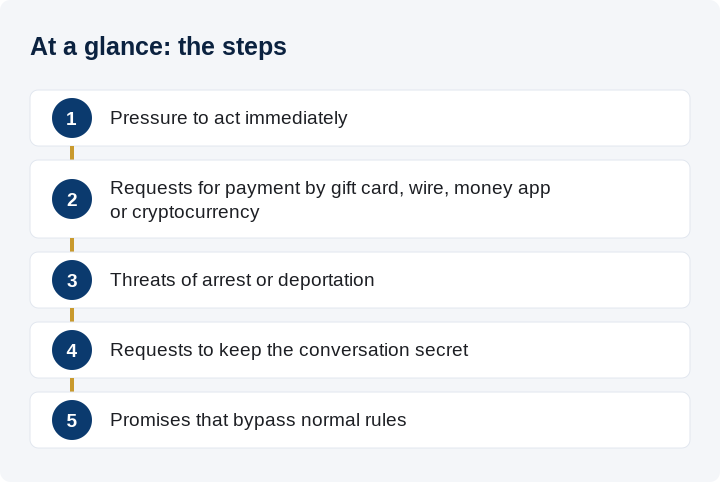
The main steps at a glance. Details in the sections below.
Immigration scams
Fake officials: callers or messages claiming to be USCIS, ICE or the State Department, saying there is a problem with your file and demanding a fee to avoid deportation. Phone numbers can be spoofed to look official.
Notario fraud: people without a license who sell immigration "services", file wrong forms or invent programs. See finding legitimate help.
Fake websites: sites that look official and charge for free forms or for "entering" the DV lottery.
Guaranteed visas or green cards in exchange for payment, marriage arrangements or fake job offers.
Money scams
Investment fraud promoted in community groups, often involving crypto or forex with "guaranteed" returns. See forex risks.
Romance scams where an online partner asks for money or introduces a trading platform ("pig butchering").
Fake checks: someone overpays you by check and asks you to send back the difference; the check bounces later.
Remittance fraud: fake transfer services or requests to send money to "release" prizes.
Tax scams: callers impersonating the IRS demanding immediate payment.
Job and housing scams
Jobs requiring upfront fees for training, uniforms or visas
Recruiters abroad promising US jobs for large fees
Rental listings for properties that do not exist
Warning signs
Pressure to act immediately
Requests for payment by gift card, wire, money app or cryptocurrency
Threats of arrest or deportation
Requests to keep the conversation secret
Promises that bypass normal rules
What to do
Stop contact and do not pay.
Verify independently using official phone numbers and your USCIS account.
Keep evidence: messages, numbers, receipts.
Contact your bank immediately if you paid.
Report to the FTC (ReportFraud.ftc.gov), USCIS's scam reporting, the FBI's IC3 for online fraud, and your state attorney general.
A worked example
A hypothetical woman with a pending green card receives a call from a number that appears to be USCIS. The caller says her fingerprints showed a problem and she must pay $900 in gift cards today to avoid arrest. She hangs up, logs into her USCIS account, sees nothing unusual, and reports the call to the FTC and USCIS. Her case continues normally.
How phone and message scams work
Scammers often use caller ID spoofing so that the number on your phone looks like a government office. They may already know your name, address or even your receipt number from data leaks or public information, which makes them convincing. They create urgency ("an officer is coming to your house today"), isolate you ("do not tell anyone, this is confidential") and insist on payment methods that cannot be reversed. If you receive such a call, hang up and call the agency using the number on its official website.
Protecting your personal information
Do not post photos of your green card, passport, receipt notices or work permit on social media.
Shred documents with your A-number, SSN or financial details.
Use strong passwords and two-step verification for your USCIS, bank and email accounts.
Freeze your credit with the three bureaus if you suspect your data was exposed; it is free.
Get an IRS Identity Protection PIN to prevent tax return fraud.
Community-based fraud
Some of the most damaging scams come from people within the same community: a trusted acquaintance who offers an investment, a "consultant" recommended at church, or a relative who pressures others to join a scheme. Affinity fraud works because trust replaces verification. Apply the same checks to friends and community leaders: is the person licensed, is the business registered, can you verify the claims independently?
If you already paid
Call your bank or card issuer immediately and ask to stop or reverse the payment.
For gift cards, contact the card company with the card numbers and receipt.
For money transfers, contact the provider and ask to cancel if not yet collected.
File reports with the FTC, IC3 and local police; keep the report numbers.
Watch for follow-up "recovery" scams that promise to get your money back for a fee.
Glossary
Spoofing: faking a caller ID or email address to appear legitimate.
Phishing: messages designed to steal passwords or personal data.
Affinity fraud: scams that target members of a community or group.
Pig butchering: long-term online relationships used to lure victims into fake investments.
Teach your family
Older parents and newly arrived relatives are frequent targets. Share the warning signs, agree that nobody pays anyone claiming to be the government without checking first, and keep a list of official phone numbers on the fridge.
More questions
Does USCIS ever call me?
USCIS may contact applicants, but it never asks for fees by phone or threatens immediate arrest. Payments go through official forms and accounts.
When in doubt, pause. A real government process will still be there tomorrow; a scam depends on you acting today.
Share what happened with your community, too: talking openly about a scam attempt is one of the most effective ways to stop the same criminals from reaching your neighbors.
Frequently asked questions
Will reporting a scam affect my immigration case?
No. Reporting fraud as a victim does not harm a case, and victims of certain crimes may even qualify for protections.
Can I get my money back?
Sometimes, if you act quickly with your bank or payment provider. Gift card and crypto payments are rarely recoverable.
Are immigration consultants legal?
They may help fill forms in some states under strict rules, but cannot give legal advice.
Disclaimer. This article is general information, not legal advice, and it is not affiliated with any government agency. US immigration rules, fees and processing times change often, and they changed repeatedly in 2025 and 2026. Confirm current requirements on uscis.gov and travel.state.gov, or speak with a licensed immigration attorney or a DOJ-accredited representative.
Where immigrants can learn English in the US for free or at low cost: adult education ESL classes, libraries, community colleges, online tools and preparing for the citizenship test.
How immigrant families enroll children in US public schools: the right to free public education regardless of status, documents, English learner programs, records and school culture.
 Tradiciones