Identity Theft: How Immigrants Can Protect and Recover Their Identity
Your Social Security number, A-number and passport details are valuable to criminals. Protecting them takes a few steps; recovering from theft takes many more.
Credit freezes are free at all three bureaus and stop new accounts in your name.
An IRS Identity Protection PIN prevents fraudulent tax returns using your SSN or ITIN.
Never share photos of immigration documents on social media or with unverified contacts.
IdentityTheft.gov creates a personalized recovery plan.
Identity theft happens when someone uses your personal information to open accounts, file taxes, obtain medical care or work. Immigrants face extra exposure: documents are shared with many offices, employers and preparers, and scammers impersonate immigration agencies to collect data. This guide explains how to reduce risk and what to do if it happens.
A credit freeze is free, takes minutes and blocks most new-account fraud. Lift it only when you apply for credit.
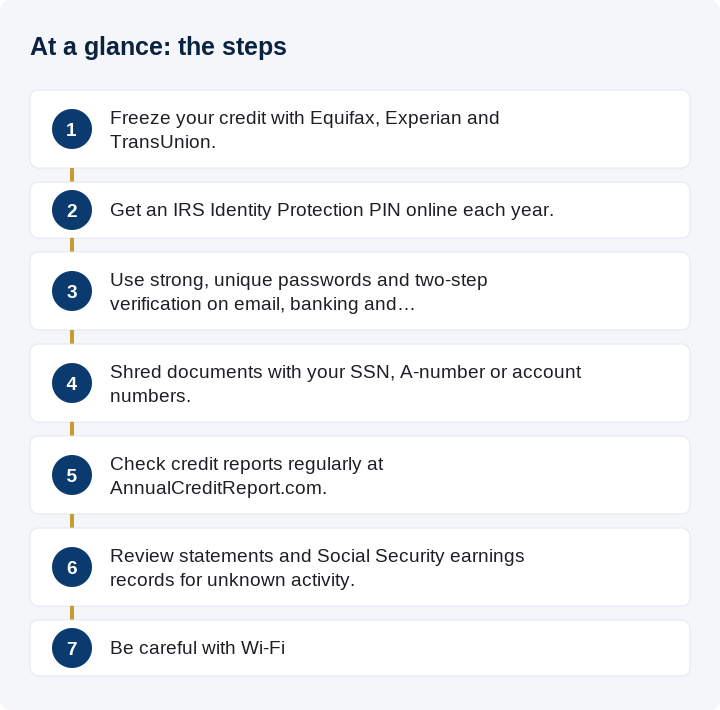
The main steps at a glance. Details in the sections below.
Common types of identity theft
New account fraud: credit cards or loans opened in your name.
Tax identity theft: a fraudulent return filed with your SSN or ITIN to claim a refund.
Employment identity theft: someone works using your SSN, which can cause tax notices about income you did not earn.
Medical identity theft: care received under your insurance.
Account takeover: criminals take control of your bank, email or USCIS account.
Prevention checklist
Freeze your credit with Equifax, Experian and TransUnion.
Get an IRS Identity Protection PIN online each year.
Use strong, unique passwords and two-step verification on email, banking and government accounts.
Shred documents with your SSN, A-number or account numbers.
Check credit reports regularly at AnnualCreditReport.com.
Review statements and Social Security earnings records for unknown activity.
Be careful with Wi-Fi: avoid accessing financial accounts on public networks.
Protecting immigration documents
Do not post photos of green cards, passports, EADs or receipt notices.
Give copies only to employers, lenders and agencies that legitimately need them.
Keep originals in a safe place and carry the green card only when needed or required.
Report lost or stolen documents immediately.
Fraud alerts vs freezes
Fraud alert
Credit freeze
Effect
Lenders must take steps to verify your identity
Blocks access to your report for new credit
Duration
1 year (7 years for victims with a report)
Until you lift it
Cost
Free
Free
Where
Contact one bureau, it notifies the others
Contact each bureau
If it happens
Report at IdentityTheft.gov for an FTC report and recovery plan.
Freeze your credit and place a fraud alert.
Contact the companies where fraud occurred and close fraudulent accounts.
Dispute errors on your credit reports.
For tax fraud, file Form 14039 with the IRS and respond to IRS letters.
Report to police if required by creditors.
Keep a log of every call, letter and case number.
A worked example
A hypothetical permanent resident receives an IRS letter saying she earned income from an employer she never worked for. Someone used her SSN to work. She reports at IdentityTheft.gov, contacts the IRS using the number on the letter, files Form 14039 and requests an Identity Protection PIN. She also checks her Social Security earnings record and asks the SSA to correct it. The process takes months, but her records are fixed.
Why immigrants are targeted
Several factors make immigrants attractive targets. Their documents pass through many hands: employers, landlords, schools, preparers, lawyers and translators. Many are unfamiliar with how US agencies communicate, so impersonation scams work better. Some send documents abroad to family or agents. And new arrivals often have "thin" credit files that nobody monitors, so fraudulent accounts can go unnoticed for months. Freezing credit from the first weeks in the US, before you even need loans, closes that window.
How to freeze your credit step by step
Visit the websites of Equifax, Experian and TransUnion, or call them.
Verify your identity with your SSN or ITIN and personal details.
Create an account or PIN to manage the freeze.
Repeat with each bureau; a freeze at one does not apply to the others.
When you need credit, lift the freeze temporarily for the days of the application.
Freezes and thaws are free by federal law, and online requests take effect quickly.
Protecting your online accounts
Use a password manager to create long, unique passwords.
Turn on two-step verification with an authenticator app where possible.
Protect your email account first: it is the key to resetting everything else.
Add a port-out PIN with your phone carrier to prevent SIM-swap fraud.
Never give verification codes to anyone who calls or messages you.
Signs your identity may be stolen
Bills or collection calls for accounts you did not open
IRS letters about returns you did not file or income you did not earn
Denied credit unexpectedly
Unknown inquiries or accounts on your credit report
Medical bills for care you did not receive
Glossary
Credit freeze: a block on access to your credit report for new credit.
Fraud alert: a notice requiring lenders to verify your identity.
IP PIN: the IRS Identity Protection PIN.
SIM swap: transferring your phone number to a criminal's SIM card.
Finally, teach older relatives and teenagers in your household the same habits: they are often targeted precisely because nobody monitors their records.
Medical identity theft
Review the "explanation of benefits" statements from your health insurer and report any care you did not receive. Errors in medical records can affect future treatment, so ask providers to correct them.
Keep copies of every report, letter and case number in one folder. Recovery can take months, and creditors, the IRS and the SSA may each ask you to prove what happened and when you reported it.
Frequently asked questions
Can I get a new Social Security number?
Only in limited cases of continued harm after you have tried to fix the problem; a new number does not erase your old history.
Does a freeze affect my credit score?
No. It only restricts access for new credit.
Can identity theft affect my immigration case?
Fraudulent records can create confusion, such as arrests or employment under your name. Keep documentation and tell your lawyer.
Disclaimer. This article is general education, not financial, investment, tax or insurance advice, and it does not recommend any specific product or provider. Prices, rates, limits and rules change; check official sources such as irs.gov, consumerfinance.gov and investor.gov, and consider a licensed professional for decisions about your own money.
How immigrants qualify for Social Security retirement: work credits, full retirement age, totalization agreements, receiving benefits abroad and the rules for non-citizens.
How newcomers open a US bank account with a passport, SSN or ITIN, how deposit insurance works, and how to build a credit score from zero in the first year.
 Tradiciones