Multi-Currency Accounts and Cards for Immigrants
How multi-currency accounts and cards work, when they save money for immigrants with income or family abroad, deposit protection, fees, and dynamic currency conversion traps.
 Tradiciones del Mundo
Forex trading is advertised everywhere, often to immigrants, as easy money. It is a legal, regulated activity in the US, and one where most retail traders lose money.
Key points
The foreign exchange market trades trillions of dollars a day, mostly between banks and institutions. Retail traders access it through brokers that let them speculate on currency movements with borrowed money. This guide explains the mechanics, the US rules designed to protect retail traders, and why regulators repeatedly warn about losses and fraud. It is education, not a recommendation to trade.
Leverage multiplies gains and losses alike. At 50:1, a 2% move against you wipes out your entire deposit.
Currencies trade in pairs, such as EUR/USD. Buying the pair means betting the euro will rise against the dollar. Prices are quoted to four or five decimals; the smallest standard move is a pip. Brokers earn through the spread (difference between buy and sell prices), commissions and financing charges for positions held overnight.
With leverage, a small deposit (margin) controls a large position. Example: with $1,000 and 50:1 leverage you can control a $50,000 position. A 1% move in your favor earns $500, half your deposit; a 1% move against you loses $500. Brokers issue margin calls and automatically close positions when losses consume your margin.
US retail forex brokers must register with the Commodity Futures Trading Commission (CFTC) as a futures commission merchant or retail foreign exchange dealer and be members of the National Futures Association (NFA). Key rules:
Check any firm or individual on the NFA's BASIC database before sending money. A broker that accepts US clients without NFA membership is operating outside US rules.
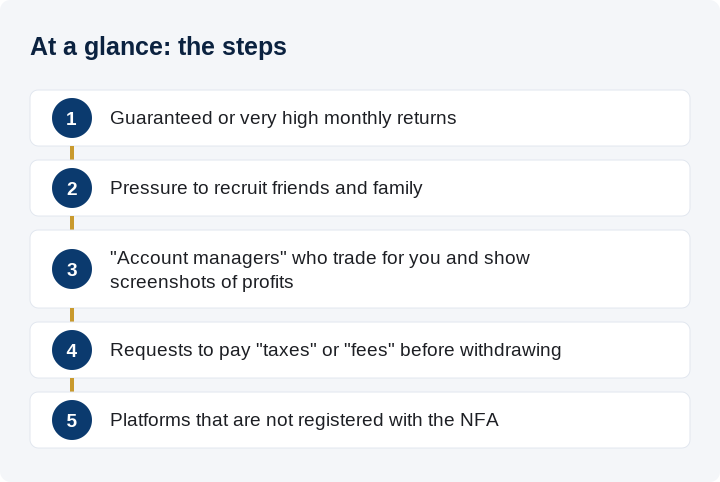
Regulators report frequent forex and crypto fraud aimed at immigrant communities, often promoted through social media, messaging groups or people from the same community. Warning signs:
"Pig butchering" schemes combine online friendship or romance with fake trading platforms. If you suspect fraud, report it to the CFTC and the FBI's Internet Crime Complaint Center.
Gains from retail spot forex are generally treated as ordinary income or loss under Section 988 of the Internal Revenue Code, unless an election is made to treat certain contracts under Section 1256 (60% long-term, 40% short-term). Currency futures traded on exchanges are Section 1256 contracts. Keep complete records and consult a tax professional.
Managing your own investments is generally considered passive and permitted for most visa holders. Trading as a business, managing other people's money or being paid for trading signals can amount to unauthorized employment. If your status restricts work, get immigration advice before trading actively.
A hypothetical trader deposits $2,000 and buys one standard lot of EUR/USD (100,000 euros, about $110,000 at 1.10) using 50:1 leverage, which requires about $2,200 margin. The broker would not even allow this position with only $2,000. With a smaller mini lot (10,000 euros, roughly $11,000), the margin required is about $220. If the euro falls 100 pips (from 1.1000 to 1.0900), the loss is $100. Ten such losing trades, plus spreads and overnight charges, consume half the account. This arithmetic explains why risk per trade matters far more than prediction.
People who want currency exposure without leverage can hold foreign currency deposits or international stock and bond funds, which provide diversification without daily margin calls. They still carry currency and market risk.
Yes, with registered firms and under CFTC and NFA rules.
Firms that solicit US customers without registration are acting unlawfully under US rules, and you lose US protections.
Brokers allow small accounts, but never trade money you need for living expenses, debts or your emergency fund.
Disclaimer. This article is general education, not financial, investment, tax or insurance advice, and it does not recommend any specific product or provider. Prices, rates, limits and rules change; check official sources such as irs.gov, consumerfinance.gov and investor.gov, and consider a licensed professional for decisions about your own money.
How multi-currency accounts and cards work, when they save money for immigrants with income or family abroad, deposit protection, fees, and dynamic currency conversion traps.
Why the US dollar rises and falls, how it is measured, and what a strong or weak dollar means for remittances, savings abroad, travel, imports and home-country assets.
How to pay and get cash when traveling: cards without foreign fees, ATMs, airport exchange counters, cash limits, dynamic currency conversion and protecting your money abroad.