Investing in the US as an Immigrant: Brokerage Accounts and Basics
How immigrants and visa holders can start investing in the US: opening a brokerage account, index funds and ETFs, fees, investor protection and capital gains tax.
 Tradiciones del Mundo
Crypto is marketed heavily to immigrant communities as a way to save, invest and send money home. It can do some of those things, with risks that are often understated.
Key points
Bitcoin, Ethereum, stablecoins and thousands of other tokens are available through apps, exchanges and even some brokerages. Some immigrants use stablecoins to send money abroad or to hold dollars in countries with unstable currencies. Others are drawn by stories of quick profits. This guide explains the risks, the rules and the taxes, without recommending any purchase.
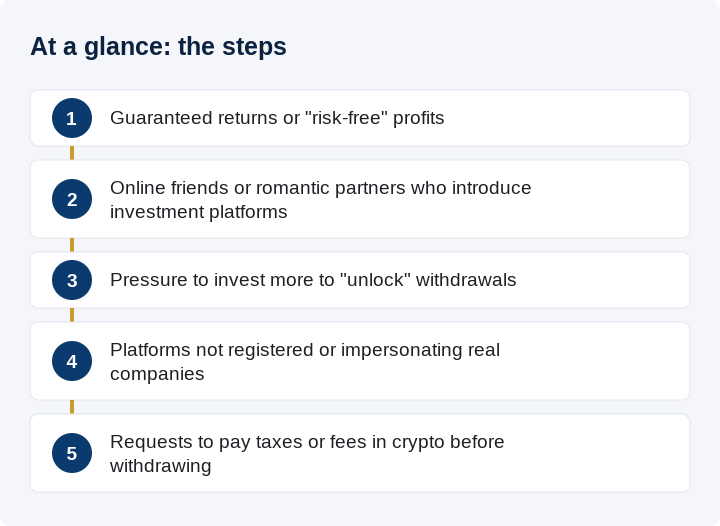
If someone you met online guides you to a crypto platform that shows huge profits but asks for fees to withdraw, it is a scam.
Cryptocurrencies are digital assets recorded on blockchains, shared ledgers maintained by networks of computers. Some, like bitcoin, have a fixed supply; others serve as platforms for applications. Stablecoins aim to keep a stable value, usually one dollar, backed by reserves. In July 2025, the GENIUS Act created a federal framework for payment stablecoins, including reserve and disclosure requirements, with implementing rules phased in over time.
Sending stablecoins can be fast and cheap on the network, but the full cost includes buying crypto, network fees, and converting to local currency at the other end, often through local exchanges with their own spreads. Recipients need wallets and access to cash-out services, and some countries restrict crypto. Compare the total amount received with regular remittance services. Federal remittance protections may not apply to crypto transfers.
| Activity | Tax treatment (general) |
|---|---|
| Buying with dollars and holding | No tax until you dispose of it |
| Selling for dollars | Capital gain or loss |
| Swapping one token for another | Taxable disposal |
| Paying for goods or services | Taxable disposal |
| Receiving crypto as pay or rewards | Ordinary income at fair market value |
| Staking and mining rewards | Generally income when received |
Form 1040 asks every taxpayer whether they received or disposed of digital assets. Brokers report gross proceeds on Form 1099-DA for sales from 2025, with cost basis reporting for many assets from 2026. Keep your own records of purchase dates and prices, especially for transfers between wallets.
Report fraud to the FBI's IC3, the FTC and the SEC or CFTC.
A hypothetical worker buys $1,000 of a cryptocurrency, swaps half of it for another token after it rises to $1,600, and later sells the rest. The swap is a taxable sale: she has a gain on the half she exchanged. Her exchange sends a Form 1099-DA, and she reports each disposal on Form 8949. Because she kept records, preparing the return takes minutes rather than days.
On most exchanges and apps, the platform holds the crypto for you ("custodial"). This is convenient, but if the platform fails, is hacked or freezes withdrawals, you may lose access, as customers of several large platforms discovered in 2022. With a self-custody wallet, you control the private keys, but no one can recover your funds if you lose them or are tricked into revealing them. Hardware wallets reduce online risks. Whatever you choose, write down your recovery phrase offline and never share it with anyone, including "support agents".
In countries with high inflation or capital controls, some families use dollar stablecoins to protect savings. This can help, but carries specific risks: local laws may restrict crypto, cash-out services may charge high spreads, and the stablecoin itself depends on its issuer's reserves and on the platform used. Learn the local rules before encouraging relatives to rely on it.
Treat crypto as a small, speculative part of your finances, if at all, never as a replacement for an emergency fund or retirement savings.
Yes, buying and holding crypto is legal; platforms must follow federal and state rules.
Reporting rules for foreign crypto accounts are evolving; ask a tax professional about FBAR and Form 8938 in your situation.
Capital losses can offset gains and up to $3,000 of other income per year.
Disclaimer. This article is general education, not financial, investment, tax or insurance advice, and it does not recommend any specific product or provider. Prices, rates, limits and rules change; check official sources such as irs.gov, consumerfinance.gov and investor.gov, and consider a licensed professional for decisions about your own money.
How immigrants and visa holders can start investing in the US: opening a brokerage account, index funds and ETFs, fees, investor protection and capital gains tax.
How US retirement accounts work for immigrants: 401(k) and IRA rules and 2026 limits, employer matches, Roth vs traditional, and options if you leave the US.

What happens to home-country investments when you become a US tax resident: PFIC rules for foreign funds, foreign pensions, rental property abroad and reporting.