Scams Targeting Immigrants: Immigration, Money and Job Fraud
The most common scams aimed at immigrants: fake USCIS calls, notario fraud, visa lottery and job scams, investment and romance fraud, and how to report them safely.
 Tradiciones del Mundo
Most US labor protections apply to everyone who works, whatever their immigration status. Knowing them is the first protection against wage theft and abuse.
Key points
Immigrant workers are overrepresented in sectors such as agriculture, construction, hospitality, care work and food processing, where wage violations and injuries are common. Fear of immigration consequences keeps many from complaining. This guide explains the core rights, how to document problems and which agencies can help, including confidential options.
Wage and hour laws protect work performed, not paperwork. If you worked, you must be paid.
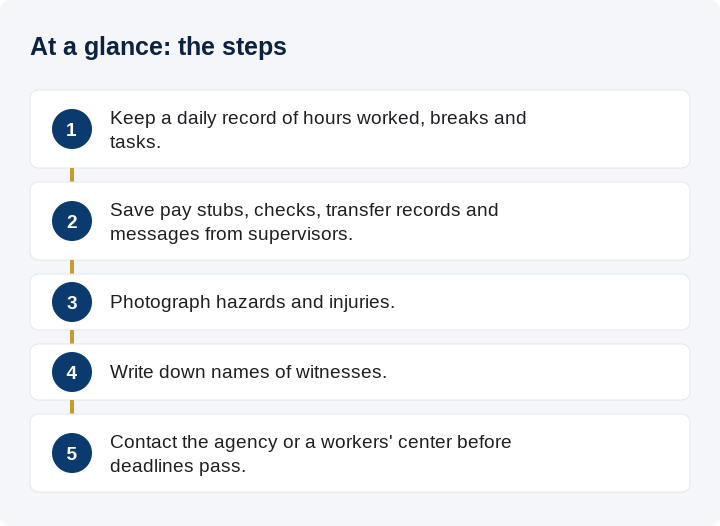
Some employers call workers "independent contractors" to avoid overtime, payroll taxes and insurance. Whether you are an employee depends on the reality of the work (control, integration into the business, permanence), not on the label. Misclassified workers can claim wages and benefits.
The Occupational Safety and Health Act requires employers to provide workplaces free of recognized serious hazards, safety training in a language workers understand, and protective equipment. Workers can file confidential complaints with OSHA, and employers cannot retaliate. Injured workers are usually entitled to workers' compensation under state law, regardless of status in most states.
| Protection | Agency |
|---|---|
| National origin, race, religion, sex and other bases in employment | Equal Employment Opportunity Commission (EEOC) |
| Citizenship status discrimination, document abuse in the I-9 process, unfair E-Verify use | DOJ Immigrant and Employee Rights Section (IER) |
| Wages, overtime, child labor, H-2A and H-2B conditions | Department of Labor Wage and Hour Division |
| Union organizing and concerted activity | National Labor Relations Board |
Employers may not fire, demote, threaten or report workers to immigration authorities because they complained about wages, safety or discrimination. The Department of Labor and DHS have long had arrangements that let labor agencies investigate without immigration enforcement interfering. In some cases, workers involved in labor investigations have been able to request deferred action from DHS; check whether that process is currently available.
H-2A agricultural and H-2B seasonal workers have specific protections: wage rates, housing and transport rules for H-2A, reimbursement of some travel costs, and prohibitions on charging recruitment fees. H-1B workers must be paid the wage stated on the Labor Condition Application, including when "benched".
A hypothetical restaurant cook works 55 hours a week for a flat weekly salary with no overtime. He keeps notes of his hours and photos of the schedule. With help from a local workers' center, he files a complaint with the Department of Labor, which investigates and finds he was owed overtime for two years. The employer pays back wages. When the owner threatens to call immigration, the retaliation becomes a further violation.
If you are injured at work, tell your supervisor in writing as soon as possible and get medical care. Workers' compensation usually pays medical costs and part of lost wages, regardless of fault. Deadlines to report injuries are short in many states. Undocumented workers are covered in most states, though rules differ. Keep copies of every medical record and communication.
Federal law does not require meal breaks or paid sick leave for most workers, but many states and cities do. Some states also require paid family leave, predictable scheduling in certain industries, and heat protection for outdoor workers. Check your state's labor department website for local rules.
Even small habits, like photographing your schedule each week, can make a later claim much stronger.
It depends on state law and on whether the Family and Medical Leave Act or local sick leave laws apply to you and your employer.
Many do; several states have domestic worker bills of rights with additional protections.
Keep in mind that many rights also depend on your employer's size: some federal laws apply only to employers with a minimum number of employees, while state laws often cover smaller businesses.
Check both federal and state rules before deciding where to complain.
No. Labor agencies generally do not ask about immigration status when investigating wage claims.
No. Withholding identity documents can be a crime under federal anti-trafficking law.
Most private-sector workers have the right to organize and act together to improve working conditions.
Disclaimer. This article is general information, not legal advice, and it is not affiliated with any government agency. US immigration rules, fees and processing times change often, and they changed repeatedly in 2025 and 2026. Confirm current requirements on uscis.gov and travel.state.gov, or speak with a licensed immigration attorney or a DOJ-accredited representative.
The most common scams aimed at immigrants: fake USCIS calls, notario fraud, visa lottery and job scams, investment and romance fraud, and how to report them safely.

Where immigrants can learn English in the US for free or at low cost: adult education ESL classes, libraries, community colleges, online tools and preparing for the citizenship test.

How immigrant families enroll children in US public schools: the right to free public education regardless of status, documents, English learner programs, records and school culture.