Selected in the DV Lottery: Next Steps, Interview and Deadline
What DV selectees must do: the DS-260, documents, fees, the consular interview, adjusting status in the US and the absolute 30 September deadline.
 Tradiciones del Mundo
Results are never sent by email, and every year criminals exploit that confusion. Here is how to check, what your case number means and how to stay safe.
Key points
The period between entering and being interviewed is where most entrants lose track of their case or fall for fraud. The sections below explain the official results check, how to estimate when your number might be reached, and the scam patterns to watch for.
If an email says you won the green card lottery, it is fake. Results are only available through the Entrant Status Check.
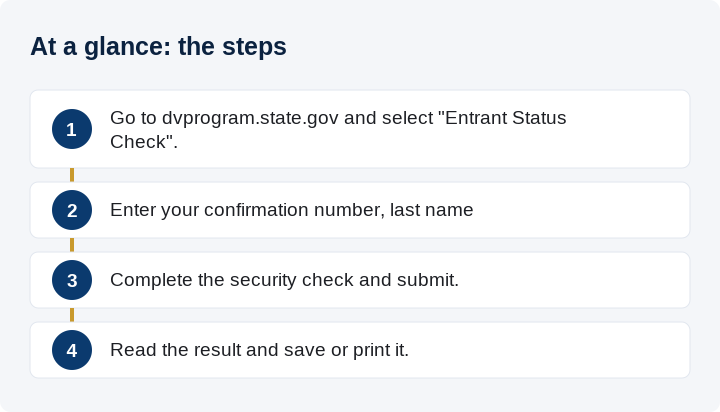
Results are never sent by email. You must check them yourself, with your confirmation number, on one official website.
In a normal program year, results are available from early May on the Entrant Status Check at dvprogram.state.gov until 30 September of the following year. You need your confirmation number, last name and year of birth.
The page shows a selection letter with your case number (which includes your region and rank number) and instructions for the next steps: completing the DS-260 online and preparing documents. Print and save it. See next steps after selection.
The page says your entry was not selected. You can try again in the next program year, if one opens.
The Entrant Status Check has a "Forgot Confirmation Number" option that resends it to the email used in the entry, during the period results are available.
In some years the State Department has made a second round of selections later in the year when the first round did not produce enough applicants. Keep checking until the end of the period if you were not selected initially.
Your case number tells you when you can be interviewed, and whether you probably will be at all.
A DV case number looks like 2026AF12345: the program year, a region code (AF Africa, AS Asia, EU Europe, NA North America, OC Oceania, SA South America and Caribbean) and your rank number. Lower numbers are interviewed first.
Each month's Visa Bulletin includes a section with the rank numbers that can be scheduled for interview two months later, by region, with separate cutoffs for some countries.
Many more people are selected than there are visas. In most years the cutoffs end the year at a level that leaves many selectees without an interview. If your number is high, prepare anyway: you cannot know in advance how far the cutoffs will move, and they often jump in the last months.
If a region shows "CURRENT", every selectee from that region who has submitted the DS-260 can be scheduled, as long as visas remain.
A hypothetical selectee from Europe has case number 2026EU8500. In the bulletin published in October, the Europe cutoff for December is 6,000. She is not yet eligible. In the January bulletin, the March cutoff advances to 9,000. Her number is now below the cutoff, so she can be scheduled for an interview in March, provided her DS-260 and documents are complete.
When a single country generates a large share of a region's selectees, the bulletin may list a separate, lower cutoff for that country to keep it within the 7% per-country limit for diversity visas. Egypt, Iran, Nepal and Uzbekistan, among others, have had separate cutoffs in past years.
Every year, criminals target lottery hopefuls with convincing emails and websites. Knowing how the real program works is the best defense.
Messages, often using US government logos, telling you to pay a fee to "process" your visa or book a flight. They are fake.
Sites that look official and charge large fees to "submit" an entry. Some do submit an entry, but keep the confirmation number to extort more money later. The real fee is $1.
Agents who promise guaranteed selection or a job in the US, or who ask for your passport.
Report scams to the US Federal Trade Commission or the US embassy in your country.
Stop all payments, keep the messages and receipts, report the fraud to the FTC and your local police, and contact your bank. If an agent submitted an entry for you and holds the confirmation number, the entry is still valid; you can retrieve the number through the Entrant Status Check if you have access to the email used.
No. The State Department never notifies selectees by email. Check only through the Entrant Status Check.
Anyone with your confirmation number, name and year of birth can check, which is why you should keep the number private.
From the date announced in the instructions, usually early May, and again later in the year in case of a second round.
No, but it makes an interview very likely if you complete the process on time and visas are being issued.
Past bulletins are archived on travel.state.gov and give a sense of how far each region usually advances.
No. You can only make sure your case is complete so it can be scheduled once current.
No. You only pay the DV fee when applying for the visa, at the embassy or as instructed by the State Department.
No. Selection is random and based on one valid entry per person.
Disclaimer. This article is general information, not legal advice, and it is not affiliated with any government agency. US immigration rules, fees and processing times change often, and they changed repeatedly in 2025 and 2026. Confirm current requirements on uscis.gov and travel.state.gov, or speak with a licensed immigration attorney or a DOJ-accredited representative.
What DV selectees must do: the DS-260, documents, fees, the consular interview, adjusting status in the US and the absolute 30 September deadline.
The green card lottery explained: how selection works, which countries are eligible, chargeability exceptions, and the current status of the program after the 2025 pause.
Step-by-step DV entry guide: the education or work requirement, who to list, passport details, the $1 fee, photo rules and the mistakes that disqualify entries.