Learning English in the US: Free Classes and Resources for Immigrants
English opens doors to better jobs, citizenship and daily independence. The US has a large network of free and low-cost classes for adults, if you know where to look.
Public adult education programs offer free or low-cost ESL classes in every state.
Libraries and community organizations run conversation groups and tutoring.
Community colleges offer credit and non-credit English courses.
Citizenship classes combine English with civics test preparation.
Millions of adults in the US are learning English. Federal and state funding supports adult education programs, often called ESL (English as a Second Language) or ESOL. Classes are offered mornings, evenings and weekends, in person and online, so they fit around work and family. This guide shows where to find them and how to make progress.
The best English class is the one you can attend every week. Consistency matters more than intensity.
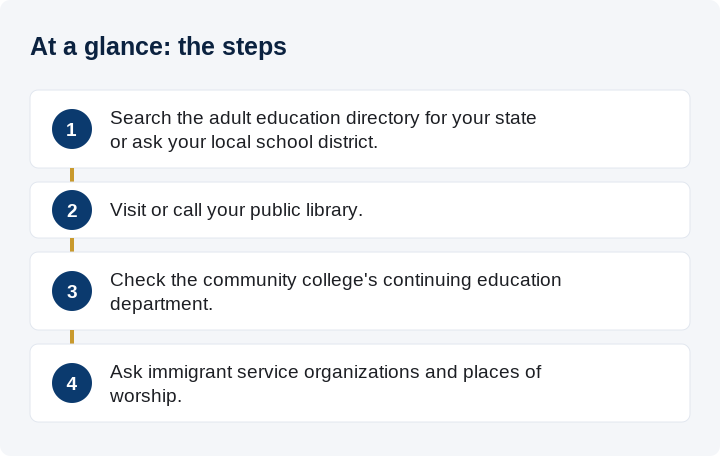
The main steps at a glance. Details in the sections below.
Free and low-cost options
Option
What it offers
Adult education centers (public school districts)
ESL classes by level, often free, sometimes with childcare
Community colleges
Non-credit ESL and academic English for college
Public libraries
Conversation groups, tutoring, free access to language apps
Free courses, apps, podcasts and USCIS study materials
How to find a class
Search the adult education directory for your state or ask your local school district.
Visit or call your public library.
Check the community college's continuing education department.
Ask immigrant service organizations and places of worship.
Programs usually begin with a placement test to find your level.
Making progress
Set a goal: a job interview, the citizenship test, helping children with homework.
Practice daily, even for 15 minutes.
Use English in real life: shopping, appointments, volunteering.
Listen and read things you enjoy, with subtitles at first.
Find a conversation partner through libraries or community groups.
English for the citizenship test
The naturalization English test covers reading and writing simple sentences and speaking during the interview. Many citizenship classes combine English and civics. USCIS publishes free study materials and vocabulary lists. See the citizenship test.
English for work
Workplace English focuses on vocabulary for your field, emails, meetings and interviews. Community colleges and workforce programs sometimes offer "vocational ESL" that combines English with job training, such as for healthcare or construction.
A worked example
A hypothetical mother from Guatemala with two school-age children enrolls in an evening ESL class at her district's adult education center, which offers childcare. She also joins a weekly conversation group at the library. After a year she moves up two levels, starts helping with homework, and enrolls in a citizenship class to prepare for the N-400.
Understanding ESL levels
Adult education programs usually group learners into levels from beginning literacy to advanced. A common framework, the National Reporting System used in federally funded programs, describes levels such as:
Beginning literacy: learning the alphabet, basic words and simple phrases.
Low and high beginning: everyday conversations, simple forms, basic reading.
Low and high intermediate: work and community situations, short paragraphs, emails.
Advanced: complex texts, presentations, academic or professional English.
Progress through one level often takes a few months of regular classes, depending on hours of study and practice outside class.
A weekly study plan
Two classes a week at an adult education center or community college.
Fifteen minutes a day with a free app or online course.
One conversation group at the library or a community center.
Listening practice during commutes: podcasts, audiobooks, radio.
Reading practice: news for learners, children's books, local newsletters.
Writing practice: a short diary, emails to a tutor, forms.
Common challenges and solutions
No time: online and evening classes, and short daily practice.
Childcare: some programs offer childcare or family literacy classes where parents and children learn together.
Shyness: start with small groups and practice phrases before using them.
Plateaus: change the type of practice, set specific goals, find a tutor.
Family literacy programs
Some districts and libraries run programs where parents and children learn together, combining adult English classes, children's reading activities and guidance on how to support school learning. They are a good option for families who want to progress together.
Certificates and tests
Most adult ESL classes do not require tests, but some learners need certificates for jobs or college admission. Community colleges may require placement tests for academic programs, and universities often require standardized English tests for international applicants. Ask what the institution accepts before paying for any test.
Glossary
ESL / ESOL: English as a Second Language / to Speakers of Other Languages.
Adult education: publicly funded classes for adults, including ESL, high school equivalency and job skills.
Placement test: a test to decide your class level.
Free tools worth trying
USCIS citizenship study materials and flashcards, free online
Free courses offered by public broadcasters and universities
Language apps available free through many public library cards
Captioned TV and video, switching between subtitles in your language and in English
Combine a structured class with one or two tools you enjoy; enjoyment keeps the habit alive.
More questions
How long does it take to become fluent?
It depends on your starting level, hours of practice and how much English you use daily. Many adults reach comfortable everyday communication in one to three years of steady study.
Am I too old to learn?
No. Adults learn languages at every age; regular practice matters more than age.
Finally, celebrate milestones: your first phone call in English, your first form completed alone, your first conversation with a teacher. They are proof the effort is working.
Ask your teacher for feedback on your goals every few months so you can adjust your plan.
Frequently asked questions
Do I need immigration papers to take ESL classes?
Many adult education programs do not require proof of status; requirements vary by program and funding source.
Can I learn English online for free?
Yes. Many free courses and apps exist, and libraries often provide access to paid ones at no cost.
Are there classes for professionals?
Yes, including advanced and academic English at community colleges and universities.
Disclaimer. This article is general information, not legal advice, and it is not affiliated with any government agency. US immigration rules, fees and processing times change often, and they changed repeatedly in 2025 and 2026. Confirm current requirements on uscis.gov and travel.state.gov, or speak with a licensed immigration attorney or a DOJ-accredited representative.
How immigrant families enroll children in US public schools: the right to free public education regardless of status, documents, English learner programs, records and school culture.
 Tradiciones