Travel Rules for Green Card Holders: Re-entry Permits and SB-1
How long permanent residents can stay abroad, the six-month and one-year thresholds, re-entry permits and the SB-1 visa for residents stuck abroad.
 Tradiciones del Mundo
Every child living in the US has the right to attend public school from kindergarten through 12th grade, whatever their immigration status. Here is how enrollment works.
Key points
School is often the fastest way for immigrant children to integrate, and the main point of contact for families with American institutions. Public schools are free, funded by local, state and federal sources, and organized by school districts based on where you live. This guide explains enrollment, your rights and how to support your child.
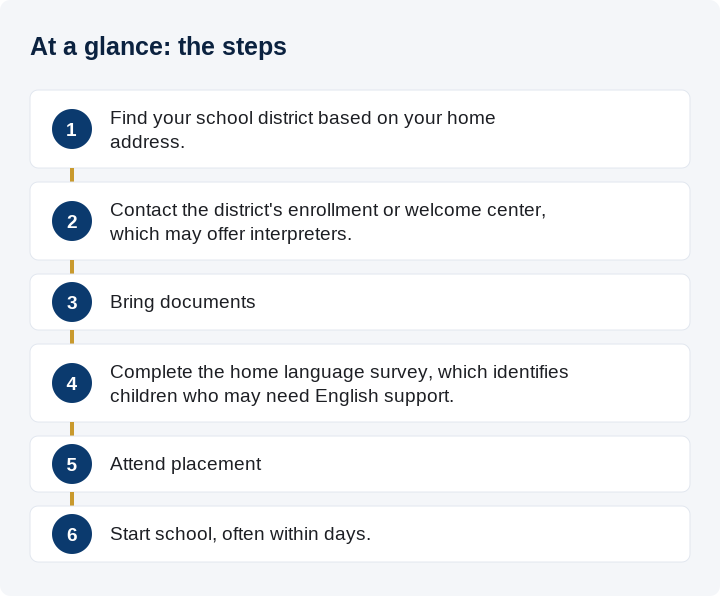
Public schools educate children who live in the district. Immigration status is not an enrollment requirement.
| Requirement | Common documents | Alternatives |
|---|---|---|
| Age | Birth certificate | Passport, baptismal record, other records |
| Residence | Lease, utility bill | Affidavit of residence, letter from the person you live with |
| Health | Vaccination records | Records from abroad, catch-up vaccines through local clinics |
| Academic history | Transcripts, report cards | Placement testing if unavailable |
Federal guidance says schools should not ask about immigration status or require a Social Security number in ways that discourage enrollment. Families experiencing homelessness have additional protections under the McKinney-Vento Act.
Under federal civil rights law, schools must help English learners overcome language barriers. Programs include English as a Second Language classes, bilingual or dual-language programs and support within regular classes. Students are tested each year until they reach proficiency. Parents have the right to information in a language they understand and to interpreters at important meetings.
Older students need credits for graduation. Bring transcripts translated if possible, so the school can grant credit for previous studies. Students without status can attend high school and, in some states, receive in-state tuition at public colleges. See college and financial aid.
A hypothetical family from Venezuela arrives in Florida in October. They visit the district welcome center with their children's passports, a lease and vaccination records. An interpreter helps them complete the forms. The children take an English test and are placed in grade-level classes with ESL support. The school nurse refers them to a clinic for missing vaccines, and they start school the following week.
Most public schools start between mid-August and early September and end in May or June, with breaks for winter holidays and spring. Students can enroll at any point in the year. Districts publish calendars online, including teacher workdays without classes. Many schools communicate through online portals and apps, which often offer translation.
Yes. Schools enroll students throughout the year.
A hypothetical 16-year-old from Ukraine arrives in March with report cards from her school in Kyiv. The district evaluates her transcripts and grants credit for math, science and history, and she takes ESL plus grade-level courses. A counselor builds a plan so she can graduate on time by taking a summer course, and introduces her to the school's newcomer club.
Ask the school which language support options exist before choosing a schedule.
Student records are protected by the federal privacy law FERPA, which limits disclosure without consent, with exceptions. Enforcement policies at schools changed in 2025; ask local legal services if worried.
Generally yes, under the same rules as other students.
Many districts offer free or low-cost pre-kindergarten, and Head Start serves eligible low-income families.
Disclaimer. This article is general information, not legal advice, and it is not affiliated with any government agency. US immigration rules, fees and processing times change often, and they changed repeatedly in 2025 and 2026. Confirm current requirements on uscis.gov and travel.state.gov, or speak with a licensed immigration attorney or a DOJ-accredited representative.
How long permanent residents can stay abroad, the six-month and one-year thresholds, re-entry permits and the SB-1 visa for residents stuck abroad.
How to renew a 10-year card with Form I-90, replace a lost or stolen card in the US or abroad, and report a change of address within 10 days.
What to do after getting a green card: Social Security, ID, taxes on worldwide income, Medicare and benefits, and college aid and in-state tuition.