How to Get Your Immigration Records with a FOIA Request
How to request your immigration file (A-file) and records from USCIS, CBP, ICE, EOIR and the State Department through FOIA, what you receive, timelines and how to use it.
 Tradiciones del Mundo
The right help can save a case; the wrong help can destroy it. In immigration, only licensed attorneys and DOJ-accredited representatives may give legal advice.
Key points
Immigration law is complicated, constantly changing and unforgiving of mistakes. Many cases are simple enough to do yourself, but many are not. This guide explains who is allowed to help, how to choose, what it costs and how to protect yourself from fraud that targets immigrant communities.
A notary public in the US can witness signatures. That is all. A notary cannot give immigration advice or represent you.
| Provider | Can give legal advice? | How to verify |
|---|---|---|
| Licensed attorney | Yes, in all immigration matters | State bar website; check for discipline |
| DOJ-accredited representative at a recognized organization | Yes, within the scope of accreditation | EOIR roster of recognized organizations and accredited representatives |
| Law student or graduate under supervision | Yes, in limited settings | Through the clinic or supervising attorney |
| Notary public, "notario", form preparer | No | Cannot provide advice or choose forms for you |
Many immigration lawyers charge flat fees for standard applications and hourly rates for litigation. Ask for a written engagement agreement that lists the services, fees and government filing fees separately. Government fees are paid to USCIS or the State Department, not kept by the lawyer.
Victims can report fraud to the Federal Trade Commission, the state attorney general and local consumer protection offices. Reporting does not require immigration status.
Straightforward cases, such as a green card renewal or a naturalization application with a clean record, are often done successfully without a lawyer. Read the official instructions, use the current form edition, and consider a one-time consultation to review your package.
A hypothetical woman wants to sponsor her husband, who entered the US without inspection years ago. A neighbor recommends a "notario" who promises a green card in six months for $3,000 and asks her to sign blank forms. Instead, she contacts a recognized nonprofit, where an accredited representative explains that her husband probably needs consular processing and an I-601A provisional waiver, and that filing an I-485 directly would be denied and could expose him to removal. She pays a modest fee for help with the waiver, and her husband's case follows the correct path.
A competent practitioner asks detailed questions about your entries, status history, family, arrests and prior applications before suggesting a strategy. They explain the options and the risks in plain language, tell you what they do not know yet (often pending your FOIA records), and give a written estimate. Be cautious of anyone who promises an outcome within minutes of meeting you, or who suggests leaving facts out of your forms. Honest advice sometimes means hearing that the best option is to wait, or that there is no option yet.
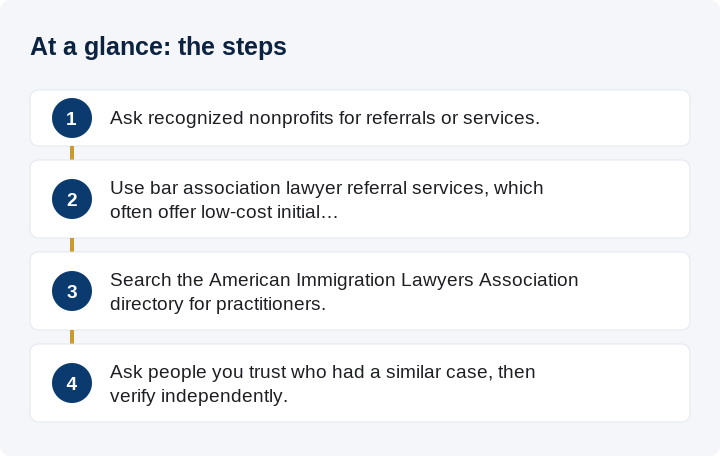
Private attorneys usually offer the widest range of services and can take complex or urgent cases. Nonprofits with accredited representatives charge little or nothing but often have waiting lists and income limits. Law school clinics provide careful work but follow the academic calendar. Choosing depends on how complex your case is, how urgent the deadline is and what you can afford.
Yes. Request your file; the new lawyer files a notice of appearance.
Ineffective assistance of counsel can sometimes be a basis to reopen a case, following specific procedures.
Immigration law is federal, so any US-licensed attorney in good standing can handle federal immigration matters.
Disclaimer. This article is general information, not legal advice, and it is not affiliated with any government agency. US immigration rules, fees and processing times change often, and they changed repeatedly in 2025 and 2026. Confirm current requirements on uscis.gov and travel.state.gov, or speak with a licensed immigration attorney or a DOJ-accredited representative.
How to request your immigration file (A-file) and records from USCIS, CBP, ICE, EOIR and the State Department through FOIA, what you receive, timelines and how to use it.
How to create and use a USCIS online account: filing forms online, linking paper cases, uploading evidence, reading notices, two-step verification and avoiding fake sites.
How to translate and prepare birth, marriage and police documents for USCIS and the NVC: translator certifications, the reciprocity schedule, unavailable records and secondary evidence.