What a Strong or Weak Dollar Means for Immigrants
Why the US dollar rises and falls, how it is measured, and what a strong or weak dollar means for remittances, savings abroad, travel, imports and home-country assets.
 Tradiciones del Mundo
If you earn, save or spend in more than one currency, a multi-currency account can cut conversion costs. Understanding how they are protected matters as much as the savings.
Key points
Immigrants often live between currencies: a salary in dollars, a mortgage or family support in pesos, euros or rupees, savings in both. Traditional banks charge for every conversion, often through wide exchange rate spreads. Multi-currency accounts and fee-free cards offer cheaper alternatives. This guide explains how they work, their limits and the traps that remain.
It is general education, not a recommendation of any provider.
The cheapest conversion is the one you do not need to make. Holding money in the currency you will spend it in avoids converting twice.
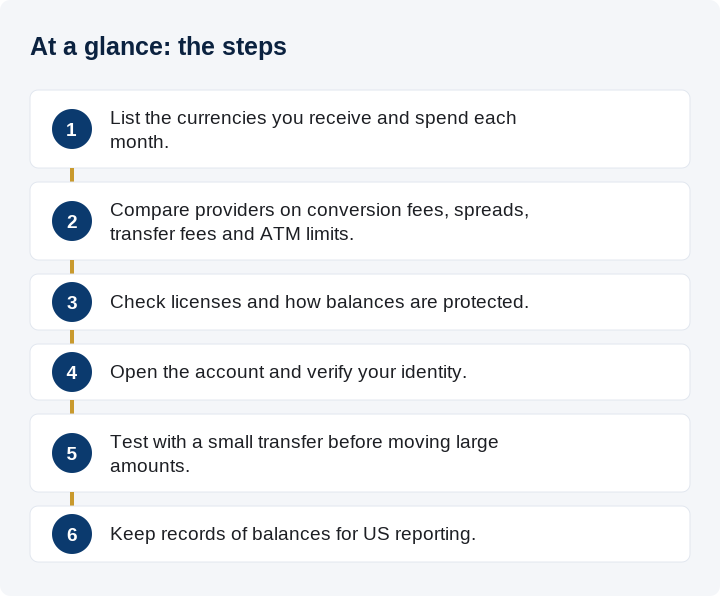
Some multi-currency services are banks with FDIC insurance. Many are licensed money transmitters that keep customer funds in safeguarded or pass-through accounts at partner banks. US deposit insurance applies only to deposits at insured banks and usually only to US dollar balances in specific structures; foreign currency balances may not be insured the same way. Read the provider's terms and its state licenses.
| Option | Strengths | Weaknesses |
|---|---|---|
| Traditional bank with foreign currency accounts | Deposit protection, in-branch help | Often wide spreads and fees |
| Fintech multi-currency account | Low conversion costs, local account details | Protection depends on structure; limits and holds |
| Credit card with no foreign transaction fees | Network exchange rates, purchase protection, credit building | Interest if you carry a balance; no holding of foreign balances |
| Brokerage with currency trading | Very low spreads for large amounts | Complex, not designed for everyday spending |
When paying abroad or on foreign websites, card terminals and ATMs often ask whether to charge you in your home currency. This is dynamic currency conversion, and the merchant's rate usually includes a markup of several percent. Choose to pay in the local currency and let your card network convert.
Accounts held with foreign institutions, or foreign currency balances held abroad, can count toward FBAR and Form 8938 thresholds. Some fintech accounts are held by US entities and others by foreign affiliates; check where your balances legally sit. Interest is taxable. See reporting rules.
A hypothetical designer in New York invoices clients in Germany in euros. Previously her US bank converted each payment at a rate about 3% worse than mid-market. With a multi-currency account she receives euros through a European account number, holds part of them to pay her mother's rent in Spain, and converts the rest to dollars at a cost below 1%. On annual income of €40,000, the change saves her about €800 a year.
A hypothetical nurse in Chicago pays a mortgage on an apartment in Manila. Each month her US bank charged a wire fee plus a wide spread. She now converts dollars to pesos once a month in a multi-currency account and pays the mortgage from a local transfer, cutting the cost of each payment. She keeps only one month's mortgage in pesos, so most of her money stays in an FDIC-insured US bank account.
Review the account every few months: fees and exchange terms change, and new options appear regularly.
Keep your main emergency fund in an insured US bank account rather than in a multi-currency wallet.
Providers can hold funds while verifying transactions under anti-money-laundering rules; keep documentation of large incoming payments.
Debit cards do not; only credit products reported to bureaus do.
For regular transfers to family, compare both; some remittance services are cheaper for specific corridors and cash pickup.
Disclaimer. This article is general education, not financial, investment, tax or insurance advice, and it does not recommend any specific product or provider. Prices, rates, limits and rules change; check official sources such as irs.gov, consumerfinance.gov and investor.gov, and consider a licensed professional for decisions about your own money.
Why the US dollar rises and falls, how it is measured, and what a strong or weak dollar means for remittances, savings abroad, travel, imports and home-country assets.
How to pay and get cash when traveling: cards without foreign fees, ATMs, airport exchange counters, cash limits, dynamic currency conversion and protecting your money abroad.
How to send money to family abroad for less: comparing fees and exchange rate markups, provider types, your federal protections and the 2026 tax on cash transfers.