Your First-Year Budget in the US: Costs Newcomers Underestimate
A practical first-year budget for immigrants: rent and deposits, utilities, transport, health care, taxes on your paycheck, emergency funds and a sample plan.
 Tradiciones del Mundo
Headlines about the Fed, inflation and jobs reports can feel abstract. For newcomers they translate directly into rent, salaries, loan costs and even how fast employers sponsor visas.

Key points
You do not need an economics degree to make good decisions, but understanding a handful of concepts helps you negotiate a salary, decide when to buy a car, choose where to live and read the news without panic. This guide explains the core mechanics of the US economy in plain language, with what each means for an immigrant household.
Every economic headline eventually reaches your kitchen table: through your rent, your paycheck or the interest rate on your next loan.
The Federal Reserve (the Fed) is the US central bank. Congress gave it a "dual mandate": maximum employment and stable prices. Its main tool is the federal funds rate, the rate banks charge each other for overnight loans. When the Fed raises it, borrowing becomes more expensive across the economy; when it cuts, borrowing becomes cheaper.
Inflation is the general rise in prices. The Consumer Price Index (CPI), published monthly by the Bureau of Labor Statistics, is the best-known measure. The Fed targets 2% inflation measured by a related index, the Personal Consumption Expenditures (PCE) price index. After the surge of 2021–2022, inflation came down but prices did not return to earlier levels; that is normal, since inflation measures the speed of increase, not the level.
On the first Friday of most months, the Bureau of Labor Statistics releases the Employment Situation report: jobs added and the unemployment rate. A strong labor market means more job offers, easier job changes and more bargaining power; a weak one means more caution.
For immigrants, the job market also shapes immigration itself. Employment-based green cards depend on employers willing to sponsor, and the PERM process requires employers to test the labor market. Layoffs in an occupation can complicate pending labor certifications.
The federal minimum wage has been $7.25 an hour since 2009, but most states and many cities set higher minimums, some well above $15. Overtime rules under the Fair Labor Standards Act require time and a half for many hourly workers beyond 40 hours a week. Your pay stub will show deductions for federal income tax, often state tax, and FICA taxes: 6.2% for Social Security (up to an annual wage cap) and 1.45% for Medicare.
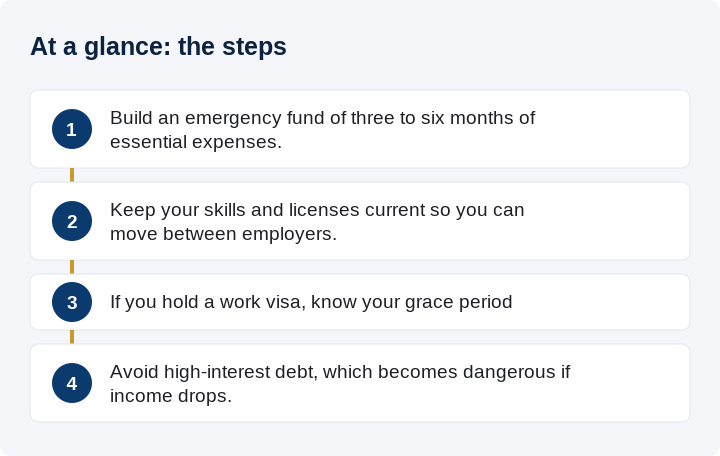
A recession is a significant, broad decline in economic activity lasting more than a few months. They are officially dated in hindsight. Practical preparation matters more than prediction:
The US is not one economy but fifty. Housing in large coastal cities can cost several times as much as in parts of the Midwest or South, while salaries differ by less. The Bureau of Economic Analysis publishes regional price parities that compare price levels by state and metro area. When comparing job offers, compare salaries after housing, taxes (some states have no income tax) and commuting costs.
A hypothetical couple plans to buy a car for $25,000 with a five-year loan. At 5% interest the monthly payment is about $472; at 9% it is about $519. Over five years the higher rate costs roughly $2,800 more. That is how a change in Federal Reserve policy, passed through banks to consumers, reaches a household budget. Improving their credit score could lower the rate offered regardless of what the Fed does.
It makes sending dollars abroad buy more in your home currency, but makes bringing savings into the US cost more dollars. See exchange rates explained.
Nobody can time rates reliably. Buy when you need the car and the payment fits your budget; you can refinance later if rates drop.
Usually yes, especially for professional roles. Use published wage data for your occupation and location.
Disclaimer. This article is general education, not financial, investment, tax or insurance advice, and it does not recommend any specific product or provider. Prices, rates, limits and rules change; check official sources such as irs.gov, consumerfinance.gov and investor.gov, and consider a licensed professional for decisions about your own money.

A practical first-year budget for immigrants: rent and deposits, utilities, transport, health care, taxes on your paycheck, emergency funds and a sample plan.

How US credit cards work for newcomers: APR, grace periods, fees, secured and starter cards, rewards, the CARD Act protections and habits that build a strong credit score.

How much emergency savings immigrants need, where to keep them (high-yield savings, money market accounts, CDs, Treasury bills), deposit insurance and building the habit.