Opening a US Bank Account and Building Credit as an Immigrant
How newcomers open a US bank account with a passport, SSN or ITIN, how deposit insurance works, and how to build a credit score from zero in the first year.
 Tradiciones del Mundo
Every paycheck with Social Security tax builds credits toward a retirement benefit. For immigrants with careers in two countries, the rules on combining and receiving benefits matter a lot.
Key points
Social Security is the foundation of retirement income for most US workers. Immigrants pay into the system from their first US job, but often arrive mid-career and may retire in another country. Understanding credits, totalization and payment rules helps you plan for a retirement split between two places.
Check your Social Security earnings record every year. Missing wages are much easier to correct while you still have the pay stubs.
You earn up to four credits a year based on covered earnings; the amount needed per credit rises each year with average wages. Forty credits make you "fully insured" for retirement benefits. Disability and survivor benefits use different, sometimes shorter, rules. Work in jobs not covered by Social Security, or while exempt (such as some students in their first years), does not earn credits.
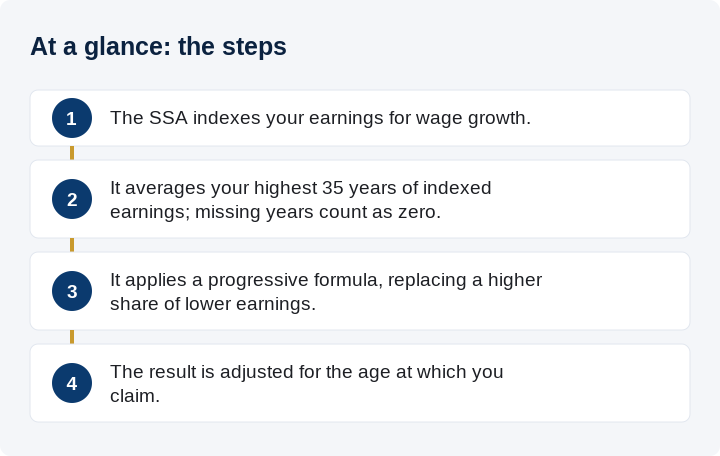
Immigrants who work fewer than 35 years in the US often receive smaller benefits because of the zero years, though the formula's progressivity softens this.
| Claiming age | Effect (born 1960 or later) |
|---|---|
| 62 | Permanently reduced benefit (about 30% less than at 67) |
| 67 | Full benefit |
| 70 | Increased benefit (about 24% more than at 67), no further increase after |
The US has agreements with around 30 countries, including Canada, most of Western Europe, Japan, South Korea, Australia, Chile and Brazil. An agreement signed with Mexico in 2004 has never entered into force. The agreements:
Without an agreement, each country's rules apply separately.
US citizens can generally receive payments in most countries. Non-citizens face more rules: payments may continue abroad if they are citizens of certain countries or meet other conditions, and may stop after six months abroad in some cases. The SSA also cannot send payments to a few countries. The SSA's Payments Abroad Screening Tool gives the answer for your situation.
Spouses can receive up to half of the worker's full benefit, and widows or widowers can receive survivor benefits. Non-citizen spouses and dependents living abroad may face additional residency requirements.
A hypothetical engineer worked 15 years in Germany and 20 years in the US before retiring at 67. She has more than 40 US credits, so she qualifies for a US benefit based on her 20 years of earnings. Through the US-Germany totalization agreement, Germany also pays a pension for her German contributions. She decides to retire in Spain, where, under current rules for her situation, both pensions can be paid.
Medicare eligibility at 65 is separate from retirement benefits but uses the same work credits for premium-free Part A. People without enough credits can buy Medicare after five years of continuous residence as permanent residents. Medicare generally does not pay for care outside the US, which matters for people planning to retire abroad.
A hypothetical worker spent 25 years working in a country without a totalization agreement and then 8 years in the US before turning 67. With 32 US credits, he is short of the 40 needed. He can keep working in the US to reach 40 credits, which takes about two more years, and then qualify for a US benefit based on his US earnings. His home-country pension is paid under that country's own rules.
Part of Social Security benefits can be subject to US income tax depending on your total income. Nonresident aliens living abroad usually have 30% withheld on 85% of the benefit (an effective 25.5%), unless a tax treaty reduces or eliminates it; several treaties do. Check how your country of residence taxes US benefits as well.
Plan early, ideally ten years before retiring.
An early review leaves time to fill gaps in your record or work a few more years if needed.
No, but you must be lawfully present in the US to receive payments while living in the US, and rules for payments abroad depend on citizenship.
Generally no, except in specific error cases.
Create a "my Social Security" account at ssa.gov.
Disclaimer. This article is general education, not financial, investment, tax or insurance advice, and it does not recommend any specific product or provider. Prices, rates, limits and rules change; check official sources such as irs.gov, consumerfinance.gov and investor.gov, and consider a licensed professional for decisions about your own money.
How newcomers open a US bank account with a passport, SSN or ITIN, how deposit insurance works, and how to build a credit score from zero in the first year.
How inflation, Federal Reserve interest rates and the job market work in the US, and how they affect immigrants' wages, rent, loans and plans.
A practical first-year budget for immigrants: rent and deposits, utilities, transport, health care, taxes on your paycheck, emergency funds and a sample plan.