Sending Money Abroad From the US: Fees, Exchange Rates and Rules
How to send money to family abroad for less: comparing fees and exchange rate markups, provider types, your federal protections and the 2026 tax on cash transfers.
 Tradiciones del Mundo
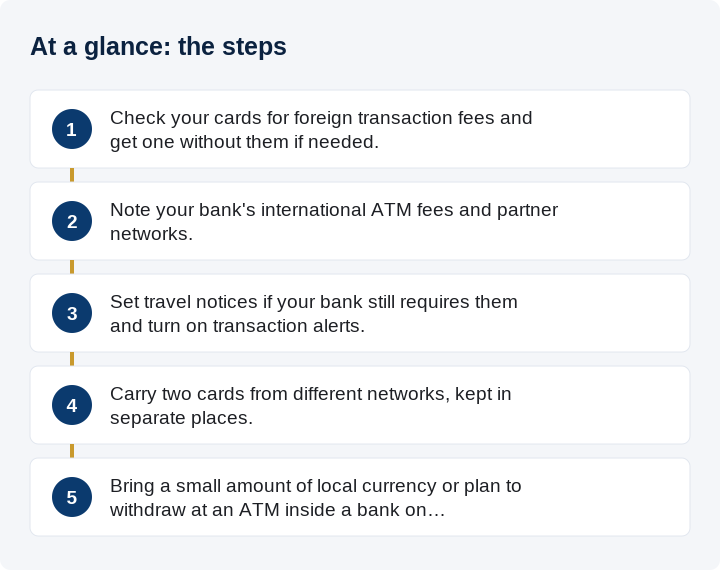
Every trip home involves currency exchange. Airport counters and default card settings quietly cost travelers a lot; a little preparation avoids most of it.
Key points
Whether you visit family once a year or travel often, how you pay abroad makes a difference. Small percentages add up across hotels, meals, gifts and cash withdrawals. This guide compares the main ways to get and spend foreign currency and the simple rules that save money.
When a card terminal asks "pay in dollars or local currency?", the right answer is almost always local currency.
| Method | Typical cost | Notes |
|---|---|---|
| Credit card without foreign transaction fees | Network rate, near mid-market | Best for most purchases |
| Debit card at a bank ATM abroad | Network rate plus possible ATM and bank fees | Use cards that refund or avoid ATM fees |
| Exchanging at your US bank before travel | Moderate to high spreads | Useful for small arrival cash |
| Airport exchange counters | High spreads and fees | Only for small emergencies |
| Prepaid travel cards | Varies; can include loading and conversion fees | Read the fee schedule |
There is no limit on how much money you can carry into or out of the US, but amounts over $10,000 in currency or monetary instruments must be reported to CBP on FinCEN Form 105. Other countries have their own declaration rules. Undeclared cash can be seized.
Coins are rarely exchangeable; spend them before leaving. Keep some notes for the next trip instead of converting back and paying the spread twice.
A hypothetical family spends $4,000 equivalent during a month in their home country. Paying with a debit card that charges 3% in foreign transaction fees and accepting dynamic currency conversion at a 4% markup would cost about $280. Using a credit card without foreign fees, paying in local currency and withdrawing cash from bank ATMs, they reduce the extra cost to a few dollars in ATM fees.
Every currency transaction has a benchmark: the mid-market rate you can see on financial news sites. The real cost of any method is the difference between the rate you receive and that benchmark, plus any explicit fees. To check, divide what you received by what you paid, compare it with the mid-market rate at the same moment, and express the difference as a percentage. Doing this once for each card and service you use shows clearly which ones are cheap and which are quietly expensive.
When you pay abroad by card in the local currency, the card network (such as Visa or Mastercard) converts the amount at its own daily rate, which is usually close to the mid-market rate. Your bank may then add a foreign transaction fee, often around 3%, unless your card waives it. Debit and credit cards from the same bank can have different fees, so check each one.
If relatives need help during your trip, compare a remittance service delivering local currency directly with withdrawing cash yourself. For large amounts, a direct transfer to their bank account avoids carrying cash and creates a record. See sending money abroad.
Keep receipts of large purchases and withdrawals until your statements arrive, so you can dispute errors or fraud quickly.
For large purchases such as a car, a property deposit or a family celebration, a bank transfer in local currency is usually cheaper and safer than cash or cards. Compare a specialist transfer service with your bank, and remember US reporting rules if the money passes through foreign accounts you control.
Many banks no longer require it, but alerts help you spot fraud quickly.
They can help with budgeting but often have fees that make them more expensive than good credit cards.
In some countries dollars are accepted, but prices in dollars often use unfavorable rates.
Disclaimer. This article is general education, not financial, investment, tax or insurance advice, and it does not recommend any specific product or provider. Prices, rates, limits and rules change; check official sources such as irs.gov, consumerfinance.gov and investor.gov, and consider a licensed professional for decisions about your own money.
How to send money to family abroad for less: comparing fees and exchange rate markups, provider types, your federal protections and the 2026 tax on cash transfers.
How exchange rates work, how to move savings into the US at a good rate, the $10,000 cash declaration, FBAR and foreign gift reporting, and managing currency risk.
An honest guide to retail forex trading in the US: how currency pairs and leverage work, CFTC and NFA rules, taxes, visa considerations and how to spot forex scams.