Travel Money: The Cheapest Ways to Exchange Currency for Trips Home
How to pay and get cash when traveling: cards without foreign fees, ATMs, airport exchange counters, cash limits, dynamic currency conversion and protecting your money abroad.
 Tradiciones del Mundo
Headlines about the dollar can sound abstract. For immigrant families with money and relatives in two countries, the exchange rate is part of the monthly budget.
Key points
The US dollar is the world's main reserve currency, used in most international trade and finance. Its value against other currencies changes every day. For immigrants, those changes affect the purchasing power of money sent home, the value of savings and property abroad, and plans to retire or study in another country. This guide explains the forces behind the dollar and practical ways to manage the effects.
Exchange rates move in both directions. A plan that only works if the rate moves your way is not a plan.
Against a single currency, the rate shows how many units of that currency one dollar buys. To see the dollar's overall strength, analysts use indexes such as the Federal Reserve's broad trade-weighted dollar index, which compares the dollar with the currencies of major trading partners, or the widely quoted DXY index, which uses a basket dominated by the euro.
| Situation | Strong dollar | Weak dollar |
|---|---|---|
| Sending dollars to family abroad | Each dollar buys more locally | Each dollar buys less |
| Bringing savings to the US | Foreign savings convert to fewer dollars | Foreign savings convert to more dollars |
| Property or pension abroad (valued in dollars) | Worth less in dollar terms | Worth more in dollar terms |
| Travel to the home country | Cheaper | More expensive |
| Imported goods in the US | Tend to be cheaper | Tend to be more expensive |
Some currencies are pegged to the dollar, others are tightly managed, and some have experienced sharp devaluations and high inflation. If your home country has a history of devaluations or capital controls, holding savings in dollars and sending money as needed can protect value, while following local laws on exchange.
A hypothetical worker sends $500 a month to his parents. When the dollar strengthens 10% against their currency, his parents receive about 10% more local money for the same transfer. He decides to keep sending $500 and to save the extra in a local account for their medical expenses, rather than reduce his transfers, which gives his parents a buffer when the dollar weakens later.
When the Federal Reserve keeps rates higher than other central banks, investors can earn more on dollar assets, which tends to support the dollar. When the Fed cuts rates faster than others, the dollar often weakens. Expectations matter as much as decisions: currencies often move when markets change their forecasts, before any rate change happens. This is one reason why exchange rates can jump on the day of a central bank meeting or a key economic report.
A hypothetical teacher keeps savings equivalent to $30,000 in her home country to buy an apartment there one day. Over two years, the local currency loses 20% against the dollar. Measured in dollars, her savings fall to about $24,000, although their value in local terms is unchanged. Since she plans to spend the money locally, the loss in dollar terms does not affect her goal; it would matter if she brought the money to the US.
Measuring progress in the currency of your goal avoids unnecessary worry about daily rate movements.
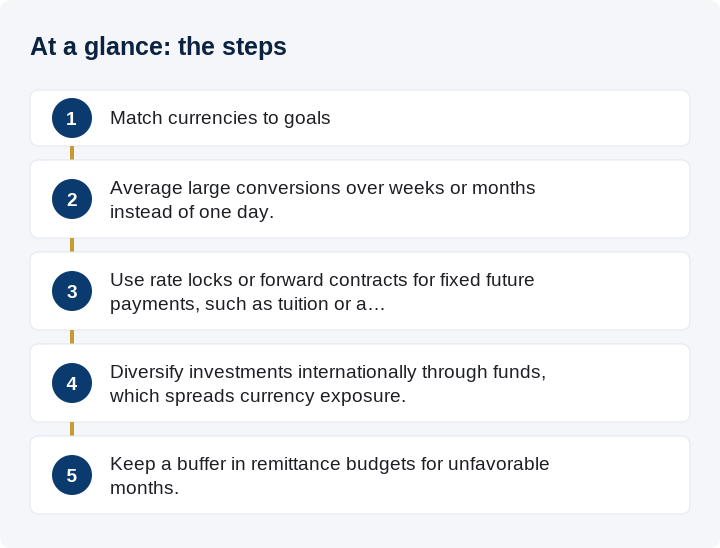
If you need to convert large sums, splitting the conversion over time smooths out the swings.
For regular family support, waiting rarely pays off consistently. For large transfers, averaging or rate alerts are reasonable tools.
Currency trading is risky and most retail traders lose money. See forex trading risks.
Each provider adds its own spread to the market rate.
Disclaimer. This article is general education, not financial, investment, tax or insurance advice, and it does not recommend any specific product or provider. Prices, rates, limits and rules change; check official sources such as irs.gov, consumerfinance.gov and investor.gov, and consider a licensed professional for decisions about your own money.
How to pay and get cash when traveling: cards without foreign fees, ATMs, airport exchange counters, cash limits, dynamic currency conversion and protecting your money abroad.
How to send money to family abroad for less: comparing fees and exchange rate markups, provider types, your federal protections and the 2026 tax on cash transfers.
How exchange rates work, how to move savings into the US at a good rate, the $10,000 cash declaration, FBAR and foreign gift reporting, and managing currency risk.