401(k) and IRA for Immigrants: 2026 Limits and What Happens If You Leave
How US retirement accounts work for immigrants: 401(k) and IRA rules and 2026 limits, employer matches, Roth vs traditional, and options if you leave the US.
 Tradiciones del Mundo
US markets are open to permanent residents and most visa holders. The basics are simple; the mistakes are expensive. Here is how to start the right way.
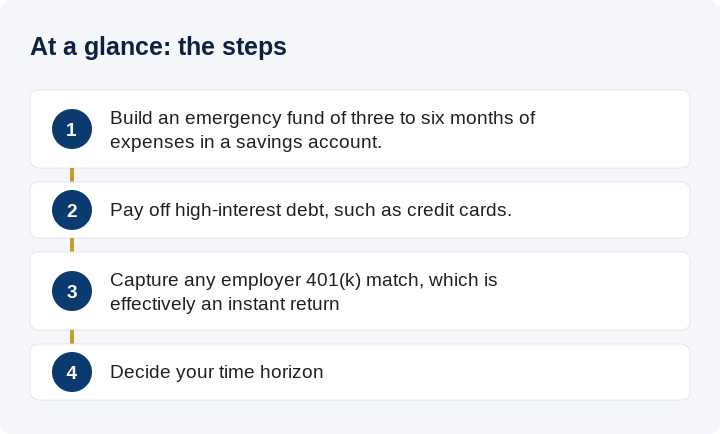
Key points
Many immigrants come from countries where investing meant real estate or bank deposits. In the United States, ordinary households commonly invest in the stock and bond markets through retirement plans and brokerage accounts. This guide explains how to open an account, what to invest in at the start, how you are protected and how investments are taxed. It is general education, not personal advice.
Time in the market, diversification and low costs explain most long-term results. None of them requires predicting the news.
Brokers are regulated by the SEC and FINRA. To open an account you typically need a US address, ID, and an SSN or ITIN, plus Form W-9 certifying you are a US person for tax purposes. Nonresident aliens use Form W-8BEN instead and face different withholding. Most major brokers now offer commission-free trading in stocks and ETFs.
Check any broker or adviser on FINRA BrokerCheck or the SEC's adviser search before opening an account.
| Investment | What it is | Main risk |
|---|---|---|
| Index funds and ETFs | Baskets that track a market index, such as the S&P 500 or a total market index | Market declines; diversified within the index |
| Individual stocks | Shares of single companies | Company-specific losses |
| Bonds and bond funds | Loans to governments or companies | Interest rate and credit risk |
| Treasury securities | US government debt, bought through brokers or TreasuryDirect | Inflation and rate changes; very low default risk |
| Money market funds | Short-term, low-risk holdings | Low returns; not deposit insured |
The expense ratio, the annual fee of a fund, matters greatly over decades. A difference of 1% a year compounds into a large share of your final balance.
Green card holders are taxed on worldwide investment income; see taxes for green card holders.
Holding investments is generally passive activity permitted for H-1B, F-1, L-1 and most other visa holders. Day trading as a business, managing other people's money or being paid for investment work can raise unauthorized employment concerns. Non-citizens who are not US tax residents follow different tax rules.
A hypothetical new resident in her thirties has paid off her credit card, built a four-month emergency fund and contributes enough to her 401(k) to get the full match. She opens a brokerage account and sets up an automatic investment of $300 a month into a broad, low-cost index fund. She does not try to time the market. Over decades, the monthly habit, market growth and low fees do most of the work. During a market decline she keeps investing, buying more shares at lower prices.
Your allocation is the split between stocks, bonds and cash. Stocks have higher expected returns and larger swings; bonds are steadier; cash is safest and earns least. A common approach is to hold more stocks when your goals are far away and gradually more bonds as they approach. Target-date funds do this automatically. Rebalancing once a year brings your mix back to its target.
Many brokers accept an ITIN. Options are fewer for people with neither.
Many brokers have no minimum, and fractional shares let you start with small amounts.
An adviser can help with complex situations such as cross-border finances. Ask how they are paid and verify their registration.
Disclaimer. This article is general education, not financial, investment, tax or insurance advice, and it does not recommend any specific product or provider. Prices, rates, limits and rules change; check official sources such as irs.gov, consumerfinance.gov and investor.gov, and consider a licensed professional for decisions about your own money.
How US retirement accounts work for immigrants: 401(k) and IRA rules and 2026 limits, employer matches, Roth vs traditional, and options if you leave the US.
What happens to home-country investments when you become a US tax resident: PFIC rules for foreign funds, foreign pensions, rental property abroad and reporting.
How US stock markets work: exchanges, shares, indexes like the S&P 500, orders, market swings, dividends, risk and the basic principles of long-term investing.