Cryptocurrency for Immigrants: Risks, Scams, Remittances and Taxes
What immigrants should know about cryptocurrency: volatility, regulation, stablecoins and the GENIUS Act, using crypto for remittances, common scams and IRS reporting rules.
 Tradiciones del Mundo
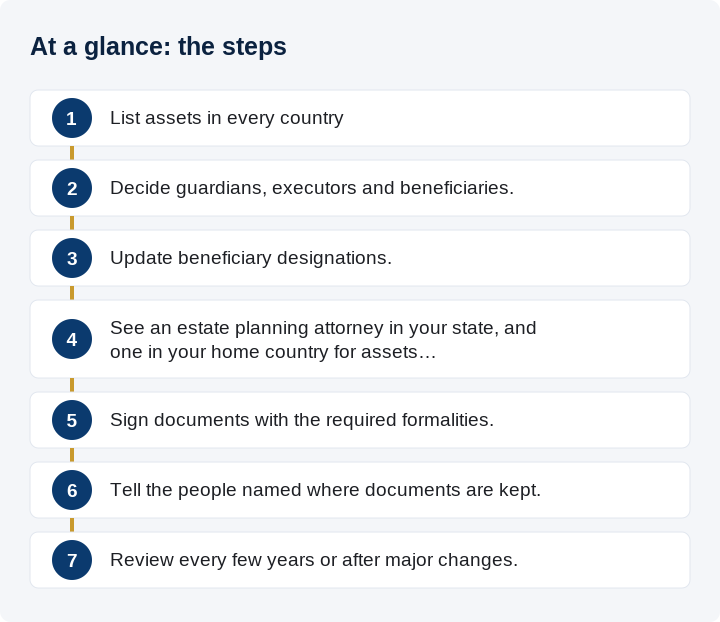
Estate planning is not only for the wealthy. For immigrant families with children, assets in two countries or a non-citizen spouse, a few documents prevent serious problems.

Key points
Many immigrants put off estate planning because it feels expensive or morbid, or because they assume their home country's rules will apply. In the US, each state's law governs wills and inheritance, and federal tax rules treat non-citizen spouses differently. A basic plan protects your children and spouse, keeps assets out of lengthy court processes and avoids conflicts between two legal systems.
The most important line in a young family's will is often not about money. It is the name of the person who will raise the children.
| Document | What it does |
|---|---|
| Will | Names who inherits, an executor and guardians for minor children |
| Revocable living trust | Holds assets during life and passes them without probate |
| Durable power of attorney | Lets someone manage your finances if you cannot |
| Health care directive and proxy | States your medical wishes and who decides for you |
| Beneficiary designations | Name who receives retirement accounts, life insurance and some bank accounts |
If both parents die without naming a guardian, a court decides who raises minor children. Families with relatives abroad should think about whether the guardian lives in the US or another country, how that affects the children's lives and schooling, and the guardian's immigration situation. Name alternates as well.
Retirement accounts, life insurance and accounts with "payable on death" or "transfer on death" designations pass directly to named beneficiaries, regardless of the will. Review them after marriage, divorce, births and moves. Naming minor children directly can require a court-supervised guardianship of the money; a trust or custodial arrangement is often better.
Some states also have their own estate or inheritance taxes with much lower thresholds.
Assets passing to a surviving spouse who is a US citizen generally avoid estate tax through the unlimited marital deduction. If the surviving spouse is not a citizen, that deduction is not available unless the assets pass into a Qualified Domestic Trust (QDOT), or the spouse becomes a citizen before the estate tax return is filed, under conditions. For most families below the exemption this does not matter, but for larger estates it is essential planning.
A hypothetical couple with green cards has two young children, a house in Texas, 401(k) accounts and an apartment in Colombia. They sign US wills naming the wife's sister in Houston as guardian, set up a trust for the children, update their 401(k) beneficiaries and execute a separate Colombian will for the apartment, coordinated by both lawyers.
Include online banking, investment and crypto accounts, email and cloud storage in your plan. List them securely, with instructions on how your executor can access them, and check each provider's options for naming a legacy contact. Without this, families can lose access to important records and assets.
If you later return to your home country or move elsewhere, review your plan: your domicile for estate tax purposes, the validity of your US documents and the rules of the new country may all change.
Store the originals in a safe place known to your executor, and give copies to the guardians you named, so that nobody has to search for them at a difficult moment.
US states often recognize wills validly made elsewhere, but using them can be slow and complicated. A local will is usually better.
Simple wills can be done with forms, but cross-border assets, non-citizen spouses and trusts benefit from professional help.
Yes, beneficiaries can live anywhere, though transfers may take longer.
Disclaimer. This article is general education, not financial, investment, tax or insurance advice, and it does not recommend any specific product or provider. Prices, rates, limits and rules change; check official sources such as irs.gov, consumerfinance.gov and investor.gov, and consider a licensed professional for decisions about your own money.

What immigrants should know about cryptocurrency: volatility, regulation, stablecoins and the GENIUS Act, using crypto for remittances, common scams and IRS reporting rules.
How immigrants and visa holders can start investing in the US: opening a brokerage account, index funds and ETFs, fees, investor protection and capital gains tax.
How US retirement accounts work for immigrants: 401(k) and IRA rules and 2026 limits, employer matches, Roth vs traditional, and options if you leave the US.