How the US Stock Market Works: A Beginner's Guide for Newcomers
How US stock markets work: exchanges, shares, indexes like the S&P 500, orders, market swings, dividends, risk and the basic principles of long-term investing.
 Tradiciones del Mundo
Investments that were perfectly sensible at home can become tax traps once you are a US tax resident. Foreign mutual funds are the classic example.
Key points
Moving to the United States does not just change where you live; it changes how the IRS sees everything you own worldwide. Some home-country products are treated far worse under US tax law than domestic ones. This guide explains the main traps, so you can ask the right questions of a cross-border tax professional before, not after, problems arise.
The best time to review foreign investments is before you become a US tax resident, not after the first tax season.
You become a US tax resident by holding a green card (the "green card test") or by spending enough days in the US (the "substantial presence test"). From then on you are taxed on worldwide income, subject to treaties and foreign tax credits. The year you arrive can be a "dual-status" year with special rules.
A Passive Foreign Investment Company (PFIC) is a non-US company whose income is mostly passive or whose assets mostly produce passive income. Most foreign mutual funds, foreign ETFs and many foreign insurance-investment products fall into this category.
Many immigrants sell foreign funds before becoming residents, or shortly after with professional advice, and invest through US-domiciled funds instead.
Treatment varies widely. Some government and employer pensions are covered by tax treaties that defer US tax until payment. Others, especially private schemes, may be treated as foreign trusts or taxable accounts. Contributions you or your employer make abroad may not be deductible in the US. This is an area where a specialist is worth the cost.
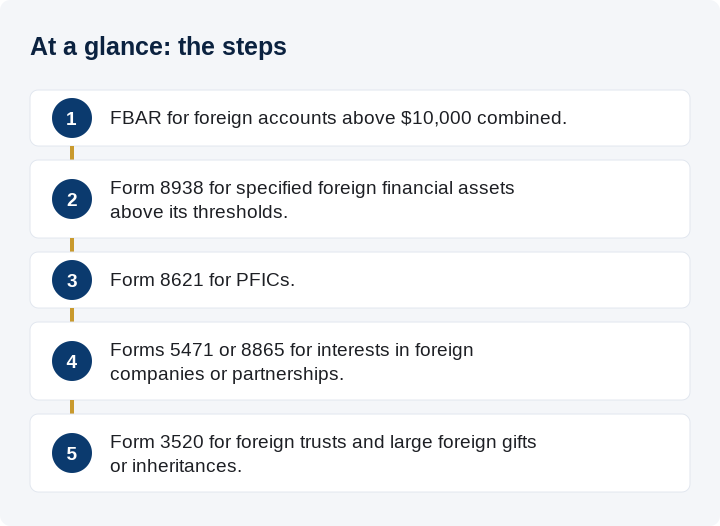
Penalties for missing forms can be severe even when no tax is owed. The IRS offers streamlined procedures for taxpayers whose failures were non-willful.
A hypothetical engineer from Germany owns shares in two German-domiciled equity funds worth €80,000 when she receives her green card. Both are almost certainly PFICs. If she keeps them and sells ten years later at a large gain, the default regime allocates the gain across the holding period, taxes each year's share at the highest ordinary income rate in effect, and adds an interest charge. Her effective US tax rate on the gain could exceed what she would have paid on a similar US fund many times over. Had she sold before becoming a US tax resident (subject to German tax) and reinvested in US-domiciled index funds, she would face ordinary long-term capital gains rules going forward. A cross-border tax adviser can compare these options, including whether a mark-to-market election makes sense.
Look for an enrolled agent, CPA or tax attorney with specific cross-border experience. Ask how many returns with foreign assets they prepare each year and whether they are familiar with your home country's system. Verify credentials through the IRS directory of federal tax return preparers and state licensing boards.
For every foreign investment, keep purchase dates, amounts in the original currency, exchange rates used and annual statements. US gains are calculated in dollars, so these records determine your tax years later.
Shares of ordinary operating companies usually are not, but some holding or investment companies are.
FBAR uses the combined maximum value of all foreign accounts; if the total exceeds $10,000 at any time, all of them are reported.
Yes. The IRS has streamlined filing compliance procedures for non-willful failures, and delinquent FBAR procedures.
Disclaimer. This article is general education, not financial, investment, tax or insurance advice, and it does not recommend any specific product or provider. Prices, rates, limits and rules change; check official sources such as irs.gov, consumerfinance.gov and investor.gov, and consider a licensed professional for decisions about your own money.
How US stock markets work: exchanges, shares, indexes like the S&P 500, orders, market swings, dividends, risk and the basic principles of long-term investing.
The difference between index funds and actively managed funds, how fees compound, what long-term performance studies show, ETFs vs mutual funds and how to compare funds.
How bonds work, the types of US Treasury securities, TIPS and I bonds, buying through TreasuryDirect or a broker, interest rate risk and taxes for immigrants.