Buying a Home in the US as an Immigrant: Mortgages by Status
How green card holders, visa holders and ITIN borrowers buy homes in the US: mortgage types, down payments, credit, closing costs, the 2025 FHA change and common pitfalls.
 Tradiciones del Mundo
An emergency fund turns a crisis into an inconvenience. For immigrants, whose status may depend on a job or who support family abroad, it matters even more.
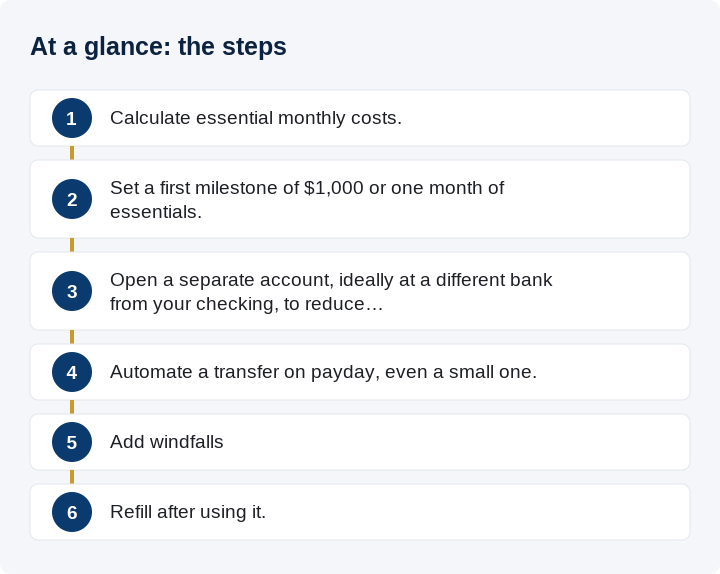
Key points
Job loss, a medical bill, a car repair, an urgent trip home: emergencies are not rare, and they arrive without warning. Without savings, people turn to credit cards or payday loans, which make the problem worse. This guide explains how much to save, where to keep it and how to build the fund on a tight budget.
The emergency fund is not an investment. Its job is to be there, in full, on the worst day.
| Situation | Suggested target |
|---|---|
| Stable job, dual income, no dependents | About 3 months of essentials |
| Single income or dependents | About 6 months |
| Work visa tied to one employer (H-1B, L-1) | 6 months or more: a job loss starts a short clock |
| Self-employed or variable income | 6 to 12 months |
| Supporting relatives abroad | Add their monthly support to your essentials |
"Essentials" means rent or mortgage, utilities, food, transport, insurance, minimum debt payments and fixed obligations such as remittances, not your full spending.
Avoid stocks, crypto or anything whose value can fall sharply for money you may need next month.
Confirm the bank is FDIC-insured or the credit union is NCUA-insured. With fintech apps, check whether your money is held at an insured partner bank and how the "pass-through" insurance works; problems with intermediaries in 2024 showed that records matter.
Use it for genuine emergencies: loss of income, urgent medical or dental care, essential repairs, urgent travel for family emergencies, immigration costs that cannot wait. Planned expenses, such as holidays or a new phone, belong in separate savings goals.
A hypothetical H-1B engineer spends $3,500 a month on essentials, including $400 sent to his parents. He targets six months: $21,000. He saves $800 a month automatically into a high-yield savings account and adds his tax refund. After two years he reaches the target. When his employer announces layoffs, he has six months of runway to find a new sponsor within the 60-day grace period and, if needed, to pay for a change of status.
| Option | Access | Protection | Return |
|---|---|---|---|
| Traditional savings | Immediate | FDIC/NCUA | Usually very low |
| High-yield savings | 1–2 business days | FDIC/NCUA | Higher, variable |
| Money market deposit account | Immediate, sometimes checks | FDIC/NCUA | Variable |
| CD | At maturity, penalty if early | FDIC/NCUA | Fixed for the term |
| Treasury bills | At maturity or sold through a broker | Backed by the US government | Set at purchase |
| Money market fund | 1–2 business days | Not deposit-insured; SIPC covers broker failure only | Variable |
A hypothetical family runs a small cleaning business with income that changes from month to month. Their essential costs are $4,000 a month. Because income is irregular, they aim for nine months, $36,000. They keep three months in a high-yield savings account for instant access, three months in a CD ladder with maturities every few months, and three months in Treasury bills through a brokerage account. In slow months they draw from savings; in busy months they refill it. After a slow winter, the fund carries them through without debt.
Review the plan each year, because a new job, a child or a move changes what "enough" means.
Even a small fund is far better than none at all.
Yes, interest is taxable income, reported on Form 1099-INT.
Many advisers suggest a small starter fund first, then high-interest debt, then the full fund.
Possibly, if you may need it there, but remember currency risk and US reporting rules for foreign accounts.
Disclaimer. This article is general education, not financial, investment, tax or insurance advice, and it does not recommend any specific product or provider. Prices, rates, limits and rules change; check official sources such as irs.gov, consumerfinance.gov and investor.gov, and consider a licensed professional for decisions about your own money.
How green card holders, visa holders and ITIN borrowers buy homes in the US: mortgage types, down payments, credit, closing costs, the 2025 FHA change and common pitfalls.
How immigrant entrepreneurs finance a US business: bank loans, the 2025–2026 SBA citizenship rules, CDFIs, microloans, credit unions, investors and building business credit.
How identity theft happens, why immigrants are targeted, credit freezes, fraud alerts, IRS Identity Protection PINs, protecting immigration documents and recovery steps.