Index Funds vs Actively Managed Funds: What Long-Term Data Shows
The difference between index funds and actively managed funds, how fees compound, what long-term performance studies show, ETFs vs mutual funds and how to compare funds.
 Tradiciones del Mundo
The US stock market is the largest in the world and, for many households, the main engine of long-term savings. Understanding how it works removes much of the fear.
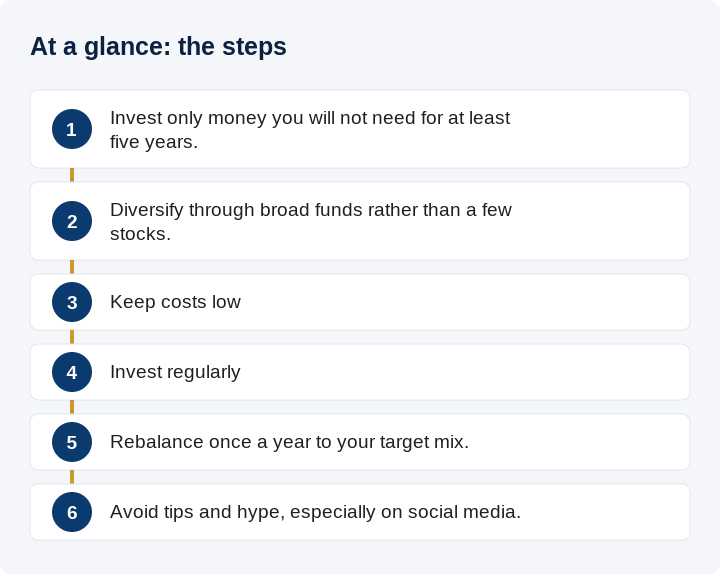
Key points
Many immigrants come from countries where stock markets are small, volatile or associated with speculation. In the US, ordinary workers invest in stocks through retirement plans and brokerage accounts, usually via funds. This guide explains the basic mechanics in plain language so you can understand what you own and why prices move.
It is education, not advice to buy any investment.
Owning the market through a diversified fund means owning a small part of thousands of businesses, not betting on one.
When you buy a share, you own a fraction of a company. Shareholders may receive part of the profits as dividends and benefit if the company becomes more valuable. They also share the risk: if the company fails, the shares can become worthless. Unlike a bank deposit, stocks are not insured against losses.
Most US stocks trade on two main exchanges, the New York Stock Exchange and Nasdaq, as well as other trading venues. Regular trading hours run from 9:30 a.m. to 4:00 p.m. Eastern Time on business days. Prices change constantly as buyers and sellers meet. Brokers route your orders to these markets.
| Index | What it tracks |
|---|---|
| S&P 500 | About 500 large US companies, weighted by market value |
| Dow Jones Industrial Average | 30 large companies, weighted by price |
| Nasdaq Composite | Thousands of stocks listed on Nasdaq, heavy in technology |
| Total market indexes | Nearly all US public companies |
You cannot buy an index directly, but index funds and ETFs replicate them at low cost. See index funds vs active funds.
For long-term investors buying funds, simple market or limit orders during regular hours are usually enough.
Over short periods, prices can move for reasons unrelated to a company's long-term value.
A correction is commonly described as a decline of 10% or more from a recent high; a bear market as a decline of 20% or more; a bull market as a sustained rise. US stocks have experienced many corrections and several deep bear markets, including in 2008 and 2020, followed by recoveries that took months or years. Investors who sold in panic often locked in losses.
A hypothetical new resident invests $200 a month in a total-market index fund. In her second year the market falls 25%. She keeps investing, buying more shares at lower prices. When the market recovers, those cheaper shares raise her average return. Had she sold during the decline, she would have turned a temporary loss into a permanent one.
A company becomes public through an initial public offering (IPO), selling shares to investors and listing them on an exchange. Public companies must file regular financial reports with the SEC, including annual reports (Form 10-K) and quarterly reports (Form 10-Q), which anyone can read for free on the SEC's EDGAR database. These disclosures are one of the strengths of US markets.
US exchanges close on major holidays such as New Year's Day, Thanksgiving and Christmas, and some close early before certain holidays. Pre-market and after-hours trading exist but have lower liquidity and wider spreads, which makes them less suitable for beginners.
Company filings on the SEC's EDGAR database, educational material on Investor.gov and FINRA, and your fund's official documents are reliable starting points. Treat anonymous tips, paid promotions and social media "gurus" with skepticism.
Remember that time in the market matters more than finding the perfect moment to start.
Patience is the most valuable skill a new investor can build.
Yes. Residents and many nonresidents can, with different tax treatment.
Yes; qualified dividends receive lower rates for US taxpayers.
SIPC protects missing securities and cash up to limits; it does not protect against market losses.
Disclaimer. This article is general education, not financial, investment, tax or insurance advice, and it does not recommend any specific product or provider. Prices, rates, limits and rules change; check official sources such as irs.gov, consumerfinance.gov and investor.gov, and consider a licensed professional for decisions about your own money.
The difference between index funds and actively managed funds, how fees compound, what long-term performance studies show, ETFs vs mutual funds and how to compare funds.
How bonds work, the types of US Treasury securities, TIPS and I bonds, buying through TreasuryDirect or a broker, interest rate risk and taxes for immigrants.
How immigrants invest in US real estate: buying rental property, landlord duties, financing, REITs, taxes and depreciation, FIRPTA for foreign sellers and common risks.