Health Insurance for Visiting Parents: Visitor Medical Insurance Explained
How to insure parents visiting the US on B-2 visas or ESTA: why Medicare and ACA plans do not cover them, visitor plan types, pre-existing conditions, costs and claims.
 Tradiciones del Mundo
If your family depends on your income, here or abroad, life and disability insurance replace that income if something happens to you. Immigration status affects how you buy it.

Key points
Many immigrants support relatives in two countries at once. Losing that income through death or long-term disability would hit both households. Insurance is one way to manage that risk. This guide explains the types of coverage, how much people typically consider, and the specific questions immigrants face when applying.
Insurance is not an investment. It is a way to transfer a risk your family cannot afford to carry alone.
| Type | How it works | Typical use |
|---|---|---|
| Term life | Pays if you die during the term (10, 20 or 30 years); no cash value | Protecting children until adulthood, covering a mortgage |
| Whole life | Lifetime coverage with a savings component; much higher premiums | Estate planning, specific long-term needs |
| Universal life | Flexible premiums and coverage with cash value linked to interest or markets | Complex planning; requires careful review |
| Group life (employer) | Often one or two times salary, cheap or free | Basic layer while employed |
Be cautious with products sold mainly as investments. Their fees and surrender charges can be high, and comparing them requires detailed illustrations. The SEC and state insurance regulators publish guidance on indexed and variable products.
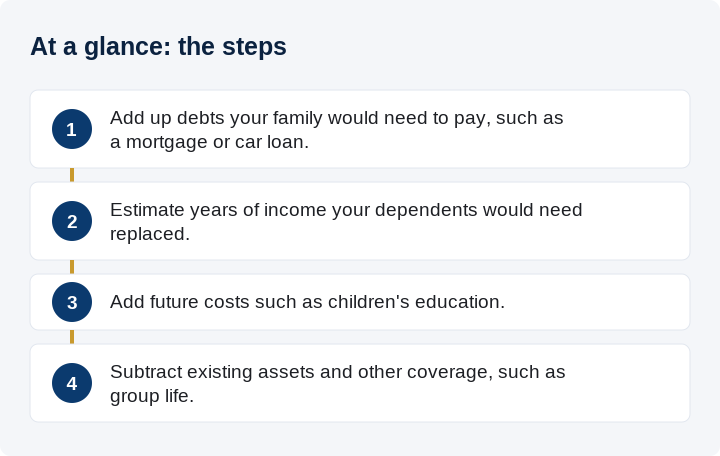
A common starting point is a multiple of income, often cited as 10 times annual salary, but a needs-based calculation is better:
You are far more likely to be unable to work for a period than to die young. Disability coverage pays a percentage of income, commonly 50% to 70%.
Check whether a policy defines disability as being unable to do your own occupation or any occupation; the first is more protective.
Each insurer sets its own underwriting rules for non-citizens. Typical factors:
You can usually name beneficiaries who live outside the US, but payouts may take longer and require extra identification. Life insurance proceeds are generally not taxable income to beneficiaries under US federal law, though estate tax rules for non-citizens are complex. Keep beneficiary designations up to date after marriage, divorce or births.
A hypothetical couple with two young children earns $90,000 a year, mostly from one spouse, and sends $400 a month to parents abroad. Their needs-based calculation might look like this: $250,000 remaining on a mortgage, ten years of income replacement at roughly 70% of $90,000 ($630,000), and $100,000 for future education, minus $50,000 in savings and $90,000 of group life coverage through work. The gap is about $840,000. A 20-year term policy of $850,000 to $1 million on the main earner, plus a smaller policy on the other spouse to cover childcare, would close it. Term premiums for healthy non-smokers in their thirties are typically a small fraction of the cost of permanent insurance for the same coverage.
Riders modify a policy. Common examples include a waiver of premium if you become disabled, an accelerated death benefit for terminal illness, and child term riders. Each adds cost; buy only those that solve a real need.
Many policies remain in force as long as premiums are paid, but check the contract's residence clauses before moving.
Most US insurers require US residence; visitors rarely qualify.
Verify the insurer and agent are licensed with your state insurance department and look up complaint data through the NAIC.
Disclaimer. This article is general education, not financial, investment, tax or insurance advice, and it does not recommend any specific product or provider. Prices, rates, limits and rules change; check official sources such as irs.gov, consumerfinance.gov and investor.gov, and consider a licensed professional for decisions about your own money.

How to insure parents visiting the US on B-2 visas or ESTA: why Medicare and ACA plans do not cover them, visitor plan types, pre-existing conditions, costs and claims.

How US medical billing works, the No Surprises Act, good faith estimates for the uninsured, hospital financial assistance, negotiating bills and medical debt.
How state unemployment insurance works for immigrants: who qualifies, the work authorization requirement, visa holders after job loss, applying, and what it means for public charge.