Your First US Tax Return as an Immigrant: A Step-by-Step Guide
How newcomers file their first US tax return: deadlines, forms (1040 or 1040-NR), W-2 and 1099 forms, deductions and credits, state returns, free help and common mistakes.
 Tradiciones del Mundo
For US taxes, "resident" does not mean what immigration law means. Your tax residency decides whether you are taxed on worldwide income or only US income.

Key points
Tax residency is one of the most important and least understood questions for immigrants. A person can be a nonimmigrant for immigration purposes and a resident for tax purposes, or a green card holder living abroad who is still a tax resident. The answer changes which forms you file, which income is taxed and what you must report about foreign accounts.
Tax residency is decided by the tax code, not by your visa. Count your days and check the tests each year.
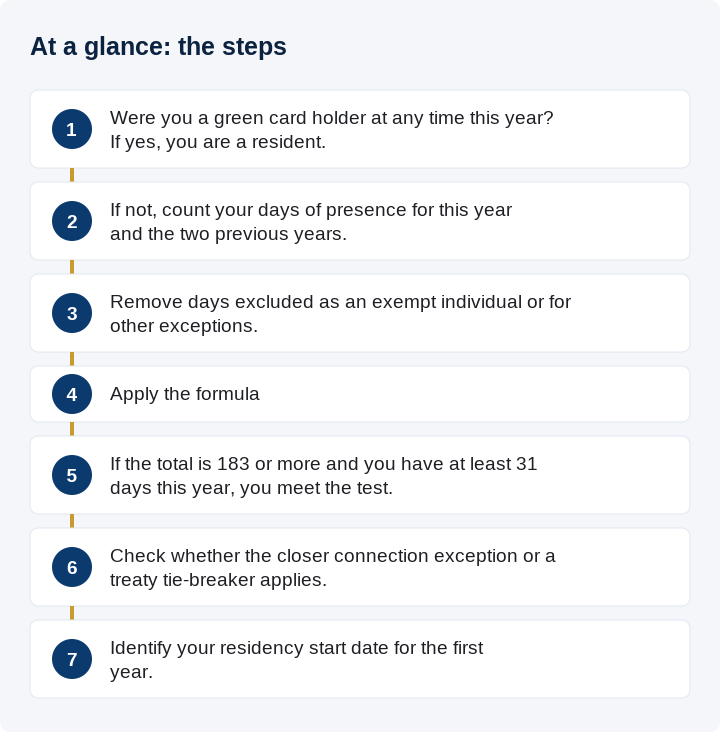
You are a resident for tax purposes if you were a lawful permanent resident at any time during the calendar year. The status continues until it is formally abandoned or rescinded, for example by filing Form I-407 or by a final order. Simply moving abroad does not end tax residency for a green card holder.
You meet the test if you were physically present in the US for:
| Year | Days present | Multiplier | Counted days |
|---|---|---|---|
| Current year | 120 | 1 | 120 |
| Previous year | 120 | 1/3 | 40 |
| Year before | 120 | 1/6 | 20 |
| Total | 180 (does not meet the test) | ||
Exempt individuals file Form 8843 to document excluded days.
In the year you arrive or leave, you may be a nonresident for part of the year and a resident for the rest. Dual-status returns have special rules: limits on deductions, filing status and how income from each period is reported. Many people choose professional help for this year.
A hypothetical L-1 manager arrives on 1 July and stays in the US the rest of the year: 184 days. She meets the substantial presence test for that year. Her residency starts on her first day of presence, 1 July, so she files a dual-status return: nonresident from January to June and resident from July. Married to a nonresident spouse, they could instead elect to be treated as full-year residents to file jointly, reporting worldwide income for the whole year.
When you leave, your residency usually ends on your last day of presence if you meet certain conditions, such as having a closer connection to another country for the rest of the year. Green card holders remain residents until they formally give up status. Long-term residents who give up a green card may face the expatriation rules, including a possible exit tax.
Keep a travel log with dates of every entry and exit; it is the basis of every calculation above.
When the result is close to 183 days, a tax professional can confirm how each excluded day should be treated.
Run the numbers: use our substantial presence test calculator to apply the 183-day formula to your own days.
Yes, any part of a day in the US counts as a day of presence, with the exceptions above.
Only in limited cases, through treaty tie-breaker rules, which can have immigration consequences.
Form 1040-NR.
Disclaimer. This article is general education, not financial, investment, tax or insurance advice, and it does not recommend any specific product or provider. Prices, rates, limits and rules change; check official sources such as irs.gov, consumerfinance.gov and investor.gov, and consider a licensed professional for decisions about your own money.
How newcomers file their first US tax return: deadlines, forms (1040 or 1040-NR), W-2 and 1099 forms, deductions and credits, state returns, free help and common mistakes.
How self-employed immigrants pay US taxes: the 15.3% self-employment tax, quarterly estimated payments, deductions, forming an LLC and which visa statuses allow self-employment.

What an Individual Taxpayer Identification Number is, who needs one, how to apply with Form W-7, acceptance agents, renewals, and what an ITIN can and cannot do.