Good Moral Character, Military Naturalization and the Oath
The final citizenship hurdles: good moral character bars and the 2025 policy, faster naturalization through military service, and the oath ceremony.
 Tradiciones del Mundo
The interview combines a review of your N-400 under oath with the civics and English tests. Here is how each part works and how to prepare.

Key points
The citizenship interview is the moment most applicants worry about, and also the most predictable part of the process. This guide explains the new civics test, the English test and the interview itself, with study plans and checklists.
Asking the officer to repeat or rephrase a question is completely acceptable.
A new, longer civics test applies to applicants who filed on or after 20 October 2025. Here is how it differs from the old one.
| 2008 test | 2025 test | |
|---|---|---|
| Applies to N-400s filed | Before 20 October 2025 | On or after 20 October 2025 |
| Question bank | 100 | 128 |
| Questions asked | Up to 10 | Up to 20 |
| To pass | 6 correct | 12 correct |
On the 2025 test, the officer stops once you answer 12 correctly or 9 incorrectly. Questions are asked orally in English.
Some answers depend on who holds office when you are tested (the President, Vice President, Speaker of the House, your senators and representative, your state's governor). Check them shortly before your interview.
Applicants aged 65 or older with 20 years as permanent residents study a shorter list of specially marked questions and can take the test in their language.
You get a second chance, usually within 60 to 90 days, on the part you failed. Failing again leads to denial; you can reapply.
Questions cover the purpose of the Constitution, the Bill of Rights, the three branches of government and their powers, the number of senators and representatives, the length of their terms, major wars and figures in American history, the Civil Rights movement, and national symbols and holidays.
The English test checks basic, practical English. Most applicants pass it, but preparation reduces anxiety and mistakes.
USCIS publishes reading and writing vocabulary lists, mostly civics and history words, names of holidays and months.
| Rule | Who | Effect |
|---|---|---|
| 50/20 | 50 or older, 20 years as a resident when filing | No English test; civics in your language |
| 55/15 | 55 or older, 15 years as a resident when filing | No English test; civics in your language |
| 65/20 | 65 or older, 20 years as a resident | Above, plus a shorter civics list |
| Disability (N-648) | Medical condition preventing learning | Exemption from English and/or civics |
A hypothetical applicant reads aloud "Who was the first President?" correctly on the first try. For writing, the officer dictates "Washington was the first President." He writes it with a minor spelling mistake that does not change the meaning, which is accepted. Speaking was assessed during the review of his N-400.
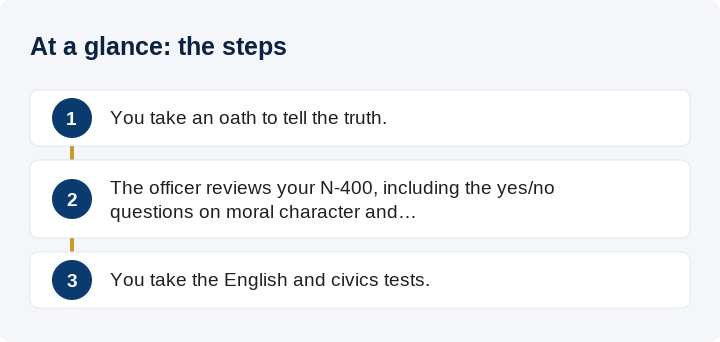
The citizenship interview combines a review of your N-400 under oath with the English and civics tests.
Reread your N-400. Prepare explanations for any trips, arrests, tax issues or changes since filing. Update anything that changed, such as address, marital status or employment.
A hypothetical applicant arrives 30 minutes early and passes security. An officer calls her name, asks her to stand and swear to tell the truth, and checks her identification. The officer goes through each part of the N-400: her name, addresses, jobs, trips, marital history and children. Then come the yes/no questions about crimes, taxes, voting, military service and allegiance, where she confirms or explains each answer. The officer hands her a tablet to read a sentence, then dictates one for her to write. Finally the officer asks civics questions until she has answered enough correctly. At the end, she receives Form N-652 with the result.
You will receive an oath ceremony notice, unless the oath is offered the same day. Do not travel abroad for long or change your situation (for example, by getting divorced under the three-year rule) before the oath without considering the effect on your eligibility.
Many answers overlap, but study the list for the version you take.
Only if you qualify for the 50/20, 55/15 or 65/20 exemptions.
No. The officer accepts reasonable answers that match the meaning.
Errors that change the meaning or make the sentence unreadable. Minor spelling or punctuation errors are often accepted.
Only if exempt from the English requirement.
You get a second opportunity, usually within 60 to 90 days.
It must be completed by a licensed medical professional and must explain the link between the condition and the inability to learn.
Usually 20 to 45 minutes.
Yes, with Form G-28 on file.
Yes, but rescheduling can delay your case by months.
You must disclose them. Bring the records and get legal advice first.
No, except in some three-year marriage cases where the officer requests it.
Disclaimer. This article is general information, not legal advice, and it is not affiliated with any government agency. US immigration rules, fees and processing times change often, and they changed repeatedly in 2025 and 2026. Confirm current requirements on uscis.gov and travel.state.gov, or speak with a licensed immigration attorney or a DOJ-accredited representative.
The final citizenship hurdles: good moral character bars and the 2025 policy, faster naturalization through military service, and the oath ceremony.

How permanent residents and citizens differ in rights and risks, how dual citizenship works, and how children become citizens automatically or with Form N-600.

Step-by-step naturalization guide: eligibility, Form N-400, fees and the reduced fee, filing 90 days early, biometrics, the interview and the oath.