Your USCIS Online Account: Filing, Tracking and Messaging
How to create and use a USCIS online account: filing forms online, linking paper cases, uploading evidence, reading notices, two-step verification and avoiding fake sites.
 Tradiciones del Mundo
Before filing anything important, many lawyers start by requesting the client's government file. The Freedom of Information Act lets you see what the government already knows about you.
Key points
People often forget details of applications filed years ago, or never learned what an officer wrote about them. Before applying for citizenship, a green card or relief in court, knowing your record avoids contradictions that can look like misrepresentation. FOIA requests are the standard way to get it.
Your new application should be consistent with everything you filed before. A FOIA request shows you what that "everything" is.
| Agency | Typical records |
|---|---|
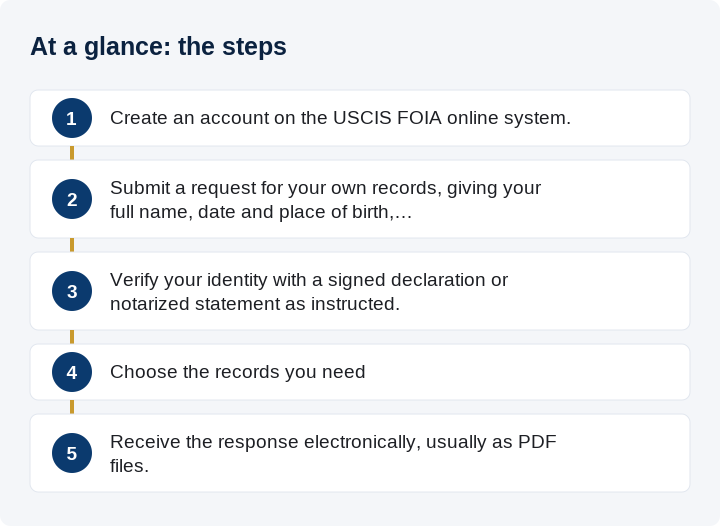
| USCIS | The A-file: petitions, applications, notices, interview notes, photographs |
| CBP | Entry and exit records, inspections, border encounters |
| ICE | Arrests, detention and enforcement records |
| EOIR | Immigration court records of proceedings and recordings |
| Department of State | Visa applications and consular records |
| FBI | Criminal history records (identity history summary) |
Requests for another person's records require that person's written consent.
Responses can be long, sometimes hundreds of pages. Some parts may be withheld or redacted under FOIA exemptions, for example to protect law enforcement techniques or third parties' privacy. You can appeal withholdings.
USCIS places requests in tracks: simple requests for specific documents move faster than full A-files. Expect several weeks to a few months, and longer for complex records. Requests can be expedited only in limited circumstances, such as an imminent court hearing with a documented need.
A hypothetical man applying for citizenship in 2026 remembers that in 2009 he was stopped at the border, sent back and later entered on a tourist visa. He is not sure whether that first encounter was recorded as a formal removal. Answering wrongly on the N-400 could look like a lie. He files FOIA requests with USCIS and CBP. The CBP records show he was allowed to withdraw his application for admission, which is not a removal. With that document, his lawyer answers the N-400 questions accurately and attaches the record, avoiding a problem at the interview.
CBP accepts FOIA requests online for border encounters and inspection records. For simple travel history, the I-94 website shows recent arrivals and departures, which is faster.
If you were ever in immigration court, request the record of proceedings from EOIR. It contains hearing notices, applications, evidence and decisions, and sometimes audio recordings of hearings.
Visa application records and consular notes can be requested through the State Department's FOIA process, though consular records are subject to confidentiality rules and may be partially withheld.
An Identity History Summary ("rap sheet") shows arrests reported to the FBI. It is requested through the FBI's own process, not FOIA, and helps when you need to know what criminal history appears in federal records.
If records are withheld or the search seems incomplete, you can file an administrative appeal within the deadline stated in the response, usually 90 days. You can also contact the agency's FOIA public liaison for help with delays. If a response is significantly overdue, a lawsuit in federal court is possible, though rarely necessary for individual requests.
Requests for your own records are handled under both the Freedom of Information Act and the Privacy Act, which gives individuals the right to access and request correction of records about themselves. In practice, USCIS processes them together through the same online system.
For entries by air and sea since the record became electronic, CBP's I-94 website lets you download your most recent I-94 and a travel history of arrivals and departures covering roughly the last ten years, free and immediately. It is the quickest way to check the date your authorized stay ends and to reconstruct trips for a naturalization application. If the online record has an error, such as a wrong class of admission or date, contact the CBP deferred inspection office at a port of entry, or USCIS if the error is on an I-94 it issued with an approval notice. Land entries and older trips may not appear, which is when a FOIA request to CBP becomes useful.
Most individual requests to USCIS are free; fees can apply for large commercial requests.
No. Requesting your own records is a right and does not trigger enforcement.
Yes, recent travel history is available on the CBP I-94 website; older records may need FOIA.
Disclaimer. This article is general information, not legal advice, and it is not affiliated with any government agency. US immigration rules, fees and processing times change often, and they changed repeatedly in 2025 and 2026. Confirm current requirements on uscis.gov and travel.state.gov, or speak with a licensed immigration attorney or a DOJ-accredited representative.
How to create and use a USCIS online account: filing forms online, linking paper cases, uploading evidence, reading notices, two-step verification and avoiding fake sites.
How to translate and prepare birth, marriage and police documents for USCIS and the NVC: translator certifications, the reciprocity schedule, unavailable records and secondary evidence.
Who can adjust status with Form I-485, the 245(c) bars, adjustment vs consular processing, and work and travel permits while the case is pending.