Adjustment of Status: Green Card Without Leaving the US
Who can adjust status with Form I-485, the 245(c) bars, adjustment vs consular processing, and work and travel permits while the case is pending.
 Tradiciones del Mundo
A missing translation or the wrong kind of birth certificate is one of the most common reasons for delays. Getting civil documents right the first time saves months.
Key points
Immigration cases depend on civil documents: birth certificates, marriage and divorce records, police certificates and court records. Each country issues them differently, and USCIS and consulates expect specific versions. This guide explains how to obtain and translate them correctly.
Any document containing foreign language submitted to USCIS shall be accompanied by a full English language translation which the translator has certified as complete and accurate, and by the translator's certification that he or she is competent to translate from the foreign language into English.
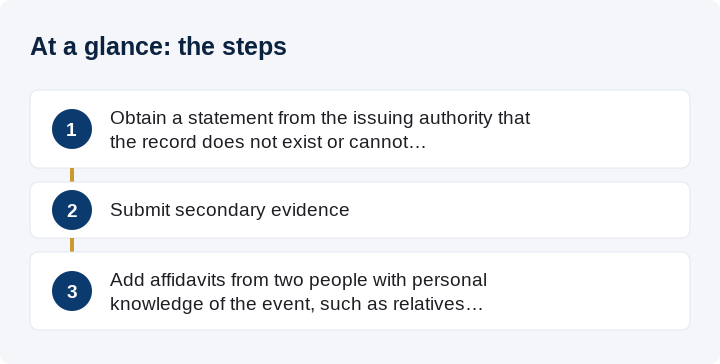
For USCIS, a certified translation is a complete English translation accompanied by a signed statement from the translator. It does not need to be notarized or done by a government-sworn translator. A typical certification states the translator's name, that they are competent to translate from the language into English, and that the translation is complete and accurate, with signature, date and contact details.
Anyone fluent in both languages can translate, including a friend or relative, though many applicants use professional services for reliability. Applicants should not translate their own documents. Translate everything, including stamps, seals and handwritten notes.
Refugees and asylees, who often cannot contact their governments, receive flexibility in practice.
For immigrant visas, applicants 16 and older generally need police certificates from their country of nationality and from countries where they lived for certain periods. The reciprocity schedule explains where they can be obtained and whether they are available.
A hypothetical applicant from Mexico submits a birth certificate extract that lacks his father's name, plus a translation by his cousin without a certification. USCIS issues an RFE. He obtains the full certified copy from the civil registry, has it translated by a professional who signs a certification, and responds. Had he checked the reciprocity schedule first, he would have avoided three months of delay.
A simple certification attached to each translation might read: "I, [full name], certify that I am competent to translate from Spanish into English, and that the attached English translation of the birth certificate of [name] is complete and accurate to the best of my knowledge and ability." It is followed by the translator's signature, printed name, address, phone number and date. Some translators add their professional credentials, which is helpful but not required.
| Case | Typical civil documents |
|---|---|
| Marriage green card | Birth certificates, marriage certificate, divorce decrees for prior marriages |
| Parent or child petition | Birth certificates showing the relationship, parents' marriage certificate |
| Immigrant visa abroad | All of the above, plus police certificates and court or military records |
| Naturalization | Marriage and divorce records, court dispositions for any arrests |
| Asylum | Identity documents, evidence of persecution, translations of all foreign evidence |
Professional services typically charge per page or per word, with standard documents such as birth certificates priced per page. Ask whether the price includes the certification letter, how corrections are handled and how long delivery takes. For large cases, a single translator for all family documents keeps names and terminology consistent, which matters more than speed. Keep the editable files so later corrections are quick.
Finally, keep the translated set together with the originals for the interview, because officers may compare them line by line, and a missing original can lead to a request for evidence even when the translation was accepted.
USCIS generally does not require apostilles; some other agencies or states may.
USCIS accepts copies unless originals are requested; bring originals to interviews.
Explain the variations, provide evidence they refer to the same person, and be consistent on forms.
Disclaimer. This article is general information, not legal advice, and it is not affiliated with any government agency. US immigration rules, fees and processing times change often, and they changed repeatedly in 2025 and 2026. Confirm current requirements on uscis.gov and travel.state.gov, or speak with a licensed immigration attorney or a DOJ-accredited representative.
Who can adjust status with Form I-485, the 245(c) bars, adjustment vs consular processing, and work and travel permits while the case is pending.
How immigrant visas are processed abroad: the National Visa Center, fees, civil documents, the medical exam, the embassy interview and entering the US.
What to file with Form I-485, what happens at the biometrics appointment and how to prepare for the green card interview, with checklists and common questions.