How to Find an Immigration Lawyer and Avoid Notario Fraud
Who can legally give immigration advice, how to find and evaluate an immigration attorney or accredited representative, typical fees, free help and how to spot notario fraud.
 Tradiciones del Mundo
Hundreds of thousands of people receive a Notice to Appear every year. Immigration court is a real court with real deadlines, and missing a single hearing can end a case.
Key points
Immigration courts are part of the Executive Office for Immigration Review (EOIR), an agency of the Department of Justice. Immigration judges decide whether a non-citizen can be removed from the US and whether they qualify for any relief. The courts have faced a backlog of several million cases in recent years, which means cases can take years, but individual hearings still move on fixed dates. This guide explains the process from the first notice to appeal.
The single most important rule in immigration court: go to every hearing, and keep the court informed of your address.
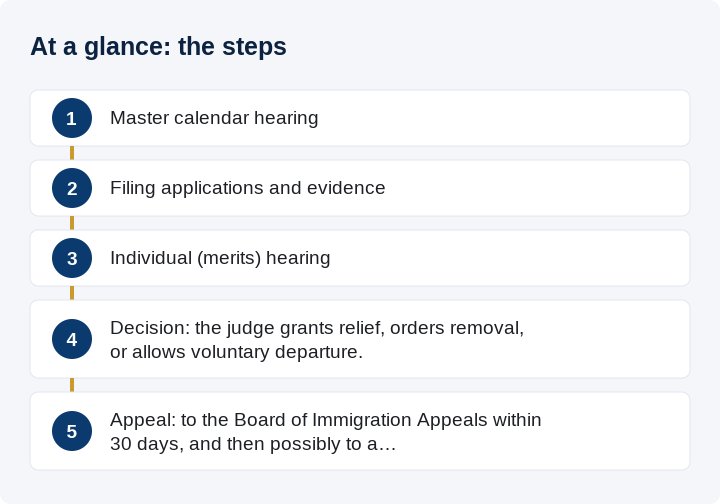
A case begins when the Department of Homeland Security (through ICE, CBP or USCIS) serves a Notice to Appear and files it with a court. The NTA lists:
Common triggers include being stopped at the border, overstays discovered by ICE, criminal arrests, and denials of USCIS applications for people without other status. Since 2025, USCIS has issued NTAs more often after denying applications, and the government has expanded expedited removal, which can remove some people without a court hearing.
| Relief | Basic idea |
|---|---|
| Asylum, withholding, CAT | Protection from persecution or torture; see asylum |
| Cancellation of removal (permanent residents) | 5 years as a resident, 7 years of continuous residence, no aggravated felony |
| Cancellation of removal (non-residents) | 10 years of presence, good moral character and exceptional and extremely unusual hardship to a US citizen or resident spouse, parent or child |
| Adjustment of status | A green card through a family or employment petition, decided by the judge |
| Waivers | For specific grounds such as fraud or certain crimes |
| Voluntary departure | Leaving at your own expense by a deadline, avoiding a formal removal order |
Children and people with serious mental conditions can receive additional protections, and some programs provide counsel in limited circumstances.
If you miss a hearing and DHS shows you were notified, the judge will usually order removal in absentia. Such orders can be reopened only in limited cases, such as lack of proper notice or exceptional circumstances (a serious illness, for example) raised within 180 days. They also make you ineligible for many forms of relief for ten years.
Some respondents are detained by ICE during proceedings. Detained cases move much faster. Detainees may request bond hearings in some cases, and the rules on bond eligibility have been the subject of significant litigation and policy changes since 2025.
Prepare your testimony with your representative, practice answering questions in chronological order, and bring witnesses who can confirm key facts. Make sure every document in a foreign language has a certified translation, and file evidence by the deadline the judge set; late evidence may be excluded. On the day, dress as for any court, arrive early and bring copies.
Only if you have a pending application that allows it, such as asylum after the required waiting period.
It varies widely: detained cases take weeks or months, non-detained cases often years.
Judges and DHS have used tools such as administrative closure or dismissal in some periods; their availability depends on current policy.
Through appeals, motions to reopen or reconsider, or in rare cases special relief. Deadlines are short.
Disclaimer. This article is general information, not legal advice, and it is not affiliated with any government agency. US immigration rules, fees and processing times change often, and they changed repeatedly in 2025 and 2026. Confirm current requirements on uscis.gov and travel.state.gov, or speak with a licensed immigration attorney or a DOJ-accredited representative.
Who can legally give immigration advice, how to find and evaluate an immigration attorney or accredited representative, typical fees, free help and how to spot notario fraud.
How to request your immigration file (A-file) and records from USCIS, CBP, ICE, EOIR and the State Department through FOIA, what you receive, timelines and how to use it.
How to create and use a USCIS online account: filing forms online, linking paper cases, uploading evidence, reading notices, two-step verification and avoiding fake sites.