Green Cards for Parents, Siblings and Widow(er)s of US Citizens
How US citizens sponsor parents and siblings, who counts as a parent or sibling, the long F4 wait, and how widows and widowers can still get a green card.
 Tradiciones del Mundo
Engaged to a foreign partner? You can bring them to the US to marry, or marry first and bring them as a spouse. Each path has a clear trade-off in cost, time and work rights.

Key points
Couples often decide between these routes based on where they want the wedding. That matters, but so do work, travel and total cost. The first section explains the K-1 process from the I-129F petition to the green card; the second compares it side by side with the spousal immigrant visa.
If the foreign partner needs to work right away, marrying first is usually the better route.
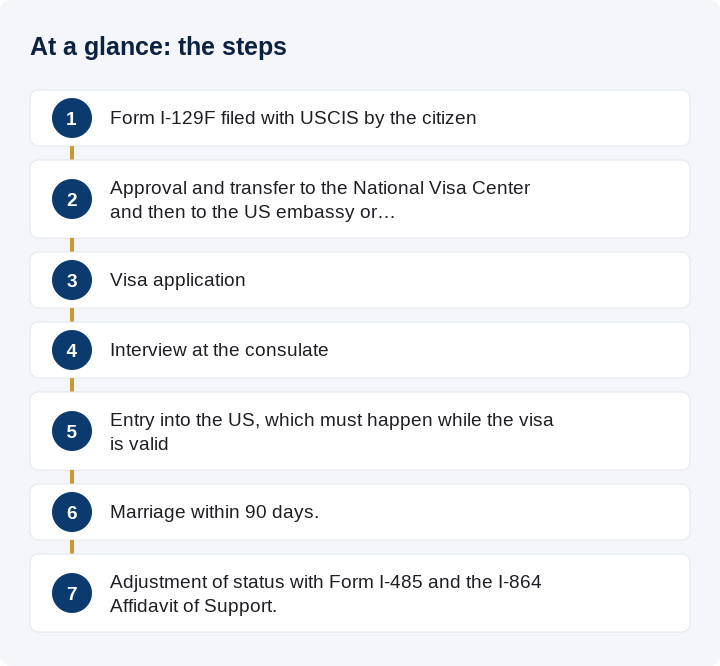
The K-1 lets a US citizen bring a foreign fiancé(e) to the United States to marry. It is fast to explain and easy to get wrong.
The K-1 status cannot be extended. If you do not marry the petitioner within 90 days, you are expected to leave. You cannot adjust status through a different person or most other categories. If you marry after the 90 days, USCIS can still approve adjustment based on that marriage, but an overstay in between creates risk.
Unmarried children under 21 of the fiancé(e) can come on K-2 visas and adjust status with the parent, as long as they file before turning 21.
The alternative is to marry abroad and apply for a CR-1 or IR-1 spousal immigrant visa. The K-1 gets you into the US sooner in some years but costs more overall and leaves the foreign partner without a work permit for months after arrival. See CR-1 vs K-1.
Petitioners with certain criminal convictions, or who have filed multiple K-1 petitions in the past, are subject to the International Marriage Broker Regulation Act and may need waivers.
Adding the I-129F fee, the visa fee, the medical exam, the I-485 after the wedding and optional work and travel permits, government costs for a K-1 route typically exceed $3,000 per person before travel and any legal fees.
Couples often choose between marrying first abroad or marrying in the US. Each route has a clear trade-off.
| K-1 | CR-1 / IR-1 | |
|---|---|---|
| Wedding | In the US | Before immigrating, anywhere |
| Petitioner | US citizen only | US citizen (residents use F2A) |
| Status on arrival | K-1 nonimmigrant | Permanent resident |
| Right to work on arrival | No (practically), must wait for an EAD | Yes, immediately |
| Travel abroad after arrival | Risky until advance parole | Free to travel |
| Government fees, approx. | I-129F $675 + visa $265 + I-485 $1,440 + optional EAD/AP | I-130 $675 + visa $325 + I-864 $120 + immigrant fee $235 |
| Second round of processing | Yes, the I-485 in the US | No |
Historically the K-1 was faster to reach the US, but USCIS and consular processing times have shifted many times, and the K-1 adds a full adjustment-of-status phase afterwards. Compare current processing times for the I-129F and the I-130 at the relevant service center and the waiting time at the consulate before deciding.
Consider a hypothetical US citizen in Texas engaged to a partner in Colombia. If they choose the K-1, the partner may arrive sooner, the wedding happens in Texas with family, but the partner cannot work for several months while the I-485 and work permit are processed, and international trips are risky until advance parole arrives. If they marry in Colombia and choose the CR-1, they wait longer apart, but the partner lands as a permanent resident, starts work at once and can travel freely.
Technically K-1 entrants can request work authorization, but it is valid only for the 90 days. Most people apply for a work permit together with the I-485 after marriage.
Not if you want to use the K-1. Marrying abroad means you should switch to a spousal immigrant visa.
Yes, but you would need a new I-130 petition and you lose the time spent on the I-129F. If you marry abroad while a K-1 is pending, the K-1 can no longer be used.
Both are approved in most genuine cases. Refusals usually come from weak evidence of the relationship, prior immigration violations or criminal records, not from the route chosen.
No. Permanent residents can only petition for an already-married spouse in the F2A category.
Disclaimer. This article is general information, not legal advice, and it is not affiliated with any government agency. US immigration rules, fees and processing times change often, and they changed repeatedly in 2025 and 2026. Confirm current requirements on uscis.gov and travel.state.gov, or speak with a licensed immigration attorney or a DOJ-accredited representative.

How US citizens sponsor parents and siblings, who counts as a parent or sibling, the long F4 wait, and how widows and widowers can still get a green card.

How citizens and permanent residents sponsor children and spouses: immediate relative, F1, F2A, F2B and F3, aging out at 21 and how the CSPA protects children.

How adopted children immigrate to the US: Hague Convention vs orphan processes, Forms I-800A and I-600A, home studies, IR3 and IR4 visas and automatic citizenship.