US Citizenship for Children Born Abroad: CRBA and Transmission Rules
When children born outside the US to American parents are citizens at birth, the physical presence rules for transmitting citizenship, and how to apply for a CRBA and passport.
 Tradiciones del Mundo
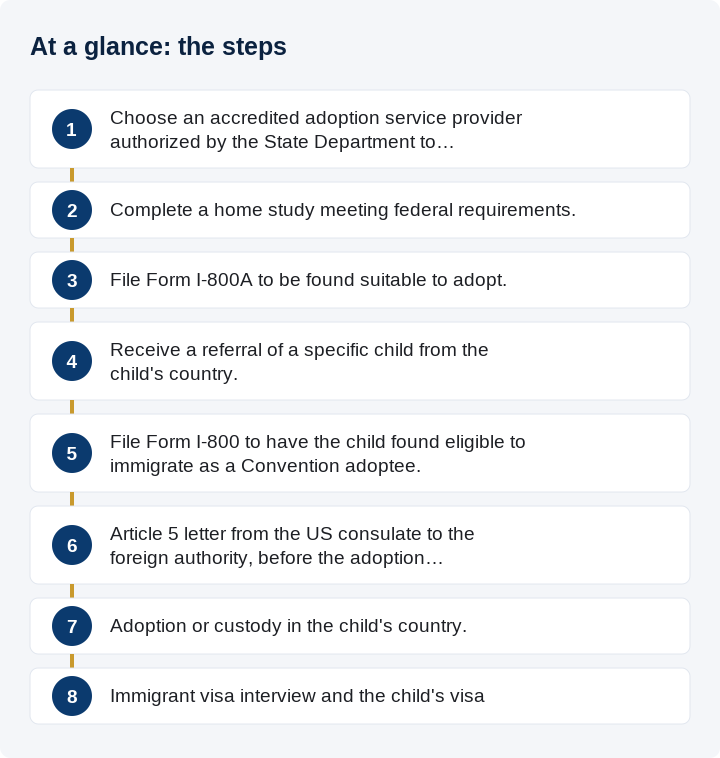
Adopting a child from another country involves two legal systems at once: the adoption law of the child's country and US immigration law. Both must be satisfied before the child can come home.
Key points
Each year, thousands of children are adopted from other countries by US families. The numbers have fallen sharply since the mid-2000s as countries changed their rules, but the process remains a well-defined path. This guide explains the immigration side: which process applies, the forms, the visas and how the child becomes a citizen. It does not replace the adoption agency and the lawyers who handle the adoption itself.
An adoption that is valid abroad is not automatically enough for immigration. The child must also qualify under US immigration law.
| Path | When it applies | Main forms |
|---|---|---|
| Hague Convention process | Child habitually resides in a country party to the Hague Adoption Convention | I-800A, then I-800 |
| Orphan process | Child resides in a non-Hague country and meets the definition of "orphan" | I-600A, then I-600 |
| Family-based petition (I-130) | Adoption finalized before age 16, with two years of legal custody and joint residence | I-130 |
For non-Hague countries, a child qualifies as an "orphan" if both parents have died or disappeared, abandoned the child or were separated from them, or if a sole or surviving parent cannot provide proper care and irrevocably releases the child for emigration and adoption. Prospective parents file Form I-600A for advance approval and later Form I-600 for the child, followed by an IR3 or IR4 visa.
Under the Child Citizenship Act of 2000, a foreign-born adopted child under 18 who is a permanent resident, lives in the legal and physical custody of a US citizen parent, and whose adoption is full and final, becomes a citizen automatically. Parents can obtain a Certificate of Citizenship with Form N-600 or a US passport. See citizenship for children.
A home study evaluates the family's suitability: interviews, home visits, background checks of adult household members, financial information, health, references and the family's preparation for an international adoption. It must be updated if circumstances change before the child immigrates.
A hypothetical couple in Minnesota wants to adopt from Colombia, a Hague country. They sign with an accredited provider, complete their home study, and USCIS approves their I-800A. Months later Colombia's authority refers a four-year-old child. USCIS provisionally approves the I-800, the consulate issues the Article 5 letter, and the Colombian court grants the adoption. After the visa interview in Bogotá, the child enters the US on an IH3 visa and becomes a US citizen on arrival.
International adoptions involve agency fees, home study costs, USCIS filing fees for the I-800A or I-600A and the child's petition, foreign program fees, travel (often more than one trip), translations, the child's immigrant visa fee and post-adoption services. Totals commonly reach tens of thousands of dollars. The federal adoption tax credit can offset part of qualified expenses for eligible families; check the IRS limits for the year the adoption is finalized.
Ask also how the provider supports families after the child arrives, including help with post-adoption reports, citizenship documents and access to counseling services for the child and parents.
US law allows it, but many countries restrict or prohibit adoption by single applicants.
Yes, but relative adoptions still follow the Hague or orphan process, or the I-130 route with two years of custody and residence.
Usually one to several years, depending on the country.
Disclaimer. This article is general information, not legal advice, and it is not affiliated with any government agency. US immigration rules, fees and processing times change often, and they changed repeatedly in 2025 and 2026. Confirm current requirements on uscis.gov and travel.state.gov, or speak with a licensed immigration attorney or a DOJ-accredited representative.
When children born outside the US to American parents are citizens at birth, the physical presence rules for transmitting citizenship, and how to apply for a CRBA and passport.
Why some green cards last two years, who gets them, and how to remove conditions with Form I-751: timing, evidence, fees, waivers after divorce and missed deadlines.

How spouses of US citizens and residents get a green card: eligibility, forms, fees, the evidence that proves a real marriage, the interview and conditional residence.