Conditional Green Cards and Removing Conditions (Form I-751)
Why some green cards last two years, who gets them, and how to remove conditions with Form I-751: timing, evidence, fees, waivers after divorce and missed deadlines.
 Tradiciones del Mundo
A child born abroad to an American parent may already be a US citizen. Whether they are depends on the parents' marriage, citizenship and how long the citizen parent lived in the US.

Key points
Many immigrants become US citizens and then have children while living or working abroad, or marry abroad. Whether those children are born American is not automatic. The Immigration and Nationality Act sets "transmission" requirements, mainly time the citizen parent spent in the US before the birth. This guide explains the main rules and how to document a child's citizenship.
Count the citizen parent's days in the US before the child's birth. That number often decides whether the child is a citizen.
| Parents | Requirement (births on or after 14 November 1986) |
|---|---|
| Both parents US citizens | At least one parent resided in the US or its outlying possessions before the birth |
| One citizen parent and one US national | The citizen parent was physically present in the US for one continuous year before the birth |
| One citizen parent and one non-citizen | The citizen parent was physically present in the US for five years before the birth, at least two of them after age 14 |
Different, stricter rules apply to births before 1986. US military service and certain government employment abroad count as physical presence.
For children of a citizen father, additional requirements apply: a blood relationship shown by clear and convincing evidence, the father's US nationality at the birth, a written agreement to provide financial support until age 18 (unless deceased), and legitimation or acknowledgment of paternity before age 18. Rules for citizen mothers have historically been different and were affected by the Supreme Court's 2017 decision in Sessions v. Morales-Santana. Check the State Department's current guidance for the child's birth date.
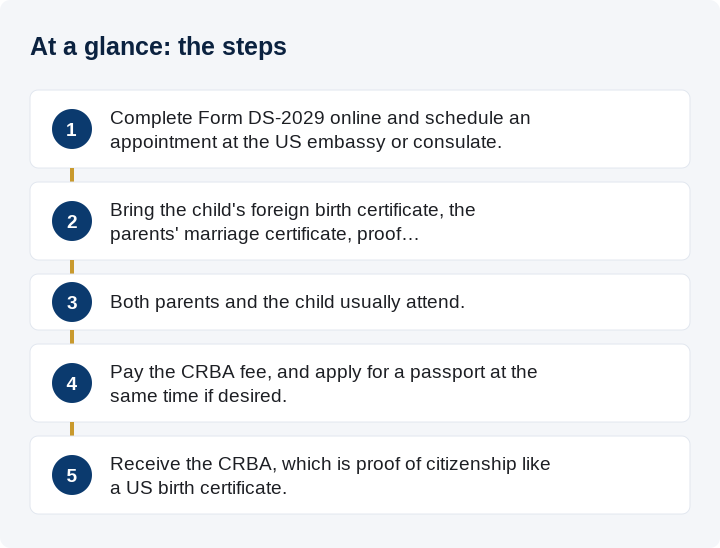
Evidence can include school transcripts, employment records, tax returns, Social Security earnings statements, leases, medical records and entry and exit stamps. Old passports are especially useful. Start gathering these before the child is born if you live abroad.
A hypothetical US citizen who naturalized at 30, after arriving in the US at 22, moves to Germany for work at 32 and has a child there with a German spouse. His physical presence in the US before the birth is about ten years, well over five, with more than two after age 14. The child is a US citizen at birth, and he applies for a CRBA and passport at the consulate in Frankfurt.
Once the child has a CRBA or US passport, parents can apply for a Social Security number, which is needed for US tax returns that claim the child and for future benefits. Some consulates assist with the application; otherwise it can be done at a Social Security office or a federal benefits unit abroad.
A hypothetical US citizen born in Texas moved to Mexico at age 3 and lived there continuously, returning only for short visits. At 25 she has a child in Mexico with a Mexican husband. Her physical presence in the US is about three years, almost all before age 14, so she does not meet the five-year, two-after-14 rule. Her child is not a US citizen at birth. She could later petition for the child as an immigrant, after which the child would become a citizen automatically while living with her in the US, or explore Form N-600K if the child's US citizen grandparent meets the presence requirements.
When in doubt, apply for the CRBA anyway with the best evidence available: the consular officer will review the facts, and a refusal letter clarifies the options.
A CRBA can be issued before the child turns 18. Adults apply for a passport directly with evidence of citizenship.
No. Retention requirements that once required some children born abroad to live in the US were repealed in 1978 for people born after 10 October 1952.
US law tolerates dual nationality; the other country decides its own rules.
Disclaimer. This article is general information, not legal advice, and it is not affiliated with any government agency. US immigration rules, fees and processing times change often, and they changed repeatedly in 2025 and 2026. Confirm current requirements on uscis.gov and travel.state.gov, or speak with a licensed immigration attorney or a DOJ-accredited representative.
Why some green cards last two years, who gets them, and how to remove conditions with Form I-751: timing, evidence, fees, waivers after divorce and missed deadlines.

How spouses of US citizens and residents get a green card: eligibility, forms, fees, the evidence that proves a real marriage, the interview and conditional residence.

How the K-1 fiancé(e) visa works, the 90-day rule and adjustment afterwards, and how it compares with marrying first and using the CR-1/IR-1 spousal visa.