F-1 Student Visa, OPT and STEM OPT: The Complete Guide
How the F-1 student visa works: the I-20, maintaining status, on-campus work, CPT, OPT, the 24-month STEM extension, cap-gap and the path to H-1B or a green card.
 Tradiciones del Mundo
The H-1B is the main US work visa for professionals, and the most common bridge to an employment green card. It changed more in 2025 than in the previous twenty years.
Key points
Each spring, hundreds of thousands of registrations compete for H-1B numbers. For international students, engineers, doctors, analysts and many other professionals, the H-1B is the first step toward a long-term life in the United States. This guide explains how the visa works, how the lottery selects workers, what changed in 2025, and how H-1B holders move to permanent residence.
The H-1B allows "dual intent": you can pursue a green card openly without endangering your status.
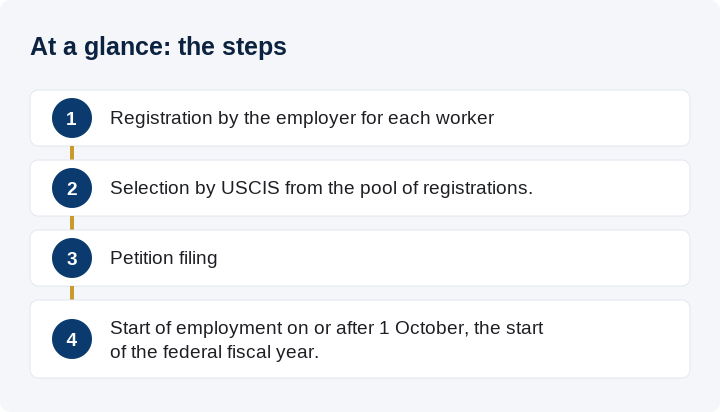
Three elements must line up:
Before filing the petition, the employer certifies a Labor Condition Application (LCA) with the Department of Labor. In it the employer promises to pay the higher of the actual wage paid to similar workers or the prevailing wage for the occupation and location, to provide working conditions that do not hurt US workers, and to post notice of the filing. The LCA specifies the work location; moving to a new area usually requires a new LCA and often an amended petition.
Most first-time H-1B workers are subject to the annual cap of 65,000, plus 20,000 reserved for people with a US master's degree or higher. Because demand far exceeds supply, USCIS runs an electronic registration in March for employment starting on 1 October.
Since 2024, selection has been made per unique beneficiary rather than per registration, which reduced the advantage of multiple employers registering the same person. In late 2025 DHS finalized a rule that weights the selection toward higher wage levels, giving workers offered higher-paid positions better odds. Check USCIS's announcements for the season you are entering, since details and litigation can change how it works.
Universities, their affiliated nonprofit entities, and nonprofit or government research organizations are cap-exempt: they can file H-1B petitions at any time of the year without the lottery. Workers who already counted against the cap in the last six years usually do not need to enter the lottery again when changing employers.
A presidential proclamation signed on 19 September 2025 imposed a $100,000 payment on certain new H-1B petitions. Government guidance clarified that it targets petitions for workers who are outside the United States, and not extensions or most changes of status for people already in the country, such as F-1 students moving to H-1B. The measure is being challenged in court and exemptions can be requested in the national interest. Employers should confirm how it applies to each specific petition before filing.
| Fee | Who pays | Notes |
|---|---|---|
| Registration | Employer | Per beneficiary, cap cases only |
| Form I-129 filing fee | Employer | Lower for small employers and nonprofits |
| Asylum Program Fee | Employer | Reduced for small employers, $0 for nonprofits |
| ACWIA training fee | Employer | Depends on employer size; not for some exempt employers |
| Fraud prevention fee | Employer | For new employment |
| Premium processing | Either | Optional, decision in 15 business days |
Employers may not pass the required ACWIA fee or the costs that are the employer's business expense on to the worker in ways that reduce pay below the required wage.
Spouses and unmarried children under 21 receive H-4 status. H-4 spouses can apply for work authorization once the H-1B worker has an approved I-140 or has extended status beyond six years under AC21. Children can study in US schools.
Yes, with concurrent H-1B petitions from each employer. Each must file its own petition.
A company you own can sponsor you if there is a genuine employer-employee relationship; rules updated in January 2025 clarified this for beneficiary-owners, with shorter initial approvals.
You can try again the following year, look for a cap-exempt employer, or use another status such as STEM OPT, O-1 or L-1.
Not usually. Extensions and changes of employer for people who already counted against the cap are not subject to the lottery.
Disclaimer. This article is general information, not legal advice, and it is not affiliated with any government agency. US immigration rules, fees and processing times change often, and they changed repeatedly in 2025 and 2026. Confirm current requirements on uscis.gov and travel.state.gov, or speak with a licensed immigration attorney or a DOJ-accredited representative.
How the F-1 student visa works: the I-20, maintaining status, on-campus work, CPT, OPT, the 24-month STEM extension, cap-gap and the path to H-1B or a green card.
How multinational companies transfer managers and specialized staff to the US on L-1 visas: requirements, new offices, blanket petitions, time limits and green card options.
How the O-1A and O-1B visas work for people with extraordinary ability in science, business, education, athletics, arts and film, with criteria, agents and green card options.