L-1 Visa for Intracompany Transferees: L-1A and L-1B Explained
How multinational companies transfer managers and specialized staff to the US on L-1 visas: requirements, new offices, blanket petitions, time limits and green card options.
 Tradiciones del Mundo
Studying in the US is the starting point for many future residents. The F-1 rules are strict, but they open real paths to work after graduation.
Key points
International students bring talent and tuition to US universities, and many stay afterwards through OPT, H-1B and eventually a green card. But F-1 status is fragile: a dropped course, unauthorized work or an unreported change can end it. This guide explains the full student journey and the work options at each stage.
Your Designated School Official (DSO) is your most important contact. Tell them before you change programs, drop classes or travel.
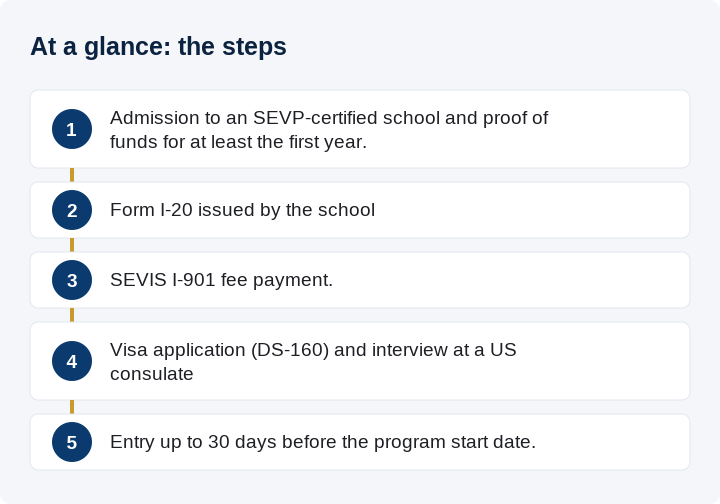
Since 2025 the State Department has applied enhanced screening to student visa applicants, including review of online presence, and has paused or limited interviews at times. Apply early.
F-1 students are admitted for "duration of status" (D/S), meaning as long as they maintain status. DHS proposed in 2025 to replace D/S with fixed admission periods; check whether a final rule applies to you.
| Type | Rules |
|---|---|
| On-campus employment | Up to 20 hours a week during terms, full time during breaks; no USCIS application needed |
| CPT (Curricular Practical Training) | Work that is an integral part of the curriculum, such as required internships; authorized by the DSO |
| Severe economic hardship | Off-campus work after one year if unforeseen circumstances arise; requires USCIS approval |
Twelve months or more of full-time CPT eliminates eligibility for OPT at the same degree level.
Optional Practical Training lets graduates work for up to 12 months in a job directly related to their field of study, at each higher degree level.
Students may accumulate up to 90 days of unemployment during post-completion OPT.
Graduates with degrees on DHS's STEM Designated Degree Program List can extend OPT by 24 months if:
An extra 60 days of unemployment are allowed during the extension, for a total of 150.
When an employer files an H-1B cap petition for an F-1 student, and the petition is selected and filed on time, the student's status and work authorization are extended until the H-1B starts, through 1 April of the next year under the rules updated in 2025. The $100,000 payment imposed in 2025 on certain H-1B petitions has been described as not applying to changes of status inside the US, which covers most F-1 to H-1B cases. See the H-1B guide.
A hypothetical student from India completes a master's degree in computer science, a STEM-designated program. She files for OPT 60 days before graduation, receives her EAD and starts working at a technology company that uses E-Verify. Her employer registers her for the H-1B lottery in March. If she is selected and the petition is filed, cap-gap protects her status until the H-1B begins in October. If she is not selected, she applies for the 24-month STEM extension with a training plan, giving her two more lottery attempts while she keeps working.
Students can transfer to another SEVP-certified school by asking the current school to release the SEVIS record. The new school issues a new I-20. Plan the transfer between terms to keep enrollment continuous.
F-1 students are usually "exempt individuals" for the substantial presence test during their first five calendar years, so they file as nonresidents with Form 1040-NR and Form 8843. They are generally exempt from Social Security and Medicare taxes on student employment and OPT while nonresidents. See the tax guides.
Work performed while physically in the US generally requires authorization, even if the employer is abroad.
Self-employment related to your field is possible on regular OPT. STEM OPT requires a bona fide employer with E-Verify and a training plan.
60 days after completing the program or OPT, to leave, transfer or change status.
Disclaimer. This article is general information, not legal advice, and it is not affiliated with any government agency. US immigration rules, fees and processing times change often, and they changed repeatedly in 2025 and 2026. Confirm current requirements on uscis.gov and travel.state.gov, or speak with a licensed immigration attorney or a DOJ-accredited representative.
How multinational companies transfer managers and specialized staff to the US on L-1 visas: requirements, new offices, blanket petitions, time limits and green card options.
How the O-1A and O-1B visas work for people with extraordinary ability in science, business, education, athletics, arts and film, with criteria, agents and green card options.
How Canadian and Mexican professionals work in the US under TN status: the USMCA profession list, requirements, applying at the border or a consulate, renewals and green card risks.